
Moissanite vs Lab-Created Diamond: Which Is Right for You?
Choosing between a moissanite and a lab-created diamond is one of the most important decisions you will make when shopping for an engagement ring, and most couples get this wrong because they rely on outdated comparisons. The moissanite vs lab-created diamond debate has shifted dramatically in the last five years, as both stones have improved in quality and dropped in price. At Livia Diamonds in Toronto, our team has guided thousands of Canadian couples through this exact decision over more than two decades, and the right answer is almost never the one people expect before they start looking.
Table of Contents
- Quick Takeaways
- What Are Moissanite and Lab-Created Diamonds?
- Key Differences in Appearance
- Durability and Wearability
- Price Comparison: What Your Budget Actually Buys
- Ethical and Environmental Considerations
- Which Stone Fits Your Lifestyle?
- Side-by-Side Comparison
- Frequently Asked Questions
- References
Quick Takeaways
Key Insight |
Explanation |
|---|---|
Moissanite costs 60-80% less than a comparable lab diamond |
A 2-carat moissanite ring typically runs $600-$1,200 CAD, while a comparable lab diamond ring can cost $3,000-$6,000 CAD at Livia Diamonds |
Lab diamonds are graded identically to mined diamonds |
Lab-created diamonds receive GIA or IGI certificates with the same 4Cs grading as natural diamonds, giving buyers a universally accepted quality standard |
Moissanite shows more rainbow fire than a diamond |
Moissanite has a refractive index of 2.65-2.69 versus diamond at 2.42, which produces more colourful sparkle, especially visible under artificial lighting |
Both stones score extremely high on hardness |
Lab diamonds score 10 on the Mohs scale while moissanite scores 9.25, making both excellent choices for daily wear engagement rings |
Neither stone requires ethical compromises |
Both moissanite and lab-created diamonds are conflict-free and produced in controlled lab environments, avoiding the supply chain concerns tied to mined diamonds |
Lab diamonds hold closer resale value than moissanite |
While neither stone matches mined diamond resale value, lab diamonds are more accepted at jewellery resellers and estate buyers in Canada |
Moissanite gives you more carat size per dollar |
For budget-conscious buyers, moissanite delivers visually impressive rings at a fraction of the price, which is a genuine advantage for many Canadian couples |
What Are Moissanite and Lab-Created Diamonds?
Moissanite is a gemstone made of silicon carbide, originally discovered in a meteor crater in 1893 by Nobel Prize-winning chemist Henri Moissan. The moissanite sold in jewellery today is entirely lab-created, primarily by Charles and Colvard and a growing number of manufacturers in Asia. It is not a diamond simulant in the way cubic zirconia is. Moissanite is a distinct mineral with its own chemical structure and optical properties.
Lab-created diamonds are chemically, physically, and optically identical to mined diamonds. They are grown using either High Pressure High Temperature (HPHT) or Chemical Vapor Deposition (CVD) processes, which replicate the conditions under which natural diamonds form. The Federal Trade Commission updated its guidelines in 2018 to confirm that lab-created diamonds are real diamonds, not imitations.
The key distinction is this: when you buy a lab diamond, you are buying a diamond. When you buy moissanite, you are buying a different gemstone entirely, one that happens to look remarkably similar to a diamond but has different optical characteristics. Both are legitimate choices. They just serve different priorities.
Key Differences in Appearance
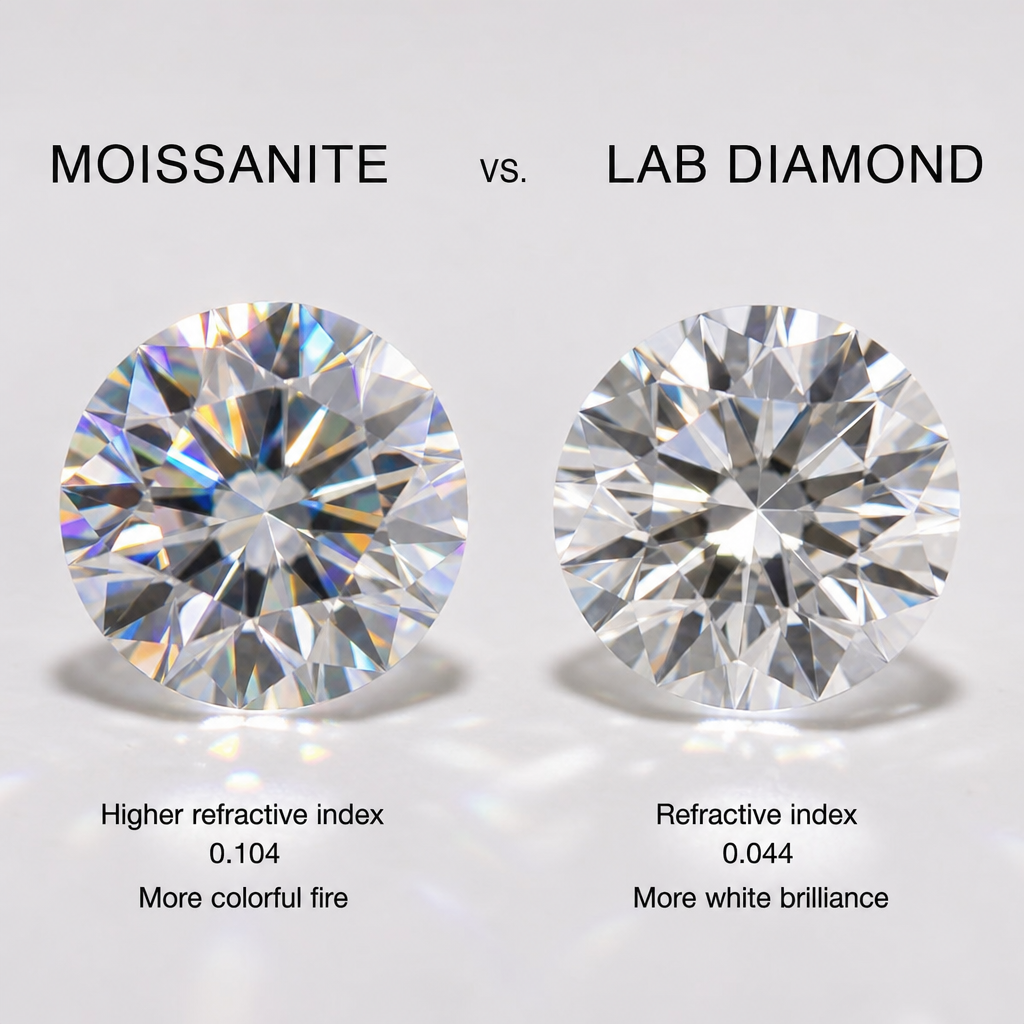
The most debated visual difference between moissanite and a lab-created diamond is fire, which is the colourful rainbow dispersion of light that comes off a stone. Moissanite produces significantly more fire than a diamond due to its higher refractive index. Under direct sunlight or spotlights, this can look breathtaking. Under the warm, diffused lighting common in Canadian winter homes or restaurants, it can read as flashy or noticeably non-diamond to a trained eye.
Lab-created diamonds, by contrast, display the same optical properties as mined diamonds. The sparkle is bright and white, with fire present but more restrained. For people who want a stone that looks exactly like a classic diamond, a lab-created diamond will always be the closer match.
Colour and Clarity Grades in Moissanite vs Lab Diamonds
Lab-created diamonds are graded on the same GIA or IGI colour scale as mined diamonds, ranging from D (colourless) to Z (light yellow). Moissanite is typically sold in three grades: colourless (equivalent to D-F), near-colourless (G-I equivalent), and with a faint yellowish or greenish tint in lower-quality versions. In practice, most moissanite sold by reputable Canadian retailers like Livia Diamonds falls in the colourless or near-colourless range.
A common mistake shoppers make is assuming all moissanite looks identical to all lab diamonds in person. They do not. The difference in fire and the subtle difference in light return are visible side by side, particularly in larger stones above 1.5 carats. Whether that difference matters to you is a personal question, not a quality judgment.
Pro tip: If you are considering a round brilliant cut, the visual similarity between moissanite and a lab diamond is highest in that shape. For fancy cuts like oval, cushion, or pear, the increased fire in moissanite is more noticeable. Ask your Livia Diamonds consultant to show you both options in the cut you are considering before deciding.
Durability and Wearability
Both moissanite and lab-created diamonds are outstanding choices for everyday wear, which matters enormously for an engagement ring that will be on your finger for decades. Lab diamonds score a 10 on the Mohs hardness scale, the maximum possible, meaning they resist scratching from virtually any material encountered in daily life. Moissanite scores 9.25, which is still harder than sapphire, ruby, and every other popular gemstone except diamond.
In practice, the difference in durability between 9.25 and 10 is negligible for most wearers. After working with clients over twenty years, we have not seen meaningful differences in chipping or scratching between properly set moissanite and lab diamond rings under normal conditions.
Heat and Chemical Resistance
Both stones handle heat and common household chemicals well. Moissanite is stable up to very high temperatures, and lab diamonds share the same thermal resistance as their mined counterparts. Neither stone will be damaged by regular cleaning with mild soap and warm water, which is the recommended cleaning approach for both at Livia Diamonds.
The setting matters as much as the stone when it comes to long-term wearability. A 14K or 18K gold setting with proper prong placement will protect either stone better than the material of the stone alone. This is a point worth discussing during your consultation, whether in-person at our Toronto office or virtually.
Price Comparison: What Your Budget Actually Buys
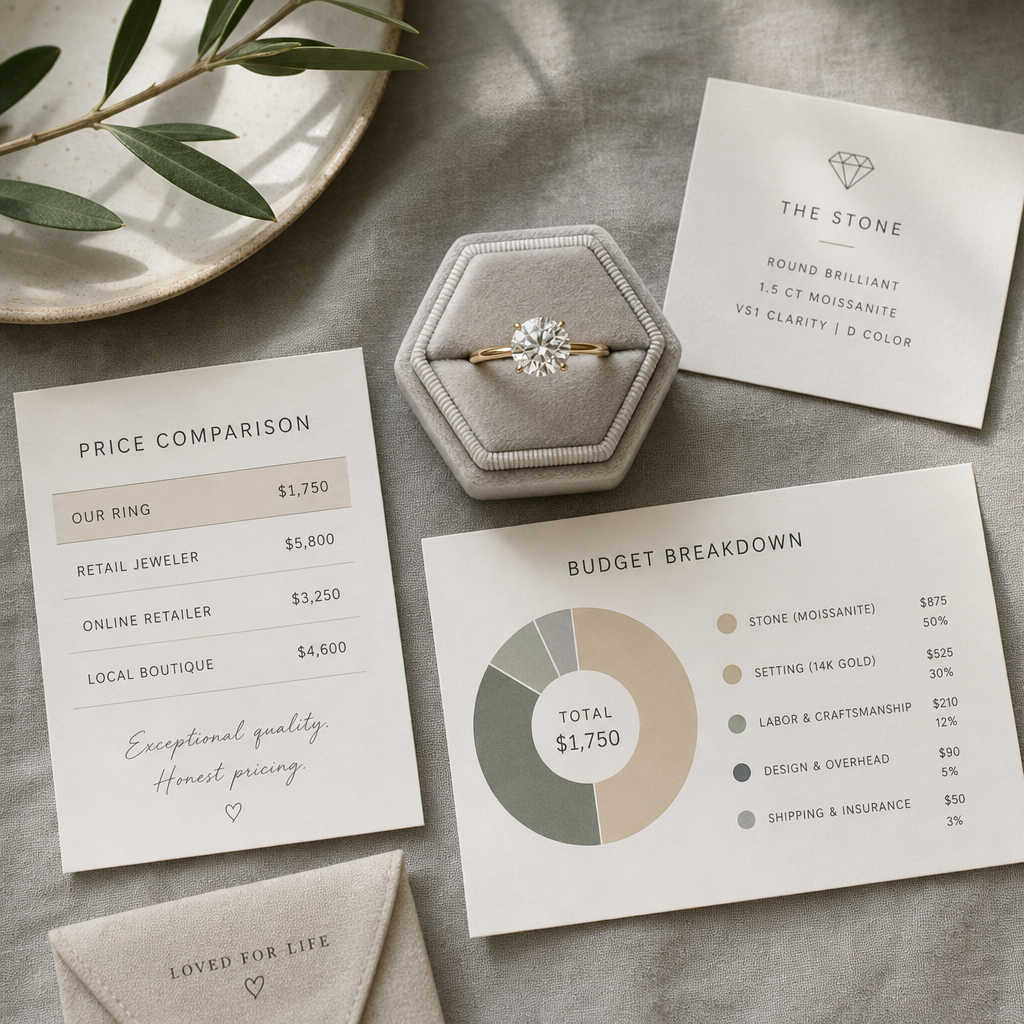
Price is where the moissanite vs lab-created diamond comparison becomes most practical. The data consistently shows that moissanite costs 60 to 80 percent less than a lab-created diamond of equivalent visual size. A high-quality 2-carat round moissanite ring in a 14K white gold solitaire setting typically retails between $700 and $1,400 CAD. A comparable 2-carat round lab diamond ring in the same setting ranges from $3,500 to $7,000 CAD or more, depending on cut quality and colour grade.
Lab-created diamonds themselves are already significantly cheaper than mined diamonds. According to data tracked by the Gemological Institute of America and retail market reporting, lab diamond prices fell by roughly 50 percent between 2020 and 2023 as production scaled globally. That drop has made lab diamonds more accessible than ever, but moissanite still wins on price by a substantial margin.
What Budget Ranges Look Like at Livia Diamonds
For couples working with a budget under $2,000 CAD, moissanite delivers a visually impressive ring that would be difficult to distinguish from a diamond in social settings. For couples with a budget of $3,000 to $6,000 CAD, a lab-created diamond in the 1 to 1.5 carat range becomes genuinely attainable. Above $6,000 CAD, you can explore lab diamonds above 2 carats with excellent cut grades and GIA or IGI certification.
Livia Diamonds also offers flexible payment plans, which changes the calculus for many couples. A lab diamond ring that feels out of reach as a single purchase often becomes manageable when spread across six or twelve months with no interest penalties. It is worth asking about payment options before eliminating lab diamonds from consideration based on the upfront price alone.
Pro tip: If resale value is a concern to you, choose a lab diamond over moissanite. Lab diamonds are recognized and accepted by estate jewellers and resale platforms in Canada in a way that moissanite currently is not. The resale value of both has declined relative to mined diamonds, but lab diamonds are still easier to sell on the secondary market.
Ethical and Environmental Considerations
One of the primary reasons Canadian couples are searching for a moissanite engagement ring in Canada or a lab diamond engagement ring is to avoid the ethical concerns tied to mined diamonds. Both moissanite and lab-created diamonds address this concern directly. Neither requires mining, which means no displacement of communities, no risk of conflict financing, and no large-scale ecosystem disruption from open-pit or underground mining operations.
"The lab-grown diamond market is fundamentally reshaping consumer expectations around ethics and value in fine jewellery. Buyers no longer accept the premise that a higher environmental cost equals higher quality." - Paul Zimnisky, independent diamond industry analyst and founder of paulzimnisky.com
Lab-created diamonds do consume significant electricity during production, particularly in the HPHT method. However, a growing number of producers are moving toward renewable energy sources, and the overall environmental footprint per carat is substantially smaller than mined diamond production. Moissanite production is similarly energy-intensive but requires no water-heavy mining infrastructure.
For buyers to whom the ethical origin story matters beyond just avoiding conflict diamonds, both stones represent a credible alternative. Livia Diamonds sources its moissanite and lab-created diamonds from vetted suppliers, and our team can walk you through the origin information available for any stone you are considering.
Which Stone Fits Your Lifestyle?
The most honest answer to the moissanite vs lab-created diamond question is not about which stone is objectively better. It is about which stone fits your priorities. After guiding couples through this decision for over two decades, the clearest patterns are these:
Choose moissanite if: your budget is under $2,000 CAD and visual size is a priority, you love the idea of a stone with exceptional fire and do not mind that it looks slightly different from a traditional diamond, or you plan to upgrade the stone later and want to keep initial costs low.
Choose a lab-created diamond if: you want a stone that is chemically and optically identical to a mined diamond, certification from GIA or IGI matters to you, you value the resale recognition that lab diamonds carry over moissanite, or your budget comfortably supports the higher price point.
The Custom Design Angle
Both stones work equally well in custom-designed settings, which is a significant part of what Livia Diamonds offers. Whether you are building a vintage-inspired halo ring, a simple solitaire, or a three-stone anniversary band, the metal setting and craftsmanship around the stone matter as much as the stone itself. A beautifully designed custom ring with a moissanite centre stone will outperform a poorly set lab diamond in overall visual impact every time.
Our in-person consultations at our Toronto office and virtual consultations for clients across Canada allow you to compare actual stones in your preferred settings before committing. This is a step that most online-only retailers, including competitors like Blue Nile or VRAI, cannot offer in the same hands-on way.
Side-by-Side Comparison
Feature |
Moissanite |
Lab-Created Diamond |
|---|---|---|
Chemical composition |
Silicon carbide (SiC) |
Pure carbon, identical to mined diamond |
Mohs hardness |
9.25 |
10 |
Refractive index |
2.65-2.69 (more fire) |
2.42 (classic diamond sparkle) |
Price range (2-carat, 14K white gold solitaire) |
$700-$1,400 CAD approx. |
$3,500-$7,000 CAD approx. |
Certification |
Brand or manufacturer grading (no GIA/IGI) |
GIA or IGI certificate standard |
Resale recognition |
Limited in Canada |
Accepted by estate jewellers |
Ethical sourcing |
Fully lab-created, conflict-free |
Fully lab-created, conflict-free |
Visual identity |
Similar to diamond, with more rainbow fire |
Identical to mined diamond appearance |
Frequently Asked Questions
Can a jeweller tell the difference between moissanite and a lab-created diamond?
Yes. A trained jeweller with a loupe or a diamond tester can distinguish moissanite from a lab diamond. Standard diamond testers that measure thermal conductivity will often read moissanite as diamond because moissanite also conducts heat similarly. However, testers that measure electrical conductivity will correctly identify moissanite. Optically, moissanite's double refraction and higher fire are visible under magnification. Most people in social settings will not notice the difference, but a qualified gemologist will.
Does moissanite look fake compared to a lab-created diamond?
Moissanite does not look fake. It looks like a gemstone with exceptional brilliance and fire. The question is whether it looks exactly like a diamond, and the honest answer is that it does not, particularly in larger carat weights and under certain lighting conditions. Many people prefer moissanite's sparkle precisely because it is so vivid. Others want the specific optical profile of a diamond. Neither preference is wrong, but being clear about which one matters to you will lead to a better decision.
Is moissanite a good choice for a moissanite engagement ring in Canada?
Moissanite is an excellent choice for a Canadian engagement ring if your budget is a primary consideration or if you are drawn to the stone's fire and ethical origin story. Canadian couples who have purchased moissanite rings from Livia Diamonds consistently report high satisfaction, particularly when the ring is set in quality 14K or 18K gold. The stone holds up well in Canadian climate conditions and requires no special care beyond routine cleaning.
Do lab-created diamonds lose value faster than mined diamonds?
Yes, lab-created diamonds have depreciated significantly in retail price since 2020 as production volumes increased globally. This means their resale value on the secondary market has also declined relative to mined diamonds. However, for most couples, an engagement ring is not primarily a financial investment. If resale value is a major factor in your decision, it is worth discussing with a Livia Diamonds consultant who can give you a realistic picture of current market conditions in Canada.
Which stone is better for fancy cuts like oval or cushion?
Lab-created diamonds perform exceptionally well in all cut shapes and are graded for cut quality in a way that moissanite is not. For fancy cuts specifically, the visual difference between moissanite and a lab diamond becomes more apparent because moissanite's higher fire is more visible in elongated or cushion shapes. If you have your heart set on an oval, marquise, or pear cut and want the look of a traditional diamond, a lab-created diamond will be the closer match. If you love dramatic sparkle and the cut shape is secondary, moissanite is a strong option.
Can I customize both moissanite and lab diamond rings at Livia Diamonds?
Yes. Livia Diamonds offers custom design services for both moissanite and lab-created diamond engagement rings. The custom process covers stone selection, cut, setting style, band metal, and ring size, and is available through in-person appointments at our Toronto location or through virtual consultations for customers across Canada. Custom pieces can also be combined with flexible payment plans, which makes higher-end lab diamond designs more accessible for couples working within a specific monthly budget.
Which stone are you leaning toward for your engagement ring, and what factor is weighing most heavily in your decision? Share your experience or questions below, and our team is happy to help.