
Engagement Ring Cuts: Find the Best One for Your Hand
Most people spend hours comparing prices and metals without ever asking the one question that changes everything: does this cut actually flatter my hand? The wrong engagement ring cut on the wrong hand shape can make fingers look shorter, wider, or more crooked than they are. The right one can visually elongate, slim, and balance your hand in a way that feels almost effortless. After more than 20 years of helping couples in Toronto find the ideal ring, the team at Livia Diamonds has seen this mistake made constantly. This guide fixes it.
Table of Contents
- Quick Takeaways
- Why Hand Shape Matters More Than You Think
- How to Identify Your Hand Shape
- Best Engagement Ring Cuts by Hand Shape
- Moissanite vs Lab-Created Diamond Cuts: What Changes
- Cut Comparison by Hand Shape: Quick Reference
- Common Mistakes to Avoid When Choosing a Cut
- Frequently Asked Questions
- References
Quick Takeaways
Key Insight |
Explanation |
|---|---|
Elongated cuts flatter short fingers |
Oval, marquise, and pear cuts visually lengthen the finger because their vertical axis draws the eye up and down rather than across. |
Round brilliants are the most universally flattering |
The round cut works on nearly every hand shape, which is one reason it accounts for roughly 60% of all engagement ring sales globally. |
Wide bands shorten fingers |
Pairing a wide-banded setting with a small stone on short fingers creates a visual block effect. A slimmer band restores proportion. |
Cushion cuts suit wide hands beautifully |
The cushion cut's soft, square silhouette balances wider palms without looking undersized or overpowering. |
Moissanite shows cuts more brilliantly than most diamonds |
Moissanite has a refractive index of 2.65 compared to diamond's 2.42, so every cut facet appears more vivid, making cut choice even more impactful. |
Pointed cuts require practical consideration |
Marquise and pear cuts have pointed ends that are vulnerable to chipping. Bezel or V-tip prong settings protect these cuts for active wearers. |
Finger length-to-width ratio drives the decision |
Measure your middle finger's length against its width at the knuckle. A ratio above 3:1 gives you far more cut flexibility than a ratio below 2.5:1. |
Why Hand Shape Matters More Than You Think
The optical effect of a ring cut on a real hand is the single most underestimated factor in engagement ring shopping. Jewelers focus on carat weight and clarity grades, and customers follow their lead. But a 2-carat cushion cut on narrow fingers can look disproportionately large, while a 1.5-carat oval on the same fingers looks intentional and elegant.
In practice, the geometry of a cut interacts with the geometry of your finger. A cut that is wider than it is long draws the eye sideways, making fingers appear stubbier. A cut that is longer than it is wide creates a vertical line that pulls the eye upward, creating the illusion of length. This is not a minor stylistic footnote. It is the foundational principle behind every recommendation in this guide.
Livia Diamonds consultants, both in-person at the Toronto office and through virtual appointments, consistently report that customers who factor hand shape into their decision feel far more confident in their final choice. The ring is worn every day. Getting the proportions right matters far beyond the purchase moment.
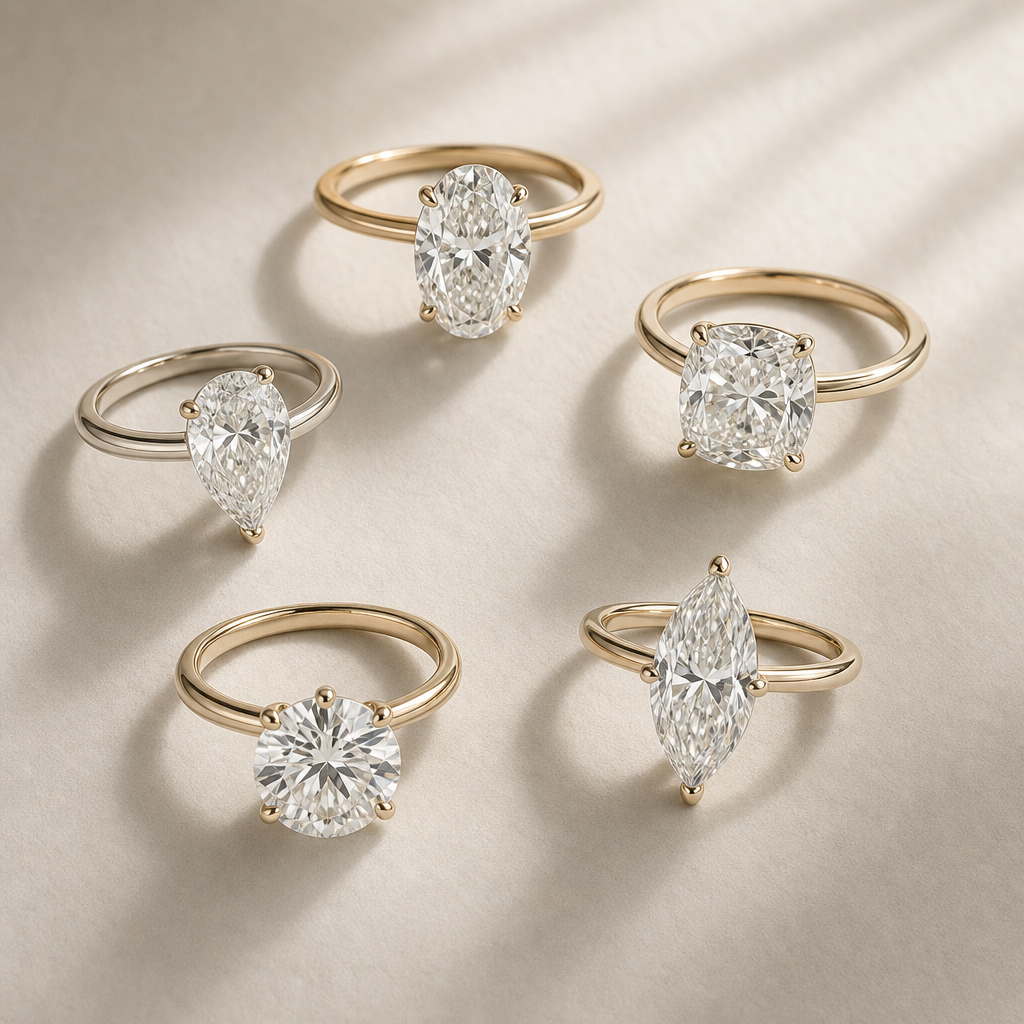
How to Identify Your Hand Shape
There are four hand profiles that meaningfully influence which engagement ring cuts will look best. You do not need a jeweler to identify yours. A quick self-assessment takes under a minute.
Short Fingers
If your fingers are noticeably shorter than the width of your palm, you have short fingers. The key challenge here is avoiding cuts that emphasize horizontal width. Round, princess, and Asscher cuts are risky because their symmetrical geometry does not offer any elongating effect.
Long Fingers
Long fingers have the most flexibility of any hand type. Nearly every cut works well here, but princess and Asscher cuts in particular look especially refined because their angular geometry is balanced by finger length rather than compressed by it.
Wide or Large Hands
Wider palms and broader knuckle bases need a stone with enough visual presence to avoid looking like a tiny dot on a large canvas. Small round solitaires can disappear on wide hands. Cushion, radiant, and emerald cuts offer the surface area to hold their own proportionally.
Slim or Narrow Hands
Narrow hands with delicate fingers are well-suited to smaller, more delicate cuts. Oval and pear are the strongest performers here because they elongate naturally and the tapered pear shape in particular echoes the natural narrowing of a slim finger.
Pro tip: Trace your hand on paper and photograph it next to a printed outline of a ring at your expected size. This simple exercise shows you real-world proportions before you ever try anything on.
Best Engagement Ring Cuts by Hand Shape
This is where the guide gets specific. The recommendations below are based on direct observation and consistent customer feedback, not abstract geometry theory. Use these as starting points, not rigid rules.
Best Cuts for Short Fingers
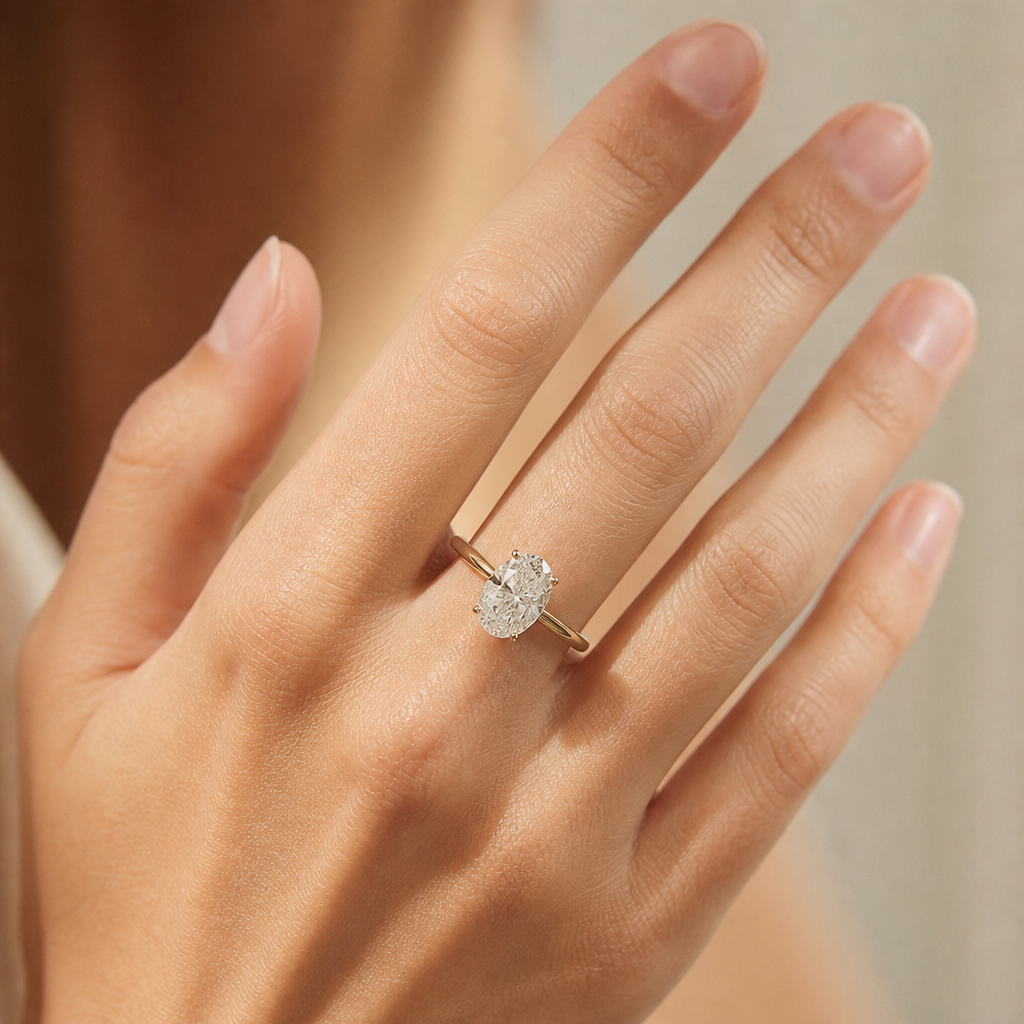
The oval cut is the single best choice for short fingers. Its elongated shape creates a continuous vertical line from the base of the stone to its tip, and the curved sides soften the look so it never appears severe. Marquise is another strong option for the same reason, though its pointed ends require a protective setting.
Pear cuts also work well on short fingers, especially when set with the point facing toward the nail. This directional elongation is visually effective and consistently praised by customers at Livia Diamonds who have shorter hand profiles.
A common mistake is choosing a princess cut on short fingers because it looks bold and modern. The square proportions do nothing to add length, and on shorter fingers it can look blocky rather than striking.
Best Cuts for Long Fingers
Long fingers handle angular, geometric cuts with ease. Princess cuts and emerald cuts are ideal because their clean lines complement natural finger length rather than fighting it. Emerald cuts in particular have a hall-of-mirror effect through their step-cut facets that looks especially elegant on longer hands.
Radiant cuts are worth considering here too. They combine the sparkle of a brilliant cut with the outline of a rectangle, and on long fingers the result is proportionally impressive without looking over-scaled.
Best Cuts for Wide Hands
Wide hands need a stone with visual weight. The cushion cut is the most recommended option because its gently squared outline and pillow-like corners balance a wider palm without the sharpness of a princess cut. Radiant cuts deliver similar visual mass with more brilliance.
Avoid narrow solitaire settings on wide hands. The contrast between a slim stone and a broad hand draws attention to the width rather than the ring. Cluster settings or halo designs around a cushion or round stone work well because they add visual diameter to the ring as a whole.
Best Cuts for Slim or Narrow Hands
Delicate hands suit delicate stones. Oval and pear cuts in smaller to medium carat weights look intentional and refined here. A round brilliant in a slim four-prong solitaire setting is another consistently strong choice because it allows the stone to float visually without overpowering the hand.
Avoid very large cushion or radiant cuts on slim hands unless the setting is designed to scale the proportions. What works on a wide hand can look theatrical on a narrow one.
Pro tip: At Livia Diamonds, virtual consultations let you hold up your hand on camera while a consultant shows you different cut options in real time. This eliminates guesswork entirely and saves you from ordering a ring that looks different on screen than it does on your actual finger.
Moissanite vs Lab-Created Diamond Cuts: What Changes
The best diamond cut for hand shape advice applies equally to moissanite, with one important difference: moissanite's higher refractive index means its facets produce more fire and brilliance per cut. This amplifies the visual effect of every cut shape choice you make.
For example, an oval moissanite on short fingers produces more light dispersion than an oval lab-created diamond of equivalent size. The elongating effect is the same, but the overall visual impact is more vivid. For some customers, this is the deciding factor when choosing between the two stone types.
"Moissanite's refractive index of 2.65 gives it more brilliance than diamond, which sits at 2.42. This difference is visible to the naked eye, especially in step cuts and brilliant cuts where light return is central to the design." - Gemological Institute of America education resources on gemstone optics
For moissanite ring cuts Canada shoppers specifically, the combination of brilliant cut moissanite with the elongating properties of an oval or marquise outline offers outstanding visual value at a price point that is typically 70 to 80 percent lower than a comparable mined diamond. This is a core reason why Livia Diamonds customers increasingly choose moissanite not as a budget compromise but as a deliberate preference.
Lab-created diamonds, on the other hand, offer the same optical properties as mined diamonds. For customers who want the precise look of a traditional diamond ring but in a cut-for-hand-shape approach, lab-created diamonds give you identical sparkle with a significantly lower price tag than mined stones.
Cut Comparison by Hand Shape: Quick Reference
Use this table to match your hand profile to your best starting cut options. This is a practical shortlist, not an exhaustive ranking.
Hand Shape |
Recommended Cuts |
Cuts to Approach with Caution |
|---|---|---|
Short Fingers |
Oval, Marquise, Pear |
Princess, Asscher, Round (large carat) |
Long Fingers |
Princess, Emerald, Radiant, Round |
Very small stones that may look underwhelming |
Wide or Large Hands |
Cushion, Radiant, Round (larger carat) |
Narrow solitaire rounds, small pear cuts |
Slim or Narrow Hands |
Oval, Pear, Round (smaller to medium carat) |
Very large cushion or radiant cuts |
Common Mistakes to Avoid When Choosing a Cut
The data consistently shows that most buyers regret their ring within the first year not because of the stone quality but because of proportion and fit. Here are the specific mistakes that cause the most dissatisfaction.
Choosing by Trend Rather Than Proportion
Cushion cuts dominated social media for several years, which drove enormous demand regardless of whether the cut actually suited the buyer's hand. Trends cycle. A ring worn for decades needs to be chosen for the person wearing it, not for what is popular when you buy it.
Ignoring the Setting Width
A thin, delicate band under a wide cushion cut on short fingers makes the stone look floating and over-scaled. A band that is too wide for a delicate oval on slim fingers shortens the finger visually. The setting is not a neutral frame. It actively shapes how the cut reads on the hand.
Not Accounting for Knuckle Size
Many shoppers measure finger width at the base and forget that the ring passes over the knuckle during wear. If your knuckle is significantly wider than your finger base, a very large fancy cut stone with a low-profile setting can become uncomfortable to remove. Livia Diamonds recommends trying sizes at multiple points of the finger, not just the base, especially for elongated cuts like marquise and oval that have a longer footprint.
Assuming Carat Size Equals Visual Size
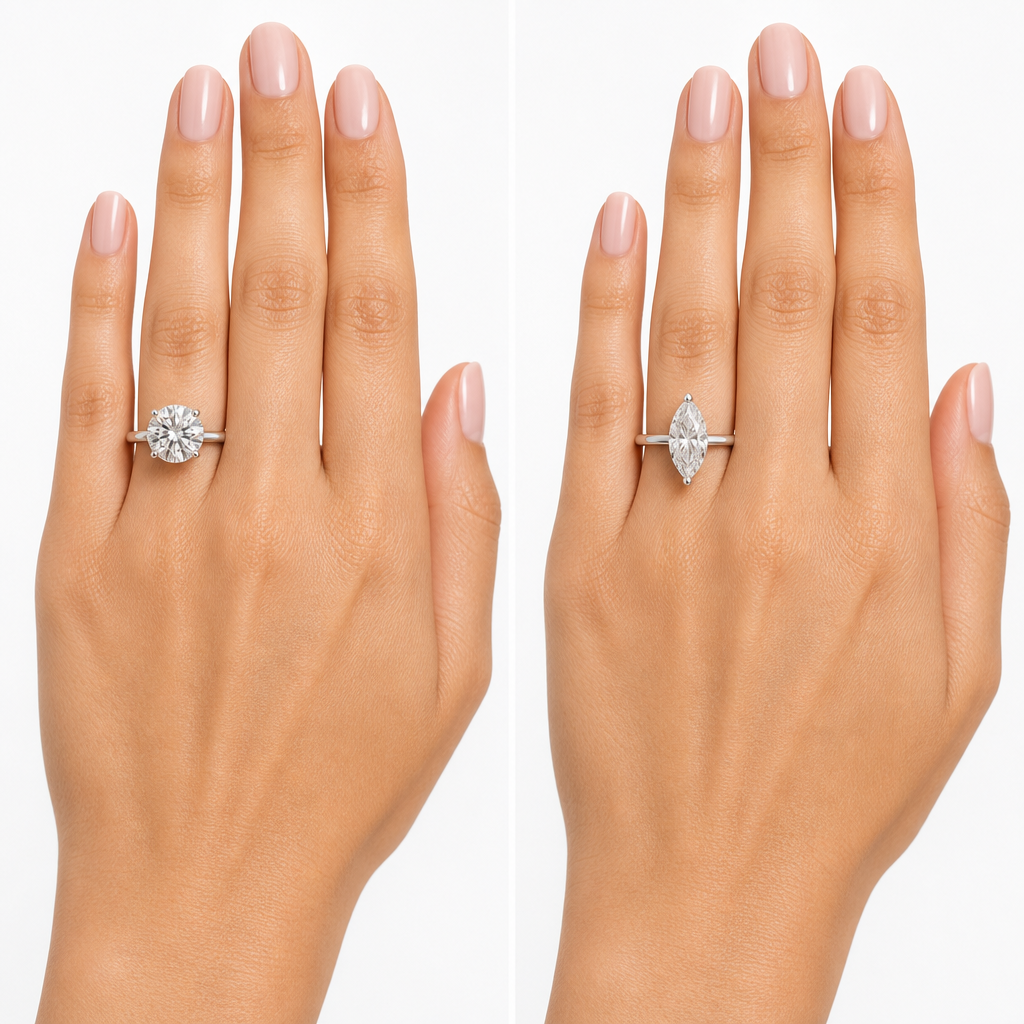
An oval at 1.5 carats typically looks larger than a round at 1.5 carats because its elongated surface area spreads across more visual space on the finger. A 1-carat marquise moissanite on short fingers can appear as impressive as a 1.5-carat round on the same finger, at a fraction of the cost. This is practical information that changes purchasing decisions when you understand it.
Pro tip: Book a free virtual consultation with Livia Diamonds before committing to a cut. The consultants have over 20 years of experience matching cuts to hand shapes and can identify your best options in under 30 minutes, something no algorithm-based ring builder tool can replicate.
Frequently Asked Questions
What is the most flattering engagement ring cut for short fingers?
The oval cut is the most consistently flattering choice for short fingers. Its elongated vertical shape draws the eye up and down rather than across, creating the visual illusion of a longer finger. Marquise and pear cuts achieve the same effect. All three are available in both moissanite and lab-created diamond versions at Livia Diamonds.
Does the choice of moissanite versus lab-created diamond change which cut looks best?
The fundamental cut-to-hand-shape logic stays the same, but moissanite's higher refractive index intensifies the visual effect of any cut. Brilliant cuts like oval and round appear even more radiant in moissanite than in lab-created diamond. Step cuts like emerald show moissanite's distinctive rainbow fire more vividly, which some customers love and others find too flashy for their taste.
Is the round brilliant cut really the safest choice for any hand shape?
Yes, but safe is not the same as optimal. A round brilliant is the most universally wearable cut because its symmetrical shape does not strongly emphasize either length or width. However, if you have short fingers, an oval will look more flattering than a round of the same carat weight. Round is the right choice when you want flexibility, not necessarily the best possible flattery for your specific hand.
What engagement ring cuts are most popular in Canada right now?
Oval and cushion cuts have been the dominant preferences among Canadian buyers for the past several years, with oval overtaking round as the top choice in many boutique and online settings. At Livia Diamonds, oval moissanite solitaires and cushion cut lab-created diamond rings consistently lead in consultation requests. Pear cuts have seen a notable increase in interest, particularly among younger buyers.
How do I know if a cut is too large for my hand before buying?
The practical test is to compare the stone's face-up millimeter dimensions to your finger width at the knuckle. If the stone is wider than your finger at its widest point, it will overhang the sides and look disproportionate. For short fingers, a stone that is narrower than the finger width but elongated vertically is almost always the right call. Livia Diamonds' virtual consultations let you check this live with a consultant before placing an order.
Are there cuts that work poorly with moissanite specifically?
Moissanite's high dispersion can create what some describe as a "rainbow effect" that is more visible in step cuts like emerald and Asscher. Buyers who prefer white, icy sparkle sometimes find this distracting. For those customers, brilliant cuts such as round, oval, or cushion channel the fire more uniformly and the result feels cleaner. It is a stylistic preference, not a quality issue, and worth discussing during a consultation.
Can the ring setting style change how a cut looks on my hand shape?
Absolutely. A halo setting adds visual diameter around any center stone, which helps smaller stones look proportionate on wider hands. A thin pavé band makes any center stone appear to float, which is ideal for slim hands with delicate fingers. A bezel setting wraps the stone in metal, which reduces the apparent visual sharpness of pointed cuts like marquise and pear, making them look more subdued and wearable for everyday lifestyles.
What cut are you leaning toward, and does it match your hand shape? Share your thoughts or questions below and we are happy to help you narrow it down.
References
Forbes: consumer jewelry market trends and engagement ring spending data
Statista: global engagement ring market statistics and consumer preference data
McKinsey and Company: luxury and fine jewelry consumer behavior research
Canadian Jeweller Magazine: Canadian fine jewelry industry news and consumer trend reporting