
5 Reasons Moissanite Engagement Rings Are Smart in 2026
The average Canadian couple spent over $5,000 CAD on an engagement ring in 2023, according to industry surveys, and that number keeps climbing. Meanwhile, moissanite engagement rings 2026 are quietly rewriting the rules of what a meaningful ring actually costs, looks like, and stands for. If you are still equating carat weight with commitment, you are paying a premium for a tradition, not a stone. This article makes the case clearly and without softening the edges: moissanite is the smarter buy, and for most couples shopping for affordable engagement rings Canada, it is the objectively better choice.
Table of Contents
- Quick Takeaways
- Reason 1: The Price-to-Quality Ratio Is Unbeatable
- Reason 2: Brilliance That Outperforms Diamond
- Reason 3: Ethical and Conflict-Free by Design
- Reason 4: Durability That Holds Up to Real Life
- Reason 5: Customization Without the Compromise
- Moissanite vs. Diamond vs. Lab Diamond: A Direct Comparison
- Why Choose Moissanite in 2026 Specifically
- Frequently Asked Questions
- References
Quick Takeaways
Key Insight |
Explanation |
|---|---|
Moissanite costs 80-90% less than mined diamonds |
A 2-carat moissanite typically costs $600-$1,200 CAD versus $15,000+ CAD for a comparable mined diamond. |
Moissanite has a higher refractive index than diamond |
At 2.65-2.69 vs. diamond's 2.42, moissanite produces more fire and brilliance per carat. |
Hardness rating of 9.25 on the Mohs scale |
Only diamond scores higher at 10, making moissanite the second hardest gem available for everyday wear. |
100% lab-created, fully conflict-free |
Every moissanite stone is grown in a controlled environment, eliminating supply chain ethical concerns entirely. |
Customization options are far wider at lower price points |
Couples can afford halo settings, custom band engravings, and larger stones without stretching budgets. |
Resale dynamics are shifting in moissanite's favor |
As lab-grown gem awareness grows, moissanite holds value better than mined diamonds relative to original retail price. |
Livia Diamonds offers virtual and in-person consultations in Toronto |
Couples across Canada can see actual stones and settings before committing, removing the guesswork of online buying. |
Reason 1: The Price-to-Quality Ratio Is Unbeatable
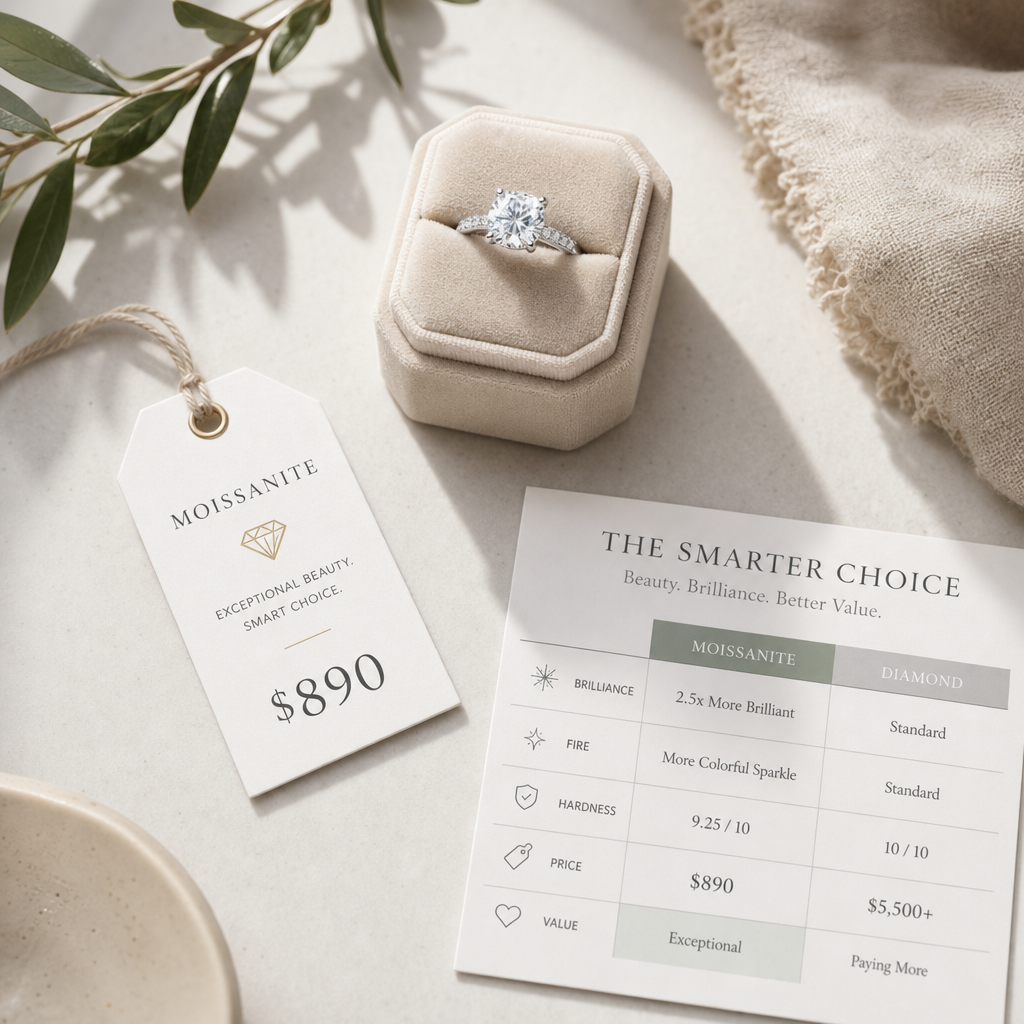
The single most compelling argument for moissanite is also the simplest one. You get a visually stunning, physically durable, chemically stable gemstone for a fraction of the cost of a mined diamond. In practice, a 2-carat round brilliant moissanite from a reputable Canadian jeweler like Livia Diamonds typically runs between $600 and $1,200 CAD. The equivalent in a mined diamond would cost anywhere from $15,000 to $30,000 CAD depending on cut, color, and clarity grades.
That price gap is not a quality gap. It is a supply chain and marketing gap. Mined diamonds carry the weight of extraction costs, international transport, multi-tier wholesalers, and decades of brand conditioning that equates price with love. Moissanite bypasses all of that.
What the savings actually mean for couples
For couples navigating real financial priorities in 2026, including housing costs, student debt, and cost of living pressures across Canadian cities, the savings from choosing moissanite are not trivial. A couple who spends $1,000 instead of $20,000 on an engagement ring has $19,000 CAD to put toward a down payment, honeymoon, or emergency fund.
The data consistently shows that Millennials and Gen Z buyers are far less willing to treat jewelry as a status symbol and far more interested in what the money can do elsewhere. Moissanite lets them have a beautiful ring without that trade-off.
Pro tip: At Livia Diamonds, you can explore flexible payment plans that make even the most intricate custom moissanite designs accessible without putting the purchase on high-interest credit. Ask about this during your virtual or in-person consultation at their Toronto office.
Reason 2: Brilliance That Outperforms Diamond
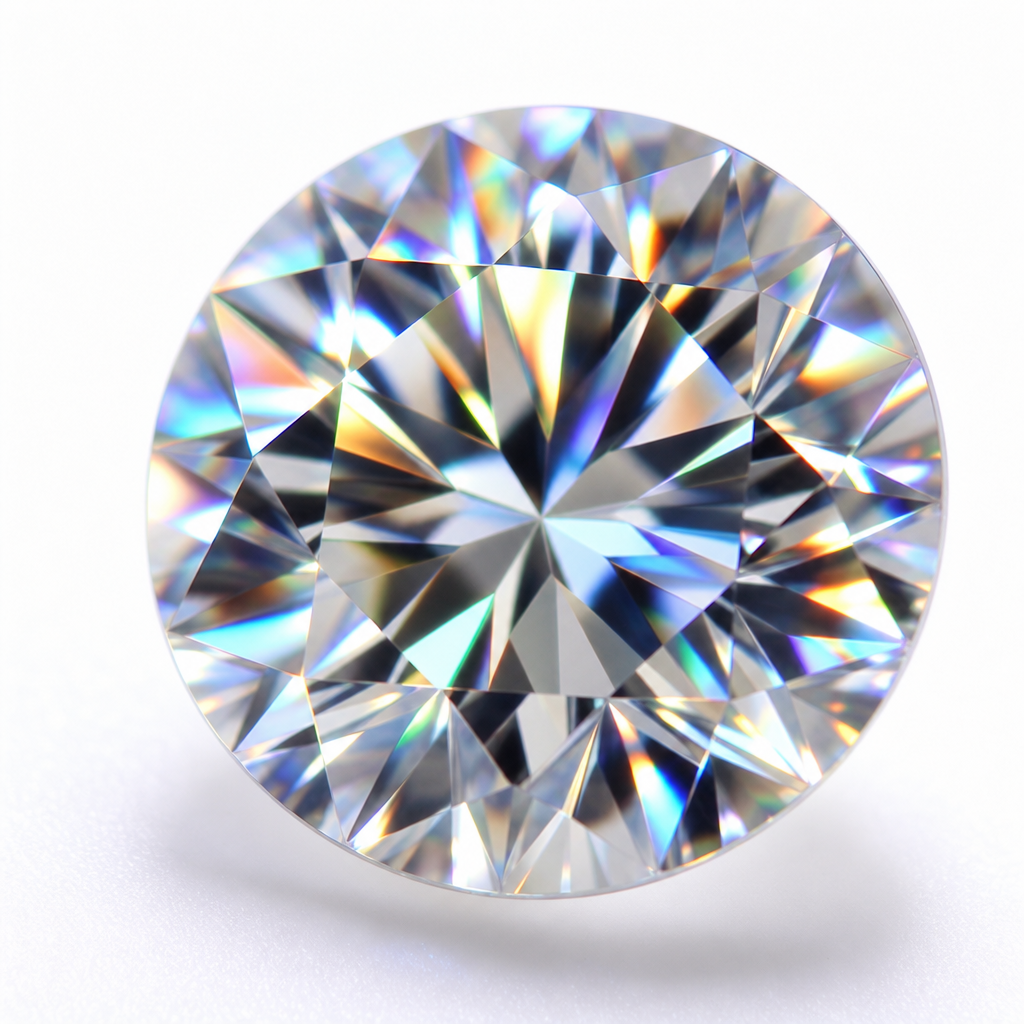
A common mistake is assuming that brilliance and diamond are synonymous. They are not. Brilliance is a function of a stone's refractive index, meaning how well it bends and returns light to the eye. Moissanite has a refractive index of 2.65 to 2.69. Diamond sits at 2.42. That difference is not subtle in a well-lit room or under natural sunlight.
What this means practically is that a moissanite stone will throw more colorful fire and more white light return than a diamond of identical cut and size. Some buyers find this effect slightly too intense for their taste, which is a legitimate preference. But for most people seeing moissanite in person for the first time, the reaction is genuine surprise at how much sparkle is coming off a stone that cost a fraction of what they expected to pay.
Cut quality still matters with moissanite
The superior refractive index only delivers its full potential when the stone is cut with precision. A poorly cut moissanite will look dull and lifeless just like a poorly cut diamond. At Livia Diamonds, every moissanite stone is handcrafted and cut to ideal proportions, which is why their pieces photograph and present so differently from budget online competitors.
Competitors like Blue Nile and VRAI offer lab diamonds at scale but with less hands-on guidance on how cut quality interacts with specific settings. When you are buying a ring that you plan to wear every day for decades, that level of attention to the stone itself matters enormously.
"Moissanite's brilliance is unlike any other gemstone. Its fiery, rainbow flashes set it apart from diamond and make it a standout choice for those who want maximum visual impact." -- Gemological Institute of America research on gemstone optical properties.
Reason 3: Ethical and Conflict-Free by Design
The ethical argument for moissanite is not a marketing angle. It is a structural reality. Every moissanite stone sold anywhere in the world today is lab-created. Natural moissanite, first discovered in 1893 in a meteorite crater, is so rare it is essentially non-existent in the commercial jewelry market. What you buy is grown in a controlled laboratory environment with no mining required.
This matters for couples who have done even a small amount of research into diamond supply chains. Despite the Kimberley Process, an international certification scheme designed to prevent conflict diamonds from entering the market, independent researchers and journalists have documented ongoing issues with traceability and enforcement. Choosing moissanite removes the need to trust a certification process entirely.
Environmental footprint comparison
Diamond mining moves enormous quantities of earth per carat produced. Estimates from environmental researchers suggest that recovering a single carat of mined diamond disturbs over 100 square feet of earth and produces significant carbon emissions through heavy machinery and transport. Moissanite production, while not zero-emission, operates at a dramatically smaller environmental scale.
For the growing segment of Canadian buyers who identify environmental impact as a purchase consideration, this distinction is a genuine differentiator and not a checkbox. Livia Diamonds has built its entire product focus around this principle, offering moissanite and lab-created diamonds as a clear alternative to mined stones.
Pro tip: If you are shopping for affordable engagement rings Canada and want to verify the ethical sourcing of a stone, ask any retailer for documentation on their supply chain. With moissanite, the answer is simple: it was grown in a lab, full stop.
Reason 4: Durability That Holds Up to Real Life
An engagement ring is not a display piece. It goes on a finger in the morning and stays there through gym sessions, dish washing, typing, gardening, and everything else a normal life involves. The gemstone needs to survive that, not just look good in photos.
Moissanite scores 9.25 on the Mohs hardness scale. Diamond is the only gemstone that scores higher at 10. This means moissanite is harder than sapphire, ruby, emerald, and every other alternative gemstone commonly used in engagement rings. In practice, moissanite does not scratch under normal daily wear conditions. You would need to drag it across another diamond to damage the surface.
Heat and chemical resistance
Beyond hardness, moissanite is highly resistant to heat and does not react to the cleaning agents used in professional jewelry cleaning. This is not a trivial consideration. Jewelers clean rings with ultrasonic cleaners and steam. Some softer or more porous stones, including certain treated sapphires and some lower-quality lab diamonds, can show degradation over time with repeated professional cleaning. Moissanite handles it without issue.
The stone will also not change color or cloud over time. Some buyers worry that moissanite will lose its brilliance after years of wear. This concern is unfounded. The optical properties of moissanite are stable, and the stone does not require any special long-term maintenance beyond standard jewelry cleaning.
Reason 5: Customization Without the Compromise
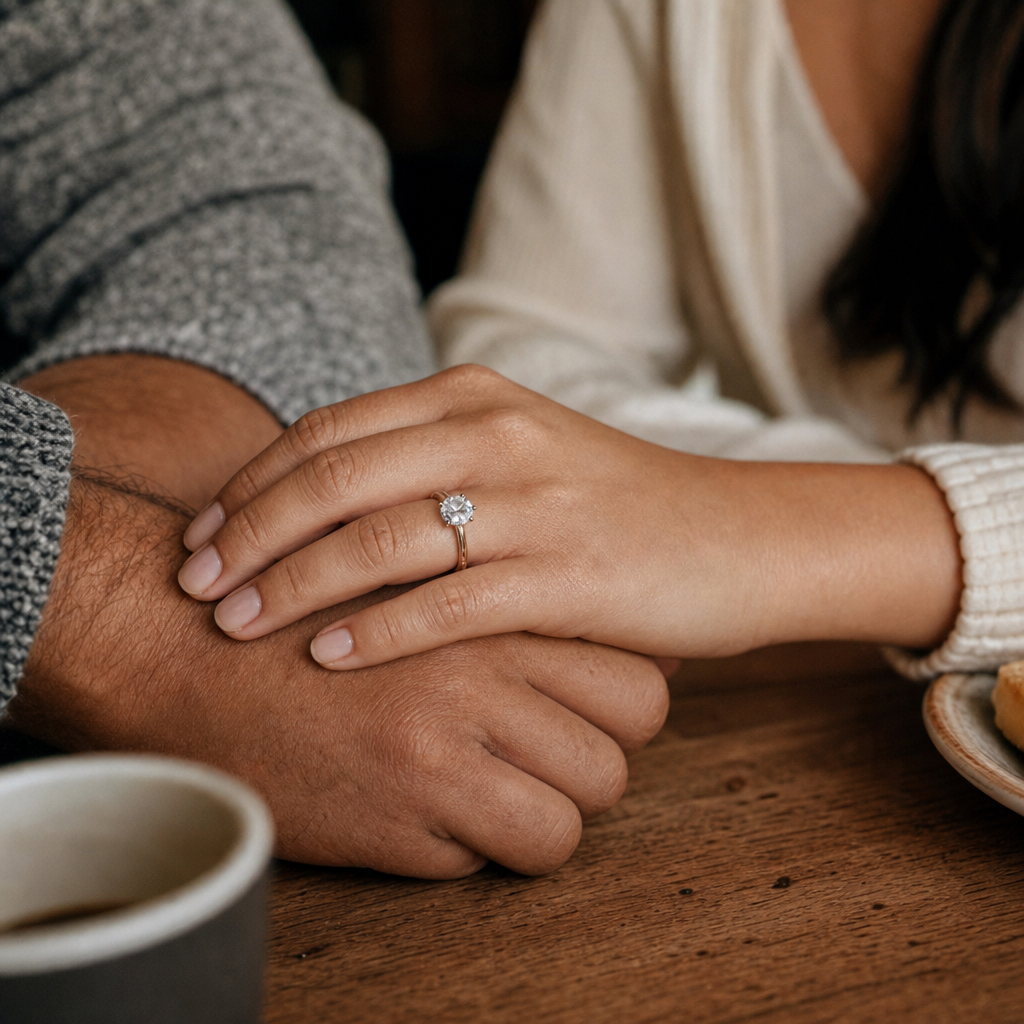
One of the most underappreciated advantages of choosing moissanite is what the price difference frees you up to do with the setting, band, and overall design. When you are not spending $15,000 on a center stone, you can actually afford to be creative with the rest of the ring.
Couples shopping at Livia Diamonds regularly use the cost savings from choosing moissanite to upgrade to more intricate settings, add side stones, select premium metal options like platinum or rose gold, or commission a fully custom design that reflects something personal about their relationship. With a mined diamond budget, that entire conversation usually stops at the center stone price.
Stone cuts available in moissanite
Moissanite is available in every cut that diamond comes in. Round brilliant, oval, cushion, emerald, pear, marquise, radiant, and asscher cuts are all standard options at Livia Diamonds. The behavior of each cut differs slightly in moissanite versus diamond due to the higher refractive index, and Livia's team can walk you through which cuts maximize that brilliance for your specific taste.
This is where the in-person and virtual consultation model that Livia Diamonds offers becomes genuinely valuable. You can see specific stone and setting combinations before committing, which is something that purely digital competitors like Blue Nile cannot replicate at the same level of personalized service.
Moissanite vs. Diamond vs. Lab Diamond: A Direct Comparison
Buyers who are genuinely evaluating all three options deserve a side-by-side that does not obscure the trade-offs. Here is the honest comparison across the factors that matter most for everyday engagement ring buyers in Canada.
Factor |
Moissanite |
Lab-Created Diamond |
Mined Diamond |
|---|---|---|---|
Average cost (2-carat equivalent, CAD) |
$600 - $1,200 |
$2,500 - $6,000 |
$15,000 - $30,000+ |
Hardness (Mohs scale) |
9.25 |
10 |
10 |
Refractive index (brilliance) |
2.65 - 2.69 (highest) |
2.42 |
2.42 |
Ethical sourcing certainty |
100% lab-grown, fully verified |
Lab-grown, generally traceable |
Varies, certification-dependent |
Customization budget headroom |
High, significant savings for setting upgrades |
Moderate |
Low for most budgets |
Available cuts |
All major cuts available |
All major cuts available |
All major cuts available |
The data in this table reflects general market pricing in the Canadian jewelry market as of 2025-2026. Prices vary by retailer and stone quality. The key takeaway is that moissanite delivers the visual performance of the category at a price that fundamentally changes what couples can afford to do with the rest of the ring budget.
Why Choose Moissanite in 2026 Specifically
The timing of this conversation matters. The moissanite engagement rings 2026 market is different from what it was even five years ago. Stone quality has improved significantly as production technology has advanced. Early moissanite had a noticeable green or yellow tint in certain lighting conditions. Modern near-colorless and colorless moissanite stones, graded DEF equivalent, are visually indistinguishable from high-quality diamonds to the naked eye of someone who is not a trained gemologist.
Consumer awareness has also shifted. The stigma that some buyers associated with non-diamond rings has largely dissolved among younger buyers. According to a 2023 survey by The Knot, one of North America's largest wedding planning platforms, nearly 20% of engagement rings purchased in 2022 featured a non-diamond center stone, up from single digits a decade earlier. That trend has only continued since.
Why Toronto-based buyers have a specific advantage
Buyers in the Greater Toronto Area and across Canada have access to Livia Diamonds in a way that fundamentally changes the buying experience. Unlike purchasing from a US-based online retailer such as VRAI or Blue Nile, shopping with Livia Diamonds means no cross-border shipping complications, no customs delays, no currency conversion surprises, and the option to walk into a Toronto office and see the ring before you commit.
Free shipping and free returns further reduce the risk. A common mistake when buying online is assuming that a stone will look in person exactly how it looks on a screen. Livia Diamonds' return policy and consultation model effectively eliminate that concern for Canadian buyers.
Pro tip: Book a virtual consultation with Livia Diamonds before you finalize any moissanite ring decision. In a 30-minute call, their team can show you multiple stone and setting combinations specific to your budget, which compresses what would otherwise be weeks of independent research into one focused conversation.
Frequently Asked Questions
Does moissanite look fake compared to a diamond?
No, modern near-colorless moissanite does not look fake to the naked eye. It looks like a high-quality diamond. In some lighting conditions, moissanite actually produces more visual fire than diamond, which catches the attention of people who notice the sparkle first. A trained gemologist can distinguish between the two using specific tests, but no one at a dinner party or office will be able to tell the difference just by looking.
Is moissanite a good long-term investment?
No gemstone, including mined diamond, should be purchased as a financial investment. Mined diamonds lose a significant percentage of their retail value the moment they leave the store. Moissanite is purchased for its beauty, durability, and the financial flexibility it gives couples at the point of purchase. The smart financial move is spending less on the ring and investing the savings elsewhere, which is exactly what moissanite enables.
Can a jeweler tell the difference between moissanite and diamond?
A trained gemologist using a thermal conductivity probe or a moissanite tester can distinguish the two. Standard diamond testers sold to consumers often test moissanite as diamond because both stones conduct heat similarly. This distinction matters only if it matters to you personally. For most couples, the relevant question is whether the ring looks beautiful and will last, and moissanite delivers on both counts.
What sizes and cuts does Livia Diamonds offer in moissanite?
Livia Diamonds offers moissanite across all major cuts including round brilliant, oval, cushion, emerald, pear, marquise, and radiant, in a wide range of sizes and ring dimensions to accommodate diverse hand types and style preferences. Their team can also accommodate custom cut and setting requests through their custom design service, which is available both in person at their Toronto office and remotely through virtual consultations.
How does moissanite compare to lab-created diamonds for engagement rings?
Both are excellent ethical choices, but they serve slightly different buyer priorities. Lab-created diamonds are chemically identical to mined diamonds and appeal to buyers who specifically want a diamond. Moissanite is a distinct gemstone that costs significantly less and produces more brilliance per carat. For couples who prioritize visual impact and budget flexibility, moissanite consistently wins the comparison. For couples who feel strongly about the word "diamond" appearing on a certificate, lab-created diamonds are the appropriate alternative.
Does Livia Diamonds ship outside Toronto?
Yes. Livia Diamonds operates as both a physical Toronto office and a full e-commerce store, with free shipping available across Canada. This means buyers in Vancouver, Calgary, Montreal, Ottawa, and every other Canadian city can access the same handcrafted moissanite rings and custom design services without traveling. Returns are also free, which removes the risk that typically comes with buying jewelry online.
If you have purchased a moissanite ring or are currently comparing your options, share what has surprised you most about the process in the comments. Your experience could help another couple make a more confident decision.
We would love your feedback and any insights you would share with others. What perspective would you add?