
Engagement Ring Trends 2026: What's Shaping the Market
The engagement ring market is shifting faster than most couples realize. If you started researching rings even twelve months ago, some of what you found is already outdated. Engagement ring trends 2026 are being driven by a sharp pivot toward alternative stones, architectural band designs, and a Canadian consumer base that is more informed and value-focused than ever. Moissanite and lab-created diamonds are no longer the "budget option" conversation. They are the conversation. At Livia Diamonds, we see this shift in real-time across consultations, and this guide maps exactly where things are heading for the rest of this year.
Table of Contents
- Quick Takeaways
- Why 2026 Is a Turning Point for Engagement Ring Buyers
- Moissanite Trends 2026: The Stone That Stopped Being a Secret
- Lab-Created Diamond Trends Driving Ring Trends Canada
- Stone Cut Trends Dominating 2026 Proposals
- Band and Setting Trends Changing the Look of Fine Jewelry
- Comparing the Top Stone Choices for 2026 Engagement Rings
- The Ethical Buying Shift: How Values Are Reshaping Ring Choices
- Broader Jewelry Trends 2026 That Are Influencing Engagement Rings
- Frequently Asked Questions
- References
Quick Takeaways
Key Insight |
Explanation |
|---|---|
Moissanite is leading alternative stone growth in Canada |
Canadian couples are choosing moissanite at higher rates than any previous year, drawn by its brilliance, durability, and price point relative to mined diamonds. |
Elongated fancy cuts are outselling round brilliants in some categories |
Oval, pear, and elongated cushion cuts create the appearance of a larger stone, which appeals to budget-conscious buyers without sacrificing visual impact. |
Lab-created diamonds have reached mainstream acceptance |
According to Statista consumer research, awareness of lab diamonds among under-40 buyers has increased significantly, and purchasing intent now matches or exceeds mined diamonds in several markets. |
Mixed metal and two-tone bands are surging |
Rose gold and white gold combinations, along with yellow gold and platinum pairings, are replacing single-metal bands as the dominant style preference for 2026. |
Custom design requests are up sharply |
Buyers want rings that tell a specific story. Cookie-cutter solitaires are declining in favor of modified settings, unique stone shapes, and engraved or personalized details. |
Minimalist east-west settings are growing in popularity |
Horizontally set stones, especially ovals and marquise cuts, offer a distinctive silhouette that stands apart from traditional north-south settings. |
Ethical sourcing is now a purchase driver, not just a preference |
Buyers are explicitly asking about stone origins and supply chain transparency before committing, which benefits retailers specializing in lab-grown and moissanite options. |
Why 2026 Is a Turning Point for Engagement Ring Buyers
The data consistently shows that 2025 was the inflection year for alternative stones in North America, and 2026 is where those preferences are cementing into buying decisions. The Knot's annual jewelry study reported that over 18% of engagement rings purchased in 2024 featured a non-diamond center stone, up from roughly 8% in 2019. That trajectory has not slowed.
In practice, this means that buyers walking into a consultation today are not asking whether moissanite or lab diamonds are legitimate. They are asking which cut, which setting, and which metal. The educational barrier has largely dissolved. What remains is the decision-making process around aesthetics and value.
For Canadian shoppers specifically, the economic environment adds a layer that US-centric trend reports often miss. The strength of the Canadian dollar, import duties on mined diamonds, and a consumer culture that rewards value without apology all push buyers toward lab-grown and moissanite options at a faster rate than comparable US demographics.
Pro tip: If you are comparing ring options across multiple retailers, ask specifically about the origin of the stone and whether it comes with a grading certificate. Reputable retailers like Livia Diamonds provide documentation that protects your investment regardless of stone type.
Moissanite Trends 2026: The Stone That Stopped Being a Secret
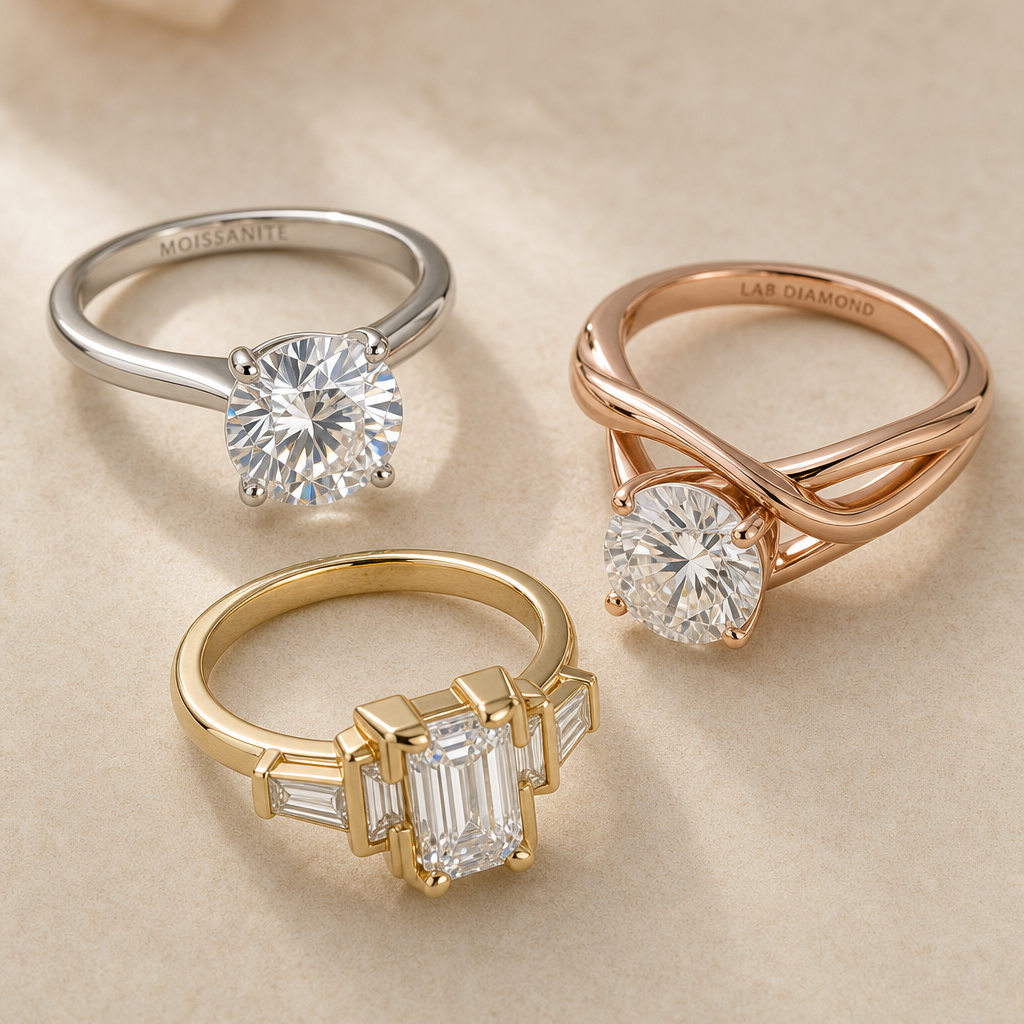
Moissanite has crossed a threshold. For years, it occupied an awkward middle ground where buyers felt they needed to justify the choice. That dynamic is gone. Moissanite trends 2026 show a stone that is being chosen on its own merits, not as a compromise.
Why Moissanite's Fire Matters More Than Its Price
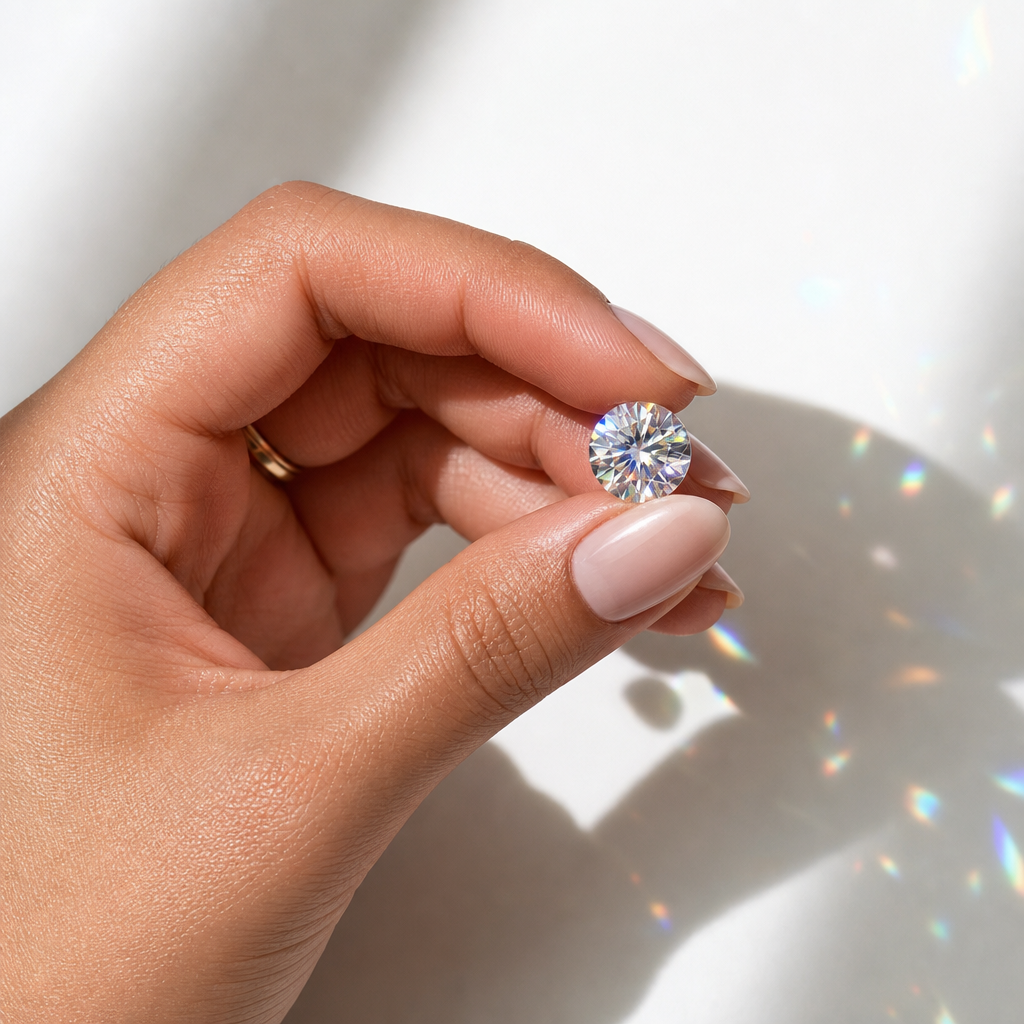
Moissanite has a refractive index of 2.65 to 2.69, compared to a diamond's 2.42. That means more light dispersion, which translates to more visible fire and brilliance, especially in certain lighting conditions. Buyers who understand this detail stop thinking of moissanite as diamond-adjacent and start thinking of it as a stone with its own optical identity.
The most popular moissanite shapes trending into 2026 are oval, cushion, and round brilliant. Oval is the current leader for new orders at Livia Diamonds, driven by its elongating effect on the finger and its exceptional fire when cut to ideal proportions.
Colorless Moissanite Is the Default Now
A common mistake buyers made five years ago was purchasing near-colorless moissanite that showed a slight yellow or green tint under certain lighting. That is largely a non-issue with current DEF-equivalent colorless moissanite. The technology has improved to the point where even gemologists need specific testing equipment to distinguish top-grade moissanite from a diamond.
At Livia Diamonds, all moissanite engagement rings use premium colorless stones. This is not a marketing claim. It is the baseline for any piece worth recommending to a customer who will wear it daily for decades.
Lab-Created Diamond Trends Driving Ring Trends Canada
Lab-created diamonds are chemically, physically, and optically identical to mined diamonds. They are not simulated diamonds. They are diamonds, grown in a controlled environment rather than extracted from the earth. This distinction matters enormously for buyers who want a diamond but cannot justify or afford mined stone pricing.
Ring trends Canada show lab diamonds gaining market share at a rate that mirrors what happened in the US market about 18 months earlier. Canadian consumers have historically been slightly more conservative in adopting new jewelry categories, but that lag is closing quickly as awareness grows.
Price Parity Has Tipped the Scale
Lab-created diamonds now sell for approximately 50 to 70 percent less than mined diamonds of comparable quality. According to Statista's consumer goods data, the price differential between lab and mined diamonds has been widening since 2021 as production technology scales. This means a buyer who could previously afford a 0.75-carat mined diamond can now purchase a 1.5-carat lab diamond within the same budget.
That is not a marginal upgrade. That is a fundamentally different ring. For the Canadian market, where budgets are being squeezed by housing costs and general cost-of-living pressures, this value shift is directly measurable in sales conversations.
Certification Is Still Non-Negotiable
One area where buyers should not cut corners is grading documentation. IGI and GIA both certify lab-created diamonds, and any reputable retailer will provide this documentation. Livia Diamonds includes certification with lab diamond purchases because it is the baseline for responsible retail, not an upsell.
Pro tip: When comparing lab diamond prices across retailers, verify that you are comparing stones with the same cut grade, not just the same carat weight. Two 1-carat lab diamonds with different cut grades can look dramatically different on the finger, and cut is the one quality factor that directly impacts visual brilliance.
Stone Cut Trends Dominating 2026 Proposals
Cut trends move in roughly five to eight year cycles, and 2026 is landing in the middle of a significant shift away from the classic round brilliant dominance that defined engagement rings for most of the last thirty years.
Oval Is the Current Volume Leader
The oval cut has been building momentum since approximately 2019, and it has not peaked. Its elongating effect on the finger, combined with a brilliance pattern that rivals round cuts, makes it the most-requested shape at consultations. In practice, oval moissanite and oval lab diamonds are among the highest-converting product listings at Livia Diamonds because the shape photographs exceptionally well and appeals to buyers who want something distinct without veering into avant-garde territory.
Emerald and Asscher Cuts Are Having a Moment
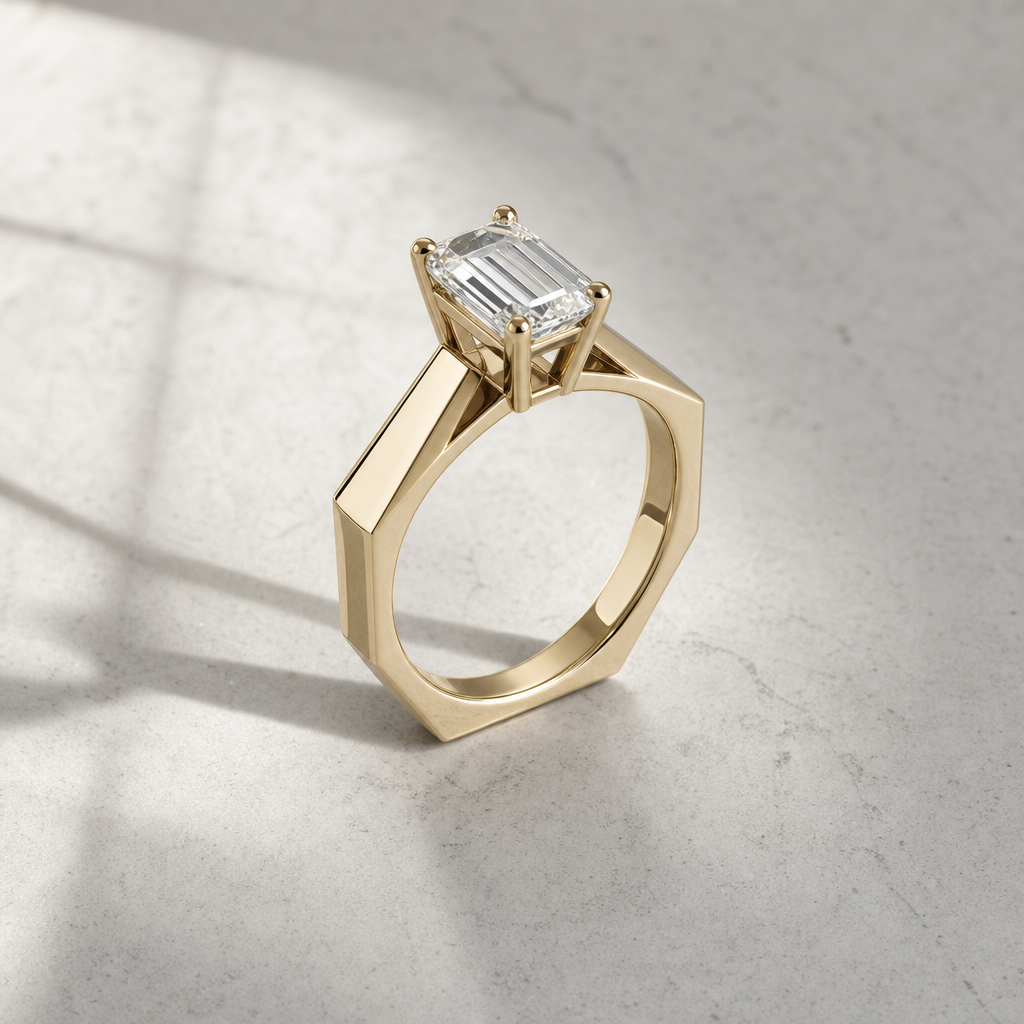
Step cuts, which include emerald and Asscher, are gaining traction among buyers who want a ring that reads as sophisticated rather than flashy. These cuts emphasize clarity over fire, which means they require a higher-quality stone to look their best. In lab diamonds and colorless moissanite, step cuts are genuinely breathtaking because the stone's clarity is unimpeded by inclusions common in lower-grade mined diamonds.
Pear and Marquise Are Returning
Both pear and marquise shapes went through a period of being associated with older aesthetics. That stigma has evaporated. East-west marquise settings and pear solitaires with thin pavé bands are appearing consistently in the 2026 trend cycle, and buyers under 35 are embracing them without any of the hesitation that existed a decade ago.
Band and Setting Trends Changing the Look of Fine Jewelry
The stone gets most of the attention, but the band and setting are responsible for roughly half of the ring's overall visual character. The trends here are just as distinct as the stone trends, and they are worth understanding before making any final decisions.
Thin Bands Are Dominant but Being Challenged
Ultra-thin bands, often under 1.5 millimeters, have been the prevailing aesthetic for several years. They are not going away, but there is growing demand for slightly wider bands with texture, milgrain detailing, or architectural elements. The thin-band look reads as elegant and modern. The wider, more detailed band reads as heirloom-quality and intentional. Both are valid, and 2026 buyers are weighing these options more deliberately than previous years.
Two-Tone Metals Are the Fastest-Growing Preference
Combining rose gold prongs with a white gold or platinum band is one of the most-requested custom variations at Livia Diamonds. The contrast creates visual interest without requiring an elaborate setting design. Yellow gold and white gold combinations are also gaining ground, driven partly by the broader yellow gold revival that has been building in fine jewelry since 2023.
Hidden Halo and Floating Halo Settings
Traditional halo settings add a visible ring of smaller stones around the center stone, increasing apparent size but also adding visual bulk. The hidden halo sits beneath the center stone, adding brilliance when viewed from the side and front without visually competing with the main stone from above. This is a setting trend that photographs differently than it looks in person, which matters for buyers who are making decisions based on images.
Comparing the Top Stone Choices for 2026 Engagement Rings
Choosing between moissanite, lab-created diamonds, and mined diamonds is the central decision for most buyers. The table below reflects real-world trade-offs based on current market conditions and Livia Diamonds' consultation experience.
Stone Type |
Value and Pricing (2026 Market) |
Best For |
|---|---|---|
Moissanite |
Lowest price per carat. A 2-carat colorless moissanite costs a fraction of an equivalent lab diamond. No depreciation concern since resale is not typically the motivation for engagement ring purchases. |
Buyers who want maximum visual size and brilliance per dollar. Ideal for large center stones where budget is a significant factor. |
Lab-Created Diamond |
50 to 70 percent less than mined diamonds of equivalent grade. Prices have continued to drop as production scales. Comes with GIA or IGI grading documentation. |
Buyers who want the chemical identity of a diamond with ethical sourcing and significant cost savings. Best when documentation matters for sentimental or resale reasons. |
Mined Diamond |
Highest price point by a significant margin. Prices have stabilized after years of decline in some grades. The traditional choice but increasingly difficult to justify on value grounds alone. |
Buyers with strong preference for natural origin or family traditions tied to mined stones. Not recommended on purely practical grounds when lab or moissanite alternatives deliver better value. |
The Ethical Buying Shift: How Values Are Reshaping Ring Choices
This trend is not abstract. In consultations at Livia Diamonds, ethical sourcing questions come up in the majority of appointments with buyers under 40. The question is rarely adversarial. Buyers are not looking to challenge a retailer. They are looking for confirmation that their purchase aligns with what they already believe.
"Consumers increasingly expect businesses to demonstrate their values through actions and supply chain decisions, not just marketing language. In jewelry, this means stone origin transparency has moved from a differentiator to a baseline expectation." - McKinsey and Company, Consumer Sentiment Research
Moissanite and lab-created diamonds both sidestep the ethical concerns associated with mined diamond extraction entirely. There are no conflict stone concerns, no environmental extraction footprint from mining, and no opacity in the supply chain. For buyers who weight these factors, the decision is essentially already made before they compare aesthetics or pricing.
The Canadian market in particular has shown strong responsiveness to this message. Ring trends Canada reflect a consumer base that reads deeply before purchasing and does not respond well to greenwashing. Straightforward documentation and clear stone origin explanations are more persuasive than vague sustainability language.
Broader Jewelry Trends 2026 That Are Influencing Engagement Rings
Engagement rings do not exist in a vacuum. The broader fine jewelry market shapes what buyers expect and request, and several jewelry trends 2026 are directly influencing how engagement rings are being designed and worn.
Stacking and Nesting Bands
The rise of stacking rings has changed how buyers think about the engagement ring itself. Instead of treating it as a standalone piece, many buyers now plan the ring as part of a set that includes a wedding band and one or two additional stacking bands. This means the engagement ring design needs to work visually with other pieces, which favors cleaner solitaire and bezel settings over highly elaborate cathedral settings.
Yellow Gold's Sustained Comeback
Yellow gold had a long absence from mainstream engagement ring preferences but has been returning steadily since 2021. The trend has not reversed. Yellow gold moissanite and yellow gold lab diamond rings account for a growing percentage of Livia Diamonds orders, particularly among buyers who want a warmer, more vintage-adjacent aesthetic without purchasing antique jewelry.
Vintage and Art Deco Influences Without Antique Prices
Buyers want the aesthetic of vintage jewelry without the condition uncertainty and premium pricing of actual antique pieces. This is where custom design services become particularly valuable. At Livia Diamonds, custom rings with milgrain borders, filigree details, and step-cut stones in vintage-style settings are consistently among the most requested design consultations. The cost is significantly lower than acquiring a comparable antique ring, and the stone quality is certifiably higher.
Pro tip: If you are drawn to a vintage aesthetic, look at Art Deco-inspired settings with emerald or Asscher-cut moissanite or lab diamonds. The geometric lines of those cuts were literally designed for that era, and they translate directly into modern settings without looking costumey.
Frequently Asked Questions
What are the biggest engagement ring trends for 2026?
The most significant trends for 2026 are the continued dominance of oval cuts, the mainstream acceptance of moissanite and lab-created diamonds as primary stone choices, the growth of two-tone metal bands, and a clear consumer preference for ethical sourcing and transparent stone origins. Custom and personalized designs are also growing relative to catalog purchases.
Is moissanite still a good choice in 2026 or is it being replaced by lab diamonds?
Moissanite and lab-created diamonds serve different buyer priorities and are not in direct competition. Moissanite offers the highest brilliance per dollar and is the right choice for buyers prioritizing visual impact and budget efficiency. Lab-created diamonds are the right choice for buyers who specifically want a stone that is chemically a diamond. Both are strong choices in 2026, and neither is declining in relevance.
What engagement ring styles are popular in Canada specifically?
Canadian buyers in 2026 are showing strong preference for clean, elegant designs rather than heavily ornate styles. Solitaires with thin pavé bands, bezel settings in yellow or two-tone gold, and oval or cushion cuts in moissanite or lab diamonds are the dominant requests. Canadian consumers also ask more consistently about stone origin and sustainability credentials than comparable US buyers, which influences the product mix at retailers like Livia Diamonds.
How do I know if a lab diamond or moissanite ring will still look good in ten years?
Both moissanite and lab-created diamonds score extremely high on hardness. Lab diamonds are a 10 on the Mohs scale, identical to mined diamonds. Moissanite is a 9.25, making it the second hardest gemstone used in jewelry. Neither stone will cloud, scratch, or degrade under normal daily wear conditions. The setting quality and band material are the more important durability factors for long-term wearability.
Are yellow gold engagement rings a lasting trend or just a phase?
The yellow gold revival has been building for over three years now and shows no sign of reversing. Yellow gold's return is tied to broader cultural interest in vintage aesthetics and a reaction against the exclusively white metal preferences that dominated the 2010s. For engagement rings specifically, yellow gold sets off colorless moissanite and lab diamonds exceptionally well, which adds a practical reason beyond aesthetics to choose it.
Can I get a custom engagement ring that incorporates 2026 trends without a massive lead time?
At Livia Diamonds, custom design consultations are available both in-person in Toronto and virtually, which removes the geographic barrier for buyers across Canada. Lead times for custom pieces depend on design complexity, but straightforward customizations such as metal choice, stone shape, and setting style can typically be accommodated within standard production windows. Booking a consultation early in your decision process gives you more flexibility on timeline.
We want to hear from you: which 2026 engagement ring trend are you most drawn to, and what is making the final decision difficult for you?