
SI1 vs VS2 vs VVS Lab Diamond Clarity: Full Guide
Most engagement ring shoppers spend weeks agonizing over diamond clarity grades, convinced that choosing SI1 over VS2 will result in a visibly inferior ring. In practice, that fear is almost entirely unfounded for lab-created diamonds, and it costs buyers thousands of dollars they did not need to spend. This diamond clarity guide cuts through the confusion by explaining exactly what SI1, VS2, and VVS grades mean, how they differ in lab-grown stones specifically, and how to make a smart decision when shopping at Livia Diamonds or any other fine jewelry retailer.
Table of Contents
- What Is Diamond Clarity and How Is It Graded?
- Quick Takeaways
- SI1 Clarity Explained: What You Actually See
- VS2 Clarity Explained: The Sweet Spot Grade
- VVS Lab Diamond: When Perfect Clarity Is Worth It
- Lab Diamond Clarity vs. Natural Diamond Clarity
- How Stone Cut Affects Visible Clarity
- Clarity Grade Comparison Table
- Frequently Asked Questions
- References
What Is Diamond Clarity and How Is It Graded?
Diamond clarity is a measure of the internal and external characteristics of a stone, called inclusions and blemishes respectively. The Gemological Institute of America (GIA) developed the standard grading scale that the entire industry uses, ranging from Flawless (FL) at the top down through VVS1, VVS2, VS1, VS2, SI1, SI2, I1, I2, and I3. Every grade reflects what a trained grader can observe under 10x magnification, not what the naked eye sees from across a jewelry counter.
The GIA defines clarity as the degree to which a diamond is free from inclusions and blemishes. Inclusions are internal features like crystals, feathers, needles, or clouds. Blemishes are surface features like scratches or nicks. Both affect the grade, but inclusions carry far more weight in the overall assessment.
"The clarity grade of a diamond is determined by the visibility, size, relief, nature, and position of inclusions and blemishes." - Gemological Institute of America, GIA Diamond Grading Standards
For lab-created diamonds, the same GIA scale applies. International Gemological Institute (IGI) and the American Gem Society (AGS) also grade lab diamonds using equivalent criteria. The grading process is identical whether the stone grew in the earth over billions of years or in a controlled laboratory environment over a few weeks.
Quick Takeaways
Key Insight |
Explanation |
|---|---|
SI1 is eye-clean in most cases |
The vast majority of SI1 lab diamonds appear flawless to the naked eye, making them a high-value choice for budget-conscious buyers. |
VS2 is the industry sweet spot |
VS2 stones are almost always eye-clean and offer a meaningful price reduction compared to VVS grades with no visible quality difference. |
VVS lab diamonds cost more without visible benefit |
For most ring settings and carat sizes under 2ct, VVS clarity provides no perceptible advantage over VS2 to the unaided eye. |
Lab diamonds grow with fewer inclusions than mined stones |
Controlled growth conditions mean lab diamonds at the same clarity grade often have fewer or less prominent inclusions than their natural counterparts. |
Stone cut dramatically influences visible clarity |
Brilliant round cuts hide inclusions better than step cuts. An SI1 round may look cleaner than a VS2 emerald cut in the same setting. |
Carat weight changes the equation |
As carat size increases, inclusions become easier to spot. A 0.5ct SI1 and a 2ct SI1 are not visually equivalent, even at the same grade. |
Clarity certificates are not interchangeable |
IGI and GIA use equivalent scales but IGI grading for lab diamonds is sometimes considered more lenient, so source of certification matters when comparing prices. |
SI1 Clarity Explained: What You Actually See
SI1 stands for Slightly Included, first degree. At this grade, inclusions are noticeable to a skilled grader under 10x magnification but are typically not visible to the naked eye. A common mistake buyers make is assuming that any inclusion automatically means a visually inferior stone. That assumption is wrong for the overwhelming majority of SI1 lab diamonds.
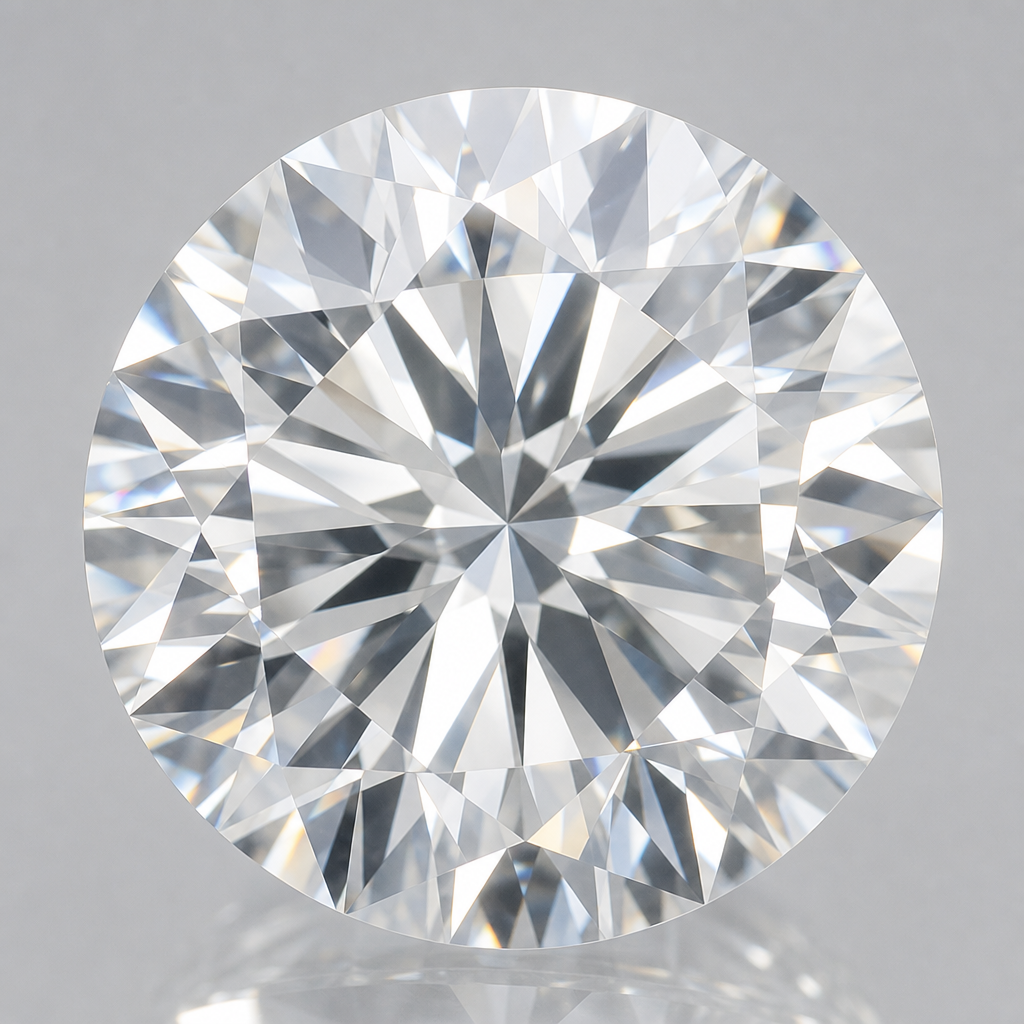
In practice, an SI1 lab diamond in a round brilliant cut at 1 carat or under will look perfectly clean to 95% of people looking at it in normal lighting conditions. The inclusions exist microscopically, but the facet pattern of a round brilliant cut scatters light in a way that conceals minor internal characteristics far better than an uncut rough stone would suggest.
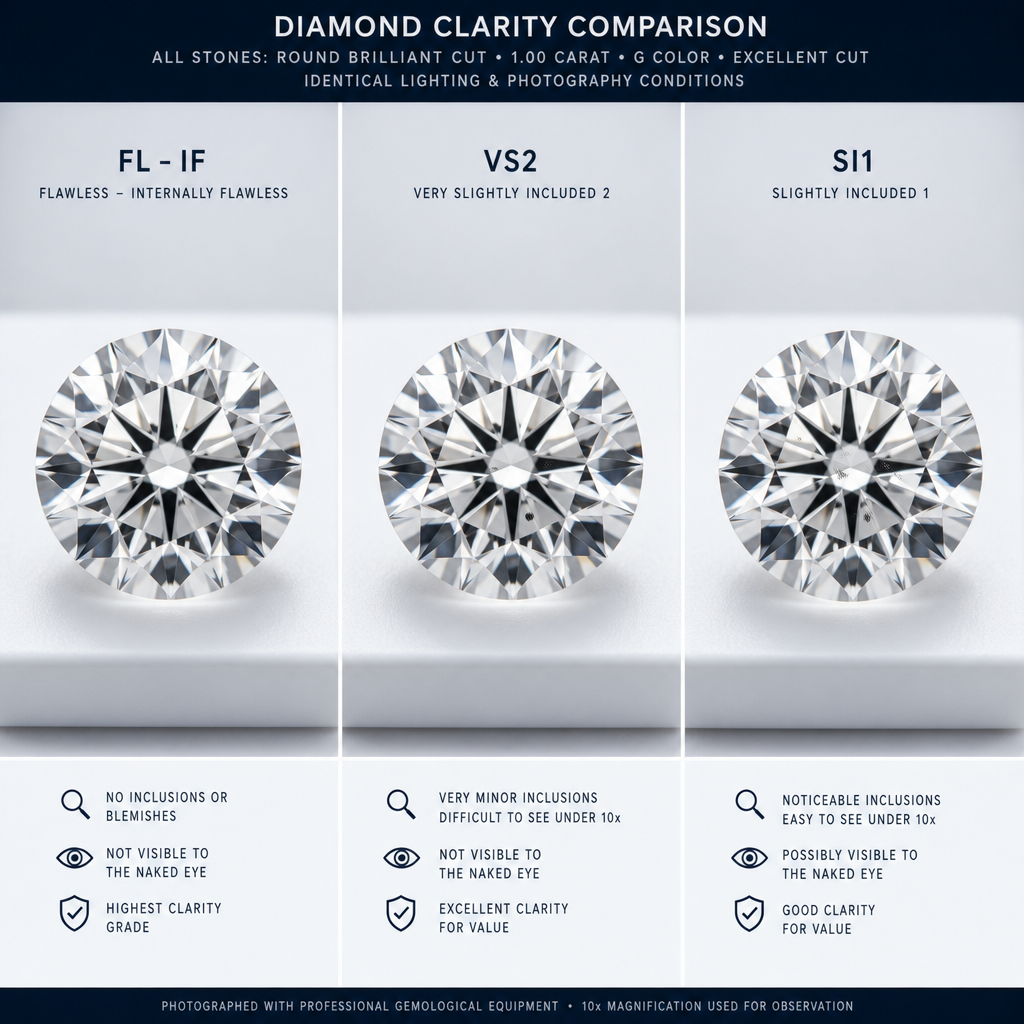
Where SI1 can become a problem is with larger stones above 1.5 carats, step-cut shapes like emerald or Asscher, or stones where the inclusion falls directly under the table facet at the center of the stone. In those specific scenarios, you might see a faint cloud or crystal with the naked eye under bright light. The solution is not to automatically upgrade to VS2. The solution is to look at the actual stone or its high-resolution grading report before purchasing.
Pro tip: When shopping for an SI1 lab diamond at Livia Diamonds, ask to see the inclusion plot on the grading certificate and request a high-magnification image. If the inclusion is positioned near the girdle or pavilion rather than under the table, you can often buy SI1 with complete confidence.
What Types of Inclusions Appear in SI1 Lab Diamonds
The most common inclusion types in SI1 lab-created diamonds are needles, pinpoint clusters, and small feathers. Needles are thin elongated crystals that often appear white or reflective and are nearly impossible to see without magnification. Pinpoint clusters look like a faint haze and are typically only visible under a loupe. Small feathers are minor fractures and are worth more attention because they can, in rare cases, affect durability if positioned poorly.
Lab diamonds also sometimes show graining or strain patterns related to their growth method, particularly in HPHT-grown stones. These internal graining lines are structural rather than optical and often do not affect the clarity grade in a meaningful way.
VS2 Clarity Explained: The Sweet Spot Grade
VS2 stands for Very Slightly Included, second degree. At this grade, inclusions are minor and difficult for a trained grader to see under 10x magnification. To the naked eye, a VS2 lab diamond is virtually always eye-clean without exception. This is why jewelry professionals, including the team at Livia Diamonds, frequently recommend VS2 as the most practical clarity grade for engagement rings.
The price difference between VS2 and VVS grades is often 15 to 25 percent on lab diamonds of equivalent cut, color, and carat. That is a significant savings with no visible trade-off. For a shopper spending $2,000 on a lab diamond engagement ring, choosing VS2 over VVS2 could free up $300 to $500 to invest in a better cut grade or a larger stone, both of which produce far more visible impact on the ring's appearance.
Pro tip: If your budget is fixed, prioritize cut quality over clarity grade every time. A VS2 stone with an Excellent or Ideal cut will outshine a VVS stone with a Very Good cut in almost every real-world lighting scenario.
When VS2 Makes More Sense Than SI1
VS2 makes clear sense over SI1 when buying step-cut shapes. Emerald cuts, Asscher cuts, and baguette cuts have large, open facets and a hall-of-mirrors effect that makes inclusions far easier to spot than in brilliant cuts. For these shapes, SI1 carries meaningful risk of visible inclusions, while VS2 eliminates that risk without the premium cost of VVS.
VS2 also makes sense for stones above 1.5 carats where the table surface is large enough that a positioned inclusion in an SI1 stone might catch the eye. At these sizes, the visual real estate of the stone expands and so does the likelihood of a visible flaw.
VVS Lab Diamond: When Perfect Clarity Is Worth It
VVS stands for Very, Very Slightly Included and comes in two sub-grades: VVS1 and VVS2. At both grades, inclusions are extremely difficult to see even under 10x magnification. A VVS lab diamond is as close to flawless as most buyers will ever need, and in many cases it is closer to flawless than the buyer will ever notice.
For lab-created diamonds specifically, VVS grading is particularly interesting because lab diamonds at this grade often contain only minor graining or tiny pinpoints that are essentially academic in nature. The stone will never visibly degrade from these characteristics and they have no effect on durability or brilliance. You are paying for a grading distinction that matters to a gemologist under a microscope, not to a person wearing the ring.
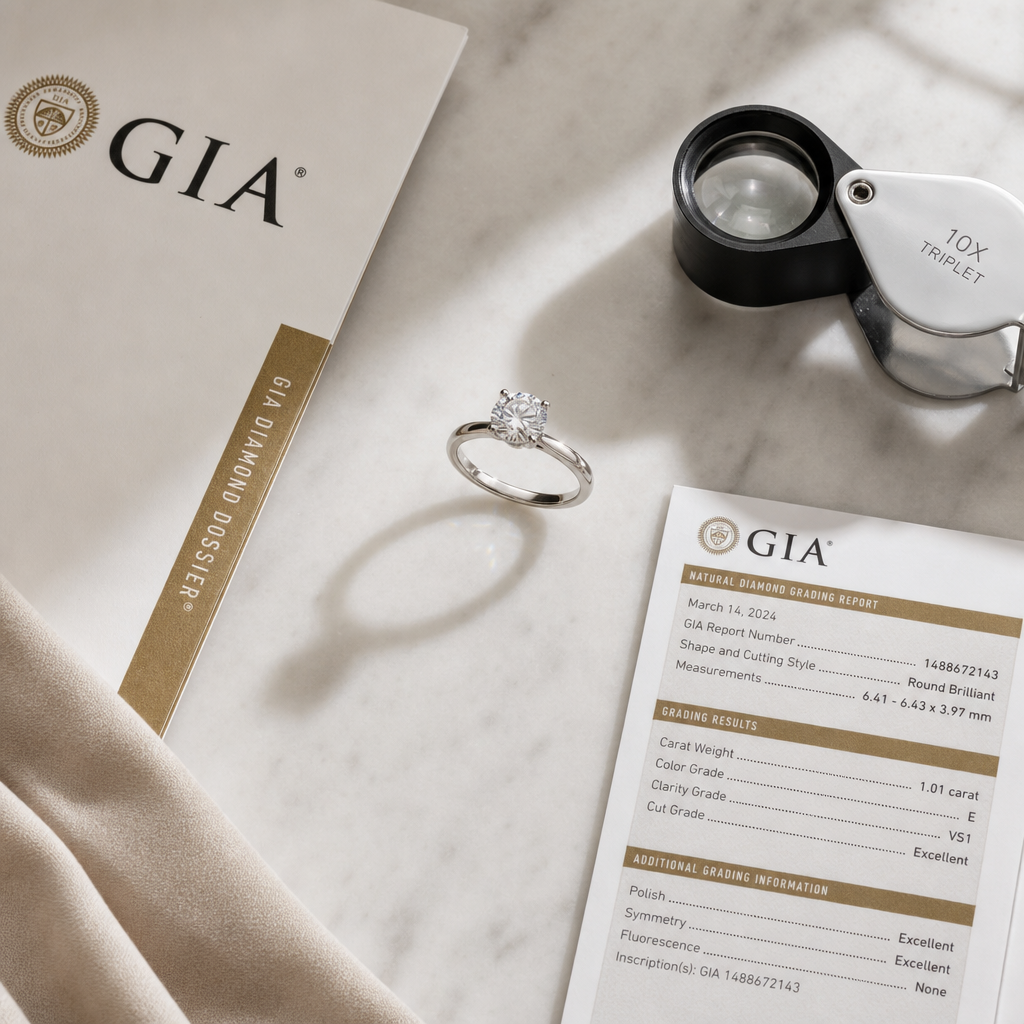
That said, VVS clarity is worth considering in two specific scenarios. First, if resale value matters to you and you expect to sell or upgrade the stone within five to ten years, VVS grades hold slightly stronger documentation of quality. Second, if you are purchasing a large step-cut stone above 2 carats where visibility of inclusions is a genuine concern, VVS gives you an unambiguous safety margin. Outside those scenarios, VS2 achieves the same visual result for less money.
Lab Diamond Clarity vs. Natural Diamond Clarity
Lab-created diamonds and natural diamonds are graded on the same clarity scale, but they are not identical in the types of inclusions they carry. Natural diamonds form under intense geological pressure over millions of years and typically contain inclusions like feathers, crystals of other minerals, cloud formations, and graining. Lab diamonds, whether grown via Chemical Vapor Deposition (CVD) or High Pressure High Temperature (HPHT) methods, form in weeks under controlled conditions and tend to have different inclusion profiles.
CVD lab diamonds commonly show needle-like inclusions, metallic flux inclusions are rare, and internal graining is the most frequent characteristic. HPHT lab diamonds sometimes contain metallic inclusions from the catalyst material used in the growth process, which can be magnetic. Neither type is inherently superior in clarity, but the nature of inclusions differs meaningfully from natural stones.
The practical result is that lab diamonds at SI1 and VS2 grades are often cleaner-looking than natural diamonds at the same grade because the inclusions they carry tend to be less prominent visually. A natural SI1 might contain a feather or cloud that catches the eye, while a lab SI1 of the same grade might carry only a faint needle or graining line. Same grade, different visual impact.
How Stone Cut Affects Visible Clarity
The relationship between cut style and clarity visibility is one of the most underexplained factors in diamond shopping. Brilliant cuts, including round brilliant, oval, cushion, radiant, and pear shapes, use complex facet patterns that create intense light return and scattering. This light performance naturally conceals minor inclusions, making brilliant cuts more forgiving of lower clarity grades.
Step cuts, including emerald, Asscher, and baguette shapes, use parallel facets arranged in steps that create a transparent, window-like appearance. This facet style offers less light scattering and makes inclusions far more visible. A stone that would be eye-clean as a round brilliant might show obvious inclusions as an emerald cut at the same clarity grade.
At Livia Diamonds, the team advises customers to consider the following general guideline when pairing clarity grade with cut style. For round brilliants and other brilliant cuts, SI1 through VS1 is typically sufficient for eye-clean results. For step cuts in moissanite and lab diamond, VS2 is the practical minimum and VVS is worth considering for larger stones. This is not a rigid rule but it reflects the real-world visual outcomes that experience with these stones produces.
Clarity Grade Comparison Table
The table below compares SI1, VS2, and VVS2 across the factors that matter most when selecting a lab-created diamond engagement ring.
Clarity Factor |
SI1 Lab Diamond |
VS2 Lab Diamond |
VVS2 Lab Diamond |
|---|---|---|---|
Visible to naked eye |
Rarely (depends on inclusion position and cut) |
Almost never |
Never |
Visible under 10x loupe |
Yes, easily noticeable |
Yes, with effort |
Very difficult to find |
Relative price (1ct round, same cut and color) |
Lowest of the three |
Mid-range |
15-25% above VS2 |
Best suited cut styles |
Round brilliant, oval, cushion, pear |
All cuts including step cuts |
All cuts, including large step cuts over 2ct |
Recommended carat range |
Under 1.5ct brilliant cuts |
All sizes, especially step cuts or over 1.5ct |
Large stones over 2ct or collector preference |
Durability impact of inclusions |
Minimal (rare exceptions with large feathers) |
Negligible |
None |
Value recommendation |
Excellent value for brilliant cuts |
Best overall value across all cuts |
Premium for documentation or very large stones |
Frequently Asked Questions
Is SI1 good enough for an engagement ring?
Yes, in most cases. An SI1 lab diamond in a brilliant cut at 1 carat or under is eye-clean for the overwhelming majority of buyers. The key is to verify the inclusion position on the grading report. If the inclusion sits near the girdle rather than under the table, SI1 is an excellent choice that saves money without any visible compromise.
What is the difference between SI1 and VS2 in price for lab diamonds?
For lab-created diamonds, the price difference between SI1 and VS2 at equivalent cut, color, and carat weight is typically 8 to 15 percent. VS2 commands a modest premium because it carries a guaranteed eye-clean status that SI1 cannot always guarantee without inspecting the specific stone. The gap is much smaller in lab diamonds than in natural diamonds due to the controlled growth conditions that produce fewer problematic inclusions overall.
Can you see the difference between VS2 and VVS with the naked eye?
No. Under normal viewing conditions, including indoor lighting, sunlight, and typical social distances, there is no visible difference between a VS2 and a VVS lab diamond. Both grades are completely eye-clean. The difference only becomes apparent under a 10x jeweler's loupe and even then requires a trained eye to distinguish.
Do lab diamonds get graded the same way as natural diamonds for clarity?
Yes. The GIA, IGI, and AGS all use the same clarity grading scale for lab-created diamonds as they use for natural diamonds. The grading process, terminology, and grade definitions are identical. The only difference is that the grading report will specify whether the stone is lab-created or natural. When comparing lab diamond clarity grades across retailers, make sure you are comparing stones certified by the same laboratory since grading stringency can vary between institutions.
Does a VVS lab diamond have better brilliance than an SI1?
No. Brilliance is determined by cut quality, not clarity grade. A well-cut SI1 lab diamond will outperform a poorly cut VVS diamond in terms of light return, sparkle, and visual impact every time. Clarity affects the grading documentation and the microscopic purity of the stone. It does not determine how the diamond interacts with light in ways visible to the naked eye, which is entirely a function of cut precision and proportions.
Should I prioritize clarity or cut quality when shopping at Livia Diamonds?
Cut quality should always take priority. The cut grade is the single largest driver of a diamond's visual beauty. At Livia Diamonds, an Excellent-cut VS2 lab diamond will look dramatically more beautiful than a Fair-cut VVS stone at the same price point. Once you have selected the best cut you can afford, then choose the clarity grade that fits your remaining budget, with VS2 as the practical minimum for step cuts and SI1 as a strong option for brilliant cuts.
Have you noticed a visible difference between clarity grades when comparing stones in person? Share your experience in the comments or reach out to the Livia Diamonds team during a consultation to talk through your specific stone options.