
Ethical Engagement Rings: Lab Diamonds & Moissanite Guide
Most people buying an engagement ring have no idea that a single mined diamond can displace up to 250 tons of earth and still arrive with a murky supply chain. The demand for an ethical engagement ring is not a passing trend. It is a direct response to documented harm inside conventional diamond mining. Lab-grown diamonds and moissanite now offer couples in Canada a clear, verified alternative without sacrificing beauty or durability. This guide explains exactly why these stones lead the conversation on sustainable jewelry Canada, how they compare to mined diamonds, and what Livia Diamonds customers consistently ask before making their choice.
Table of Contents
- Quick Takeaways
- Why Ethical Engagement Rings Matter
- Lab-Grown Diamonds Explained
- Moissanite: The Misunderstood Gem
- Comparing Your Options: Lab Diamond vs. Moissanite vs. Mined Diamond
- Environmental Impact by the Numbers
- Conflict-Free vs. Certified: What It Actually Means
- Buying Ethical Jewelry in Canada: What to Look For
- Frequently Asked Questions
- References
Quick Takeaways
Key Insight |
Explanation |
|---|---|
Lab diamonds are chemically identical to mined diamonds |
They share the same carbon crystal structure, hardness (10 on Mohs scale), and optical properties. A jeweler cannot distinguish them without specialized equipment. |
Moissanite produces more brilliance than diamond |
Moissanite has a refractive index of 2.65 vs. 2.42 for diamond, producing more fire and sparkle per carat at a significantly lower price. |
Lab diamond production uses up to 85% less land disturbance |
Growing a diamond in a controlled facility eliminates open-pit mining, the single most destructive phase of conventional diamond extraction. |
The Kimberley Process does not guarantee conflict-free status |
The Kimberley Process certifies only that a diamond is not financing rebel movements, ignoring labor abuses, environmental violations, and government-sanctioned exploitation. |
Moissanite and lab diamonds cost 40-80% less than mined equivalents |
A 1-carat mined diamond averages $4,000-$6,000 USD at retail. A comparable lab diamond runs $800-$1,500. Moissanite of the same size starts around $300-$600. |
Canada has no federal traceability standard for imported diamonds |
Unless a retailer independently verifies origin, the ethical claims on mined diamonds sold in Canada rest entirely on supplier self-reporting. |
Custom design does not require sacrificing ethics |
Livia Diamonds offers handcrafted custom engagement rings using lab-grown stones, proving that bespoke design and ethical sourcing are fully compatible goals. |
Why Ethical Engagement Rings Matter
The engagement ring industry generates roughly $13 billion annually in North America alone, and a significant portion of that revenue traces back to mining operations with serious human rights and environmental records. Buying an ethical engagement ring is not about virtue signaling. It is about understanding exactly what you are funding when you hand over your money.
A common mistake is assuming that a "conflict-free" certificate printed on a receipt settles the matter. In practice, conflict-free labeling addresses a narrow slice of the problem, specifically, whether a diamond funded a rebel militia. It says nothing about child labor in artisanal mines, acid leaching into water supplies, or workers earning subsistence wages in regulated operations.
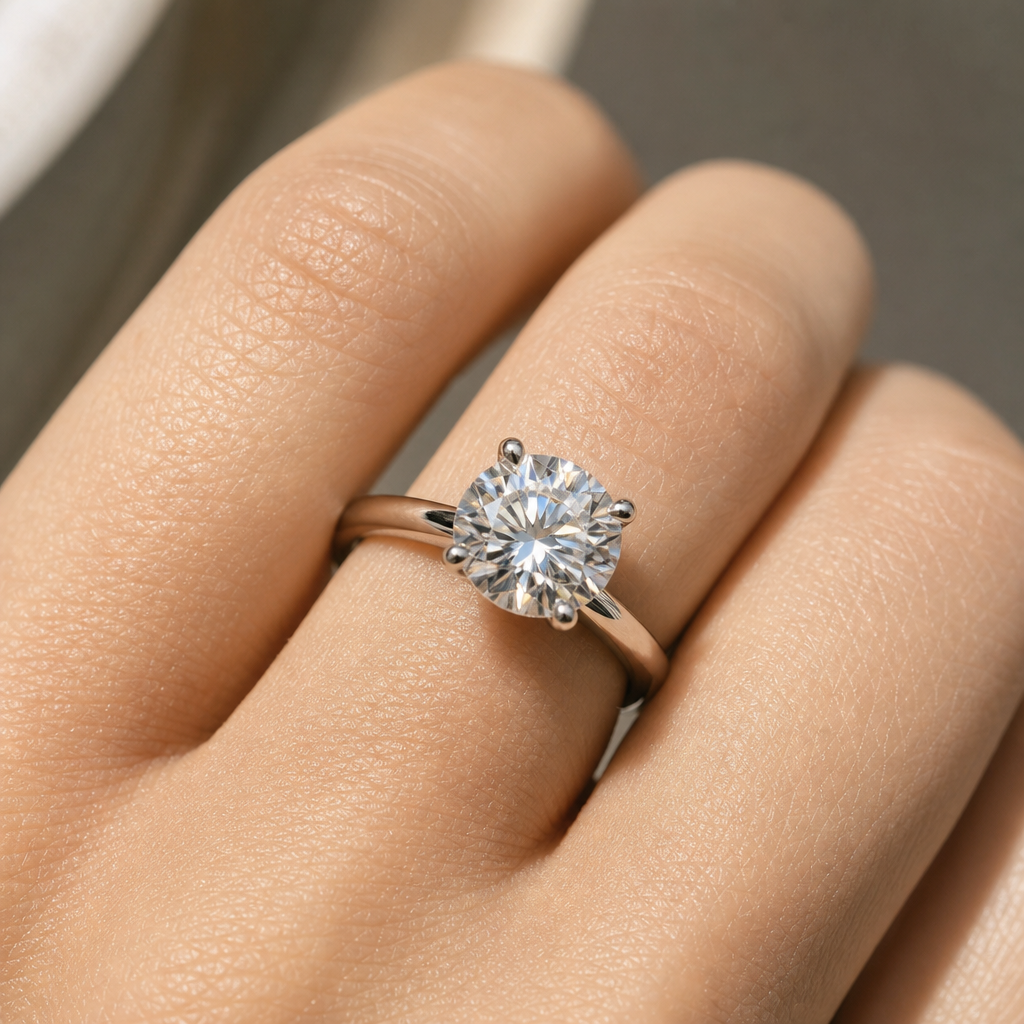
Lab-grown diamonds and moissanite sidestep these issues entirely because their supply chain starts inside a controlled facility, not underground in a politically unstable country. For couples shopping at Livia Diamonds, this means the stone in their ring has a fully traceable origin, and the price advantage is considerable enough to invest in a better setting, a higher carat weight, or both.
Lab-Grown Diamonds Explained
Lab-grown diamonds are produced through one of two methods: High Pressure High Temperature (HPHT) or Chemical Vapor Deposition (CVD). Both processes replicate the exact conditions that form diamonds in the Earth's mantle, producing stones that are physically, chemically, and optically identical to mined diamonds.
HPHT vs. CVD: Which Production Method Is Better?
HPHT mimics the extreme pressure and temperature of the Earth's core and tends to produce diamonds with slightly warmer color profiles. CVD grows diamonds layer by layer from a carbon-rich gas in a chamber and is currently the dominant method for gem-quality stones because it allows more precise control over color and clarity.
In practice, a well-cut CVD diamond in the D-F color range is visually indistinguishable from the finest mined diamonds on the market. The data consistently shows that grading laboratories like IGI and GIA now certify lab-grown diamonds with the same rigor applied to mined stones. At Livia Diamonds, the lab-grown diamond inventory is selected with this certification standard in mind, so customers receive independent third-party validation of what they are buying.
Price Trajectory for Lab Diamonds in Canada
Lab diamond prices have fallen sharply over the past five years as production capacity scaled. What cost $3,000 per carat in 2018 now runs closer to $800-$1,200 per carat for comparable quality. This is not a signal of declining value in the sense of resale. It reflects manufacturing efficiency, not a change in the stone's physical properties.
For budget-conscious couples in Toronto and across Canada, this price drop is genuinely good news. It means more stone for less money without touching a single mining operation.
Pro tip: When comparing lab diamond prices across Canadian retailers, always check whether the listed price includes the center stone or just the setting. Livia Diamonds displays complete ring prices with the stone included, so you are comparing real numbers rather than assembling costs yourself.
Moissanite: The Misunderstood Gem
Moissanite was first discovered in 1893 in a meteor crater in Arizona by Nobel Prize-winning chemist Henri Moissan. Natural moissanite is extraordinarily rare. All moissanite sold in jewelry today is lab-created silicon carbide, making it one of the cleanest supply chains in the gemstone category.
Why Moissanite Outperforms Diamond on Sparkle
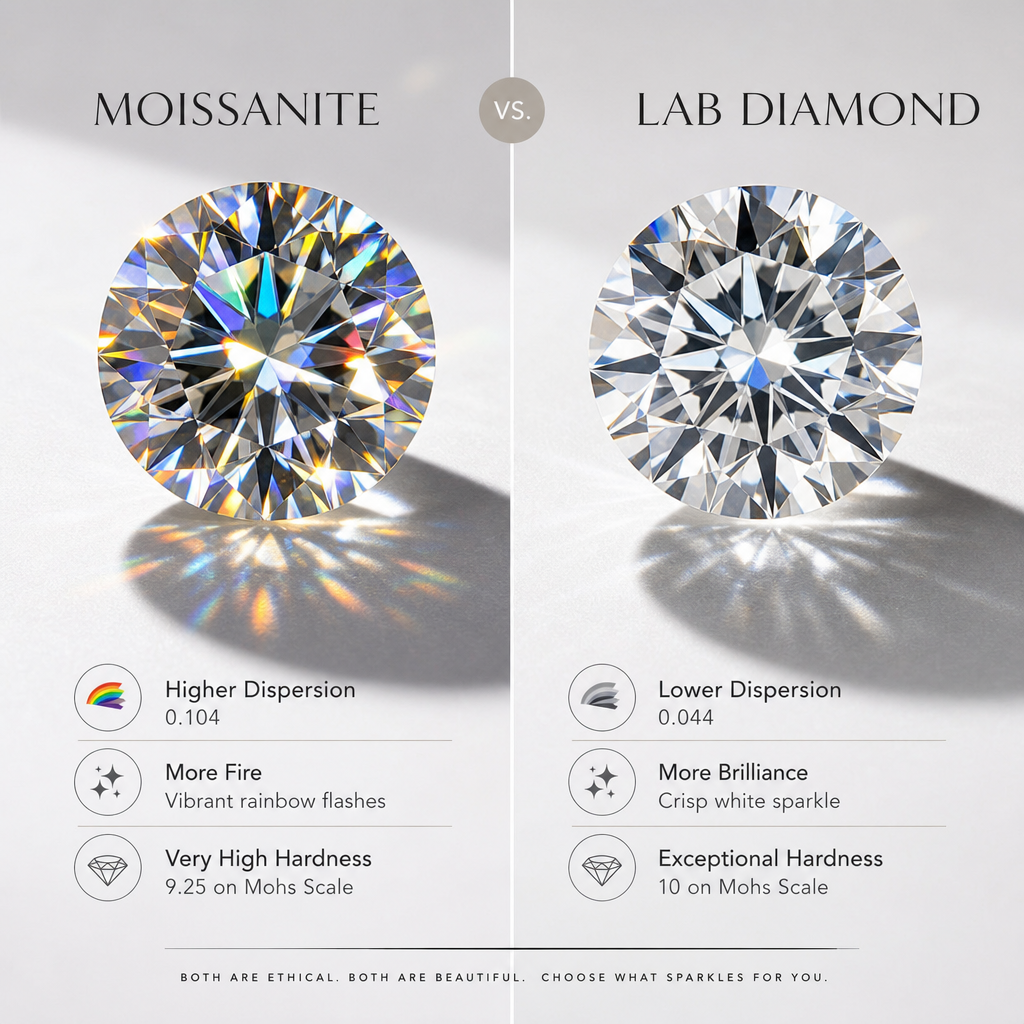
The refractive index of moissanite sits at 2.65 to 2.69, compared to 2.42 for diamond. This means moissanite bends light at a steeper angle, producing what gemologists call "fire," the rainbow-colored dispersion visible when light hits the stone. Many wearers find the sparkle of moissanite more visually striking than diamond, particularly in outdoor light.
Moissanite also scores 9.25 on the Mohs hardness scale, second only to diamond. For daily wear in an engagement ring, this hardness level is entirely sufficient. A common mistake people make is conflating hardness with durability. Moissanite will not scratch under normal wear conditions, and it does not chip easily.
Moissanite as a Conflict-Free Diamond Alternative
Because moissanite is entirely lab-created, it is by definition a conflict-free diamond alternative. There is no mine, no artisanal labor dispute, no Kimberley Process paperwork to parse. The environmental footprint of moissanite production is a fraction of mined diamond extraction.
At Livia Diamonds, moissanite rings are available across a wide range of stone cuts, including round brilliant, oval, cushion, and emerald, with custom design options for couples who want something specific. The price point for moissanite makes it the most accessible entry point into ethical fine jewelry without looking like a budget compromise.
Pro tip: If you are unsure whether moissanite is right for you, Livia Diamonds offers both in-person and virtual consultations at their Toronto office. You can view stones side by side before committing, which removes the guesswork entirely.
Comparing Your Options: Lab Diamond vs. Moissanite vs. Mined Diamond
The three main choices for an engagement ring center stone each carry distinct trade-offs around ethics, cost, durability, and appearance. Understanding where each option actually stands, not where marketing positions it, helps couples make a decision they will feel good about for decades.
Factor |
Lab-Grown Diamond |
Moissanite |
Mined Diamond |
|---|---|---|---|
Ethical sourcing |
Fully traceable, no mining required |
Fully lab-created, cleanest supply chain available |
Variable. Depends on country of origin and retailer diligence |
Environmental impact |
Low. Facility-based production with renewable energy options |
Very low. Silicon carbide synthesis has minimal land impact |
High. Open-pit and underground mining disturbs ecosystems at scale |
Cost per carat (1 ct, retail Canada) |
$800-$1,500 CAD equivalent |
$300-$600 CAD equivalent |
$5,000-$9,000 CAD equivalent |
Hardness (Mohs scale) |
10 |
9.25 |
10 |
Brilliance / fire |
Identical to mined diamond |
Higher fire than diamond (RI 2.65 vs 2.42) |
Benchmark standard |
Third-party certification |
IGI, GIA certified |
Brand certification (e.g., Charles and Colvard) plus retailer grading |
GIA, AGS certified, but origin traceability often limited |
Custom design availability at Livia Diamonds |
Yes, full custom service |
Yes, full custom service |
Not offered. Livia focuses on ethical alternatives |
The data is clear. For couples prioritizing an eco-friendly engagement ring without paying a premium for scarcity, lab diamonds and moissanite win on every measurable axis except resale value, and even that gap is narrowing as consumer demand shifts.
Environmental Impact by the Numbers
The environmental case for lab-grown stones is not just philosophical. It is measurable. According to research cited by the Diamond Producers Association and independently reviewed by environmental economists, extracting one carat of mined diamond disturbs approximately 100 square feet of land and produces close to 125 pounds of carbon per polished carat when accounting for fuel use, transportation, and processing.
Lab-grown diamonds using renewable energy sources produce as little as 4.8 pounds of carbon per carat. That is a reduction of more than 95% in carbon intensity for consumers who choose producers committed to green energy sourcing.
Water Consumption in Mining vs. Lab Production
Diamond mining is notoriously water-intensive. The processing of kimberlite ore requires significant water volumes, and in water-stressed regions of southern Africa and parts of Canada's Northwest Territories, this creates direct competition with local communities and ecosystems.
Lab diamond facilities use water in a closed-loop system, meaning the same water is recycled through the production cycle. This circular approach makes water consumption a fraction of what conventional mining demands per carat produced.
"The environmental footprint of mined diamonds is now one of the most significant liability issues facing the industry. Consumers, particularly millennials and Gen Z, are actively choosing lab-grown alternatives based on documented environmental data, not just ethical sentiment." - Edahn Golan, independent diamond industry analyst
Canadian Context: Why Sustainable Jewelry Canada Matters Locally
Canada has its own diamond mines in the Northwest Territories, often marketed as the "ethical" alternative to African conflict diamonds. While Canadian mines do operate under stricter labor laws than many international counterparts, the environmental footprint of open-pit arctic mining is significant. The Ekati and Diavik mines have permanently altered permafrost ecosystems, and reclamation costs run into the billions.
Choosing sustainable jewelry Canada from a retailer like Livia Diamonds, which focuses exclusively on lab-grown and moissanite options, removes any ambiguity about what you are supporting with your purchase.
Conflict-Free vs. Certified: What It Actually Means
The term "conflict-free" has been so aggressively marketed by the traditional diamond industry that it has lost meaningful clarity. Here is what each term actually covers, and what it does not.
The Kimberley Process: Useful but Insufficient
The Kimberley Process Certification Scheme (KPCS) was established in 2003 to stop the flow of diamonds funding civil war conflicts. It succeeded in significantly reducing the volume of war-funding diamonds on the market. However, the process has been widely criticized by human rights organizations including Global Witness, which withdrew from the scheme in 2011, for failing to address labor abuses, environmental destruction, and corruption within government-sanctioned mining operations.
A diamond carrying a Kimberley Process certificate is not conflict-free in any comprehensive ethical sense. It simply means the diamond did not directly finance a rebel army. That is a low bar.
What Lab Diamonds and Moissanite Actually Certify
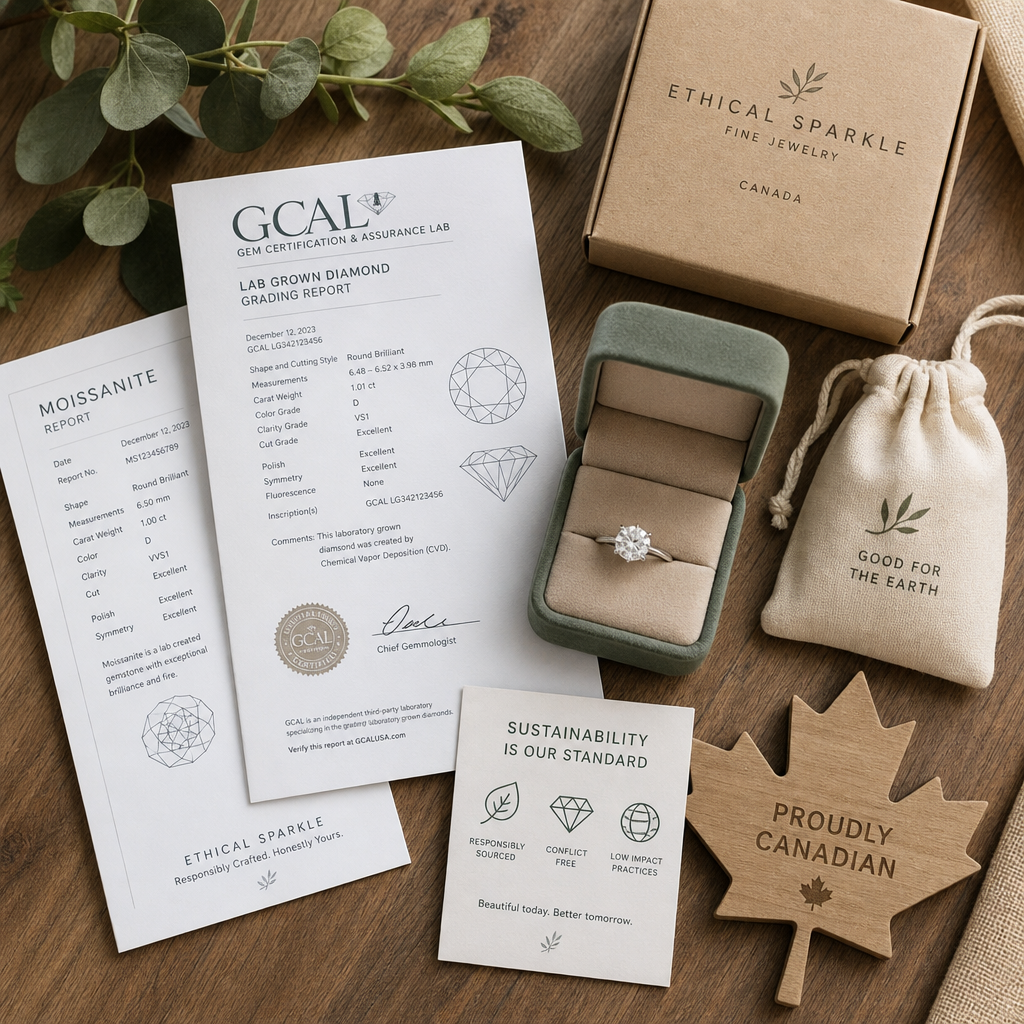
When a customer buys a lab diamond from Livia Diamonds, the stone comes with IGI or GIA certification documenting its laboratory origin, cut grade, color grade, and clarity. There is no supply chain ambiguity because the origin is a manufacturing facility with a known address, not a mine in a jurisdiction with inconsistent oversight.
Moissanite from reputable brands is similarly traceable back to a specific production facility. For couples who want to be able to answer the question "where did this stone come from?" with a clear, verified answer, lab-created stones are the only category that delivers that reliably.
Pro tip: Ask any retailer for the stone's origin documentation, not just a conflict-free declaration. If they cannot provide a lab certification or a specific facility origin for a lab-grown stone, that is a red flag worth taking seriously before you commit.
Buying Ethical Jewelry in Canada: What to Look For
Shopping for an ethical engagement ring in Canada comes with a specific set of considerations that differ from the US market. Import regulations, pricing in Canadian dollars, and the availability of in-person consultation all factor into making a confident decision.
What Differentiates Livia Diamonds from Other Online Retailers
Retailers like Blue Nile and Vrai operate primarily as online platforms that allow customers to build rings from a large inventory. This model works well for buyers who know exactly what they want and are comfortable making a significant purchase without handling the stone. However, it removes the expertise layer that matters when choosing between stone cuts, band metals, or understanding how different carat weights look on different hand sizes.
Livia Diamonds operates differently. As a Toronto-based, family-run retailer with over 20 years of direct experience in engagement jewelry, they offer both in-person and virtual consultations. A customer can sit with an expert, view actual stones, and understand what they are getting before anything is ordered. KimberFire, another Toronto competitor, focuses primarily on Canadian mined diamonds, which means their ethical differentiation rests on "better than average mining" rather than eliminating mining entirely.
Flexible Payment and Free Returns: Reducing the Risk
One reason couples hesitate on ethical alternatives is the perception that unfamiliar stone types carry higher purchase risk. Livia Diamonds addresses this with free shipping and returns across Canada, plus flexible payment plans that make higher-quality pieces accessible without requiring the full amount upfront.
This matters specifically for the Livia customer base, couples who are making one of their largest discretionary purchases and want both quality assurance and financial flexibility. The combination of ethical sourcing, custom design options, and risk-free purchasing removes nearly every objection that kept couples defaulting to conventional diamond retailers.
Frequently Asked Questions
Is a lab-grown diamond a real diamond?
Yes. A lab-grown diamond is chemically, physically, and optically identical to a mined diamond. Both are composed of carbon atoms arranged in a crystal lattice structure. The only difference is origin. A gemologist cannot distinguish them without specialized equipment, and major grading labs like GIA and IGI certify lab-grown diamonds using the same criteria applied to mined stones.
Does moissanite look fake?
No, but it does look different from diamond in certain lighting conditions. Moissanite produces more fire (rainbow sparkle) than diamond due to its higher refractive index. Most people find this visually stunning rather than suspicious. The perception of moissanite as "fake-looking" typically comes from low-quality older stones. Premium moissanite sold through retailers like Livia Diamonds is visually impressive and routinely mistaken for high-quality diamond by people who are not actively testing it.
How do I know my ring is actually ethically sourced?
Ask for documentation. A lab-grown diamond should come with an IGI or GIA laboratory certificate that states its lab-grown origin. Moissanite should come with brand or retailer certification identifying it as lab-created silicon carbide. If a retailer cannot produce paperwork confirming the stone's origin, the ethical claim is unverified. Livia Diamonds provides this documentation as standard practice, not as an add-on request.
Will a lab diamond or moissanite hold its value?
Neither lab diamonds nor moissanite hold resale value well, but neither do mined diamonds. The common belief that mined diamonds hold value is largely a marketing construction. The resale market for any diamond, mined or lab-grown, returns 20-40 cents on the dollar in most cases. Couples who prioritize resale value should understand this is a limitation of the diamond category broadly, not specific to ethical alternatives. If the goal is long-term financial value, precious metals and rare colored gemstones historically outperform colorless diamonds in resale.
Can I get a custom-designed ethical engagement ring?
Yes. Livia Diamonds specializes in custom engagement ring design using both lab-grown diamonds and moissanite. You can choose the stone cut, band style, metal type, and ring size, and have the piece handcrafted to your specifications. Custom design is available through both in-person consultations at their Toronto office and virtual consultations for customers across Canada.
How does moissanite compare to lab diamond on durability?
Both stones are highly durable for everyday wear. Diamond scores 10 on the Mohs hardness scale, the highest rating possible. Moissanite scores 9.25, which is harder than sapphire, ruby, or any other commonly used gemstone. In practice, both are excellent choices for rings worn daily over decades. Neither requires more care than standard fine jewelry maintenance, including regular cleaning and annual professional inspection of the setting.
Are there Canadian-specific advantages to buying from Livia Diamonds?
Several. Livia Diamonds is based in Toronto and serves Canadian customers directly, which means pricing is transparent in Canadian dollars, shipping and returns are free within Canada, and consultations can be done in person without crossing a border. Buying from large US-based competitors like Blue Nile means dealing with currency conversion, potential customs duties, and the absence of local expertise. For Canadian couples, a local retailer with 20-plus years of experience and a physical consultation option is a materially better buying environment.
Have you already chosen between lab diamond and moissanite for your ring, or are you still weighing the options? Share what is shaping your decision in the comments. Your experience might help another couple in exactly the same position.