
Men's Wedding Bands Canada: Styles, Metals & Modern Picks
Most grooms spend under two hours choosing their wedding band, compared to the weeks their partner devotes to finding the perfect engagement ring. That imbalance leads to regret. Men's wedding bands Canada shoppers search for have evolved significantly, with more options in metal, width, finish, and stone inlay than at any previous point in jewellery history. At Livia Diamonds, we work directly with grooms every week through in-person and virtual consultations, and the confusion is consistent: too many choices, too little guidance, and almost no one explaining the practical differences between a tungsten carbide and a 14K gold band in plain language. This guide fixes that.
Table of Contents
- Quick Takeaways
- Understanding Men's Ring Styles
- Metal Options for Men's Wedding Bands
- Men's Gold Wedding Band: What You Need to Know
- Modern Choices: Alternative Metals and Stone Inlays
- Metal Comparison Table
- Sizing, Fit Styles, and Comfort Considerations
- How Livia Diamonds Approaches Men's Bands
- Frequently Asked Questions
- References
Quick Takeaways
Key Insight |
Explanation |
|---|---|
Metal hardness matters more than you think |
Tungsten and cobalt chrome resist scratching well, but they cannot be resized. Gold and platinum can be adjusted as your finger changes over decades. |
Width affects daily comfort significantly |
Bands over 8mm feel noticeably heavier on active hands. Most men with average finger widths find 6mm to 7mm the most wearable long-term choice. |
Finish type determines how the band ages |
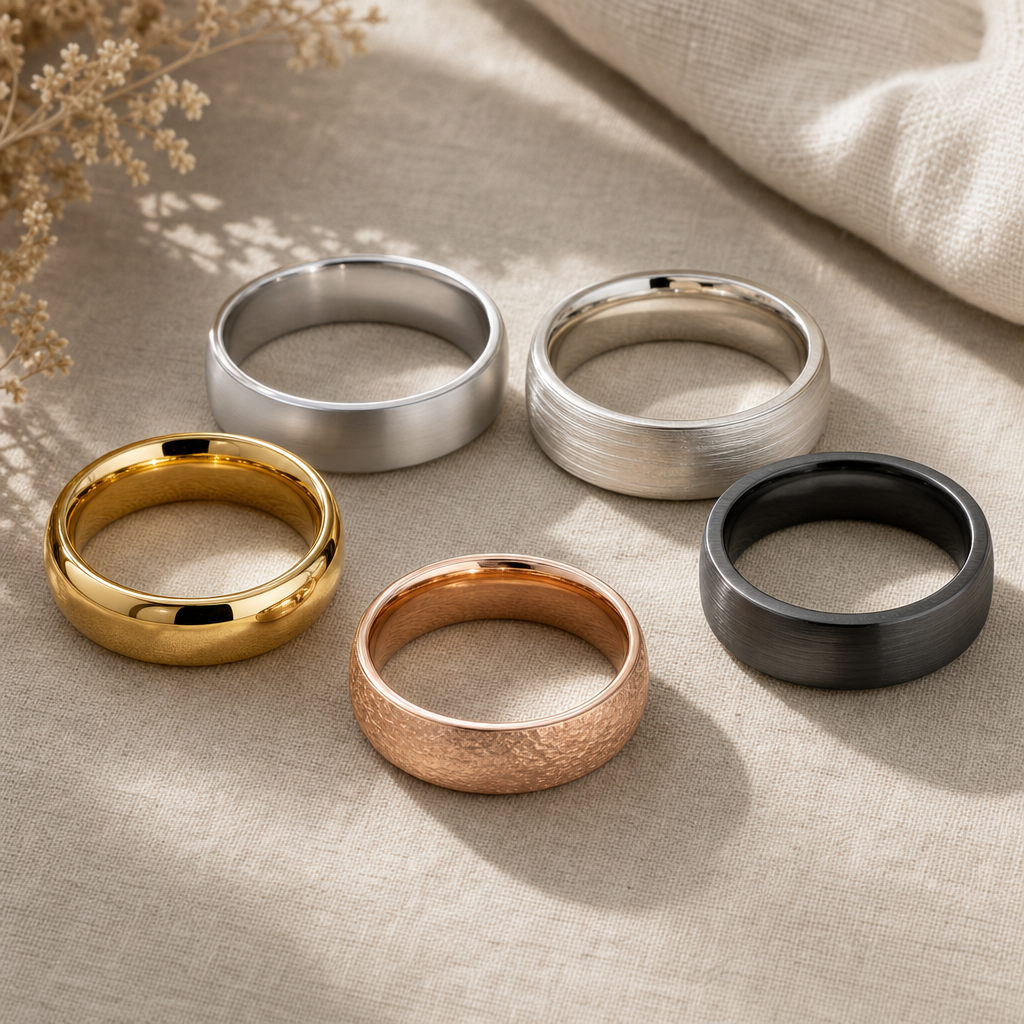
A matte or brushed finish hides everyday surface scratches. A high-polish band will show fine scratches within months of regular wear. |
Lab-created diamonds and moissanite are practical band stone options |
Stone-inlaid men's bands featuring lab diamonds or moissanite offer visual impact at a fraction of natural diamond pricing, with identical optical properties. |
14K gold outperforms 18K for daily-wear bands |
Higher gold purity means softer metal. For a band worn daily under physical conditions, 14K gold holds its shape and surface better over time. |
Custom sizing is non-negotiable for comfort fits |
Comfort-fit interiors require accurate sizing since they measure differently than standard flat-interior bands. Always size with a jeweller, not a plastic ring sizer. |
Canadian buyers should confirm duty-free domestic sourcing |
Purchasing men's wedding bands Canada retailers stock locally avoids cross-border duties and simplifies returns, which matters for a purchase you may need to exchange. |
Understanding Men's Ring Styles
Men's ring styles break down into four primary categories: classic flat bands, comfort-fit domed bands, grooved or ridged bands, and inlaid bands featuring stones or alternative materials. Each serves a different lifestyle and aesthetic, and the wrong category for a person's daily routine will lead to dissatisfaction within the first year of wear.
Classic flat bands are exactly what they sound like. The exterior profile is flat and the interior is also flat. They have a clean, minimalist appearance and are the easiest to engrave on the inside. The downside is that a flat interior can feel tight or create a tourniquet effect on fingers that swell during physical activity or warmer months.
Comfort-fit bands solve that problem. The interior is domed, so the ring slides over the knuckle easily and sits loosely enough not to constrict. In practice, men who work with their hands, travel frequently, or live in climates with significant temperature variation find comfort-fit designs dramatically more liveable. Toronto's seasonal swings make this a genuine consideration for Canadian buyers.
Grooved and Ridged Bands
Grooved bands add a horizontal channel or raised ridge across the exterior of the band. This is a popular men's ring style for grooms who want something with more visual texture than a plain band but less ornamentation than a stone-inlaid piece. The groove breaks up the surface and gives the ring a two-tone appearance when the inner channel is finished differently from the outer surface.
Ridged bands, sometimes called step-edge or bevelled-edge rings, have angled edges rather than rounded ones. The angular profile photographs well and pairs naturally with contemporary suit aesthetics. A common mistake is choosing a ridged band without considering how the sharp edges feel against adjacent fingers. Most wearers adapt within weeks, but it is worth handling one in person before committing.
Inlaid and Stone-Set Bands
Inlaid bands embed a secondary material into a channel in the band's exterior. Common inlay materials include carbon fibre, wood, antler, and meteorite for alternative styles, or diamonds and moissanite for stone-set versions. Stone-set men's bands at Livia Diamonds typically feature a row of channel-set or flush-set lab-created diamonds or moissanite stones running across the top or around the full circumference of the band.
Pro tip: If you are ordering a stone-inlaid band online, always confirm the stone setting type. Channel-set stones are protected on both sides by metal walls and are far more secure for active lifestyles than prong-set stones, which can snag and loosen.
Metal Options for Men's Wedding Bands
The metal you choose for a wedding band for men determines durability, maintenance requirements, resizability, and long-term cost. There is no universally correct answer, but there are wrong answers for specific lifestyles, and most jewellers do not spend enough time explaining those differences upfront.
Platinum
Platinum is the premium option. It is dense, naturally white, and does not require rhodium plating to maintain its colour the way white gold does. Platinum does develop a patina over time, a soft matte sheen that many wearers find appealing. It is hypoallergenic, which matters for men with sensitive skin. The major drawback is price. Platinum bands typically cost 40 to 60 percent more than equivalent white gold bands, and the weight difference is perceptible, with platinum rings feeling noticeably heavier on the hand.
Tungsten Carbide
Tungsten carbide is the most scratch-resistant metal commonly used in wedding bands. It rates between 8.5 and 9.5 on the Mohs hardness scale, compared to platinum at 4 to 4.5. For men in trades, construction, or any field involving tool use, tungsten's surface durability is a genuine advantage. The critical limitation is that tungsten bands cannot be resized and cannot be cut off in a medical emergency using standard ring cutters. Emergency removal requires vice-grip-style cracking, which is possible but not universally available at every emergency room.
Cobalt Chrome
Cobalt chrome occupies a middle ground that often gets overlooked. It is harder than gold but lighter and more workable than tungsten. It can be polished to a very bright white finish and holds that finish well. Unlike tungsten, cobalt chrome can be cut off in emergencies. It is also hypoallergenic. The data consistently shows cobalt chrome as one of the fastest-growing men's band metals in Canada, particularly among buyers who want a white metal look without the platinum price point.
Men's Gold Wedding Band: What You Need to Know
Gold remains the most requested metal for men's wedding bands, full stop. The question is not whether to choose gold but which karat and colour best suits the buyer's lifestyle and taste. Getting this decision wrong is expensive because reworking a gold band after the fact involves melting, remaking, and full reproduction costs.
Karat Choices: 10K vs 14K vs 18K
14K gold is the recommendation for most daily-wear men's wedding bands. It contains 58.3 percent pure gold mixed with alloy metals for hardness, which gives it a durable surface that resists denting and scratching better than 18K. It is also more affordable than 18K while retaining a rich gold colour. 10K gold is even harder and cheaper but has a slightly paler colour that some buyers find less appealing. 18K gold is softer, more vibrant in colour, and more prestigious from a purity standpoint, but it shows wear faster under daily use.
In practice, men who work desk jobs or are light on their hands may never notice the softness difference between 14K and 18K. Men in physical professions will see scratches and dings on 18K gold within the first few months of wear.
Gold Colour Options
Yellow gold reads as traditional and warm. Rose gold has grown substantially in popularity for men's bands over the past decade, and there is nothing unconventional about it in the current market. White gold achieves its colour through rhodium plating over a pale yellow alloy. The plating wears off over time, typically requiring replating every one to three years depending on wear conditions. This is a maintenance cost and time commitment that buyers should factor into their decision before choosing white gold over platinum or cobalt chrome.
"The wedding ring is the world's smallest handcuff, but the metal it is made from determines how comfortable it is to wear for the next fifty years." - Anonymous jewellery industry axiom, widely attributed to independent goldsmiths in trade education contexts.
Pro tip: If you are buying a matching set where the engagement ring is rose gold, consider ordering the men's band in the same alloy family. A men's gold wedding band in rose gold pairs visually without being overly matchy, and it avoids the mixed-metal look that some couples find jarring in wedding photos.
Modern Choices: Alternative Metals and Stone Inlays
The modern men's band market extends well beyond gold and platinum. Alternative metals and mixed-material designs now represent a significant portion of the wedding band for men category, particularly among buyers under 40.
Titanium Bands
Titanium is lightweight, exceptionally strong, and naturally grey. It is an ideal choice for men who find traditional metal bands uncomfortable due to weight. Titanium is also one of the most biocompatible metals available, making it the default recommendation for wearers with known metal sensitivities. The limitation is the same as tungsten: resizing is not possible, so accurate sizing before ordering is essential.
Carbon Fibre and Mixed-Material Inlays
Carbon fibre inlaid into tungsten or titanium creates a visually distinctive band with a high-tech aesthetic. These are particularly popular with men in engineering, automotive, and design fields who appreciate material-forward aesthetics. The inlay sits in a recessed channel and is extremely durable. However, if the inlay is ever damaged, the entire band typically needs to be replaced rather than repaired.
Lab-Created Diamond and Moissanite Inlays
Stone-set men's bands are no longer a niche product. At Livia Diamonds, we have seen consistent growth in demand for men's bands featuring channel-set lab-created diamonds and moissanite. These stones are chemically and visually identical to mined diamonds, with moissanite offering even higher refractive brilliance. A five-stone channel-set moissanite band in 14K yellow gold delivers a striking look at a price point that is typically 60 to 80 percent below what an equivalent mined diamond band would cost.
For couples already choosing moissanite or lab-created diamond engagement rings from Livia Diamonds, matching the men's band material to the engagement ring stone type creates visual and sentimental consistency across the set.
Metal Comparison Table
Choosing between metals comes down to four variables: hardness, resizability, maintenance, and price. This table covers the metals most commonly chosen for men's wedding bands Canada buyers request at Livia Diamonds.
Metal |
Key Strengths |
Key Limitations |
|---|---|---|
14K Yellow Gold |
Resizable, warm classic look, durable alloy, widely available in Canada |
Softer than alternative metals, can scratch with heavy use |
Platinum |
Hypoallergenic, naturally white, develops desirable patina, resizable |
Significantly more expensive, heavier than gold, requires professional polishing |
Tungsten Carbide |
Extremely scratch-resistant, low maintenance, affordable |
Cannot be resized, difficult emergency removal, brittle under sharp impact |
Cobalt Chrome |
Hypoallergenic, bright white finish, harder than gold, emergency cuttable |
Limited customisation options, less widely known, fewer local retailers carry it |
Titanium |
Lightest option, extremely biocompatible, strong and corrosion-resistant |
Cannot be resized, limited engraving options, grey tone not universally preferred |
Sizing, Fit Styles, and Comfort Considerations
Sizing a men's wedding band correctly is more complicated than most buyers expect, and this is where a significant percentage of online orders go wrong. Finger size varies across the day, across the year, and across decades of a person's life. A ring sized in the morning before physical activity may feel tight by early evening.
Comfort Fit vs Standard Fit
Standard fit bands have a flat interior. Comfort fit bands have a domed or curved interior. Comfort fit rings are typically sized half a size smaller than standard fit because the domed interior reduces the effective inner circumference. If you are ordering a comfort fit band based on a standard fit ring size you already know, you will likely need to adjust down by half a size. Livia Diamonds' consultation process covers this step explicitly, either in-person at the Toronto office or during a virtual appointment.
Band Width and Finger Proportions
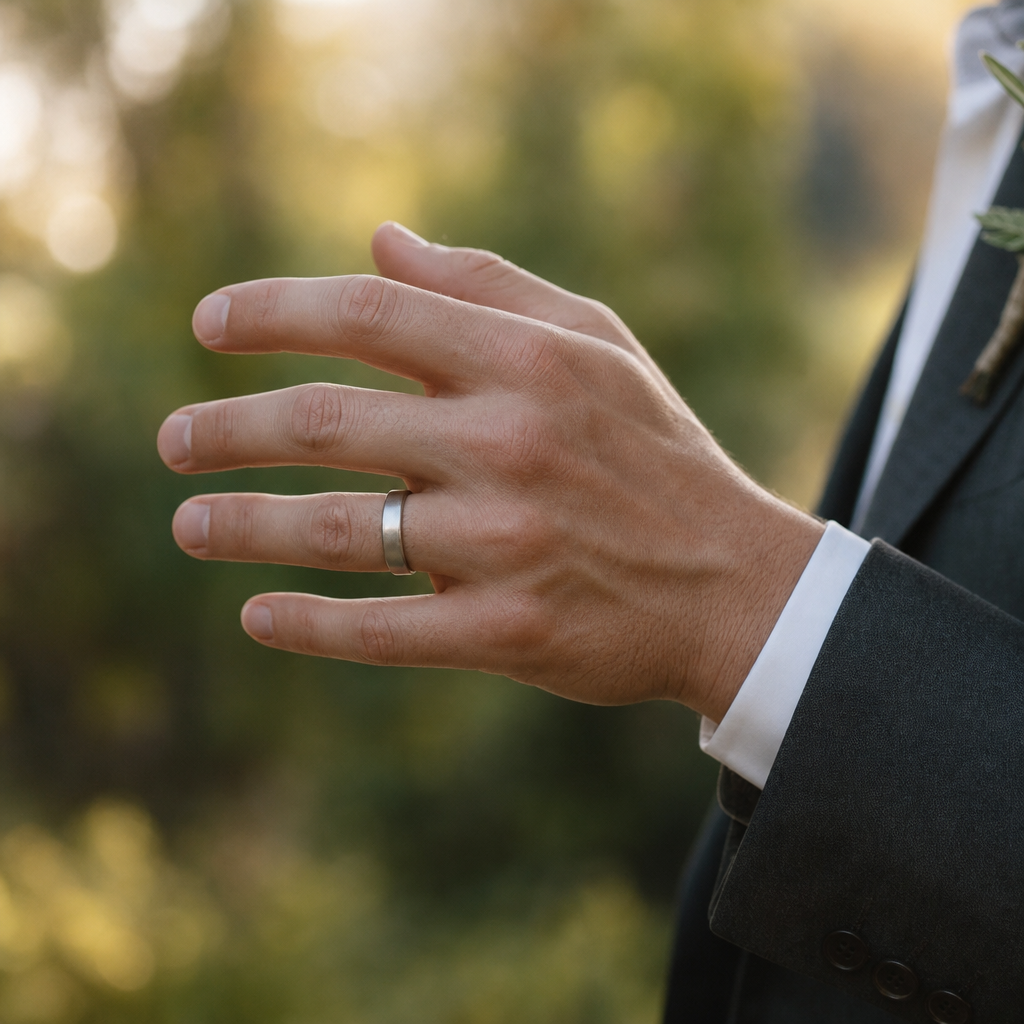
Band width should scale with finger size. A general guideline used across the industry: fingers with a knuckle circumference above 63mm look proportional with bands from 7mm to 10mm wide. Average-width fingers sit best with 5mm to 7mm. Narrow fingers often look most balanced with 4mm to 5mm bands. Going too wide creates a visual block effect that can make the hand look shorter. Going too narrow on a large hand looks delicate in a way that most grooms do not intend.
The best way to confirm is to handle physical samples. Livia Diamonds provides sizing kits and in-person consultations precisely because digital shopping cannot replicate the experience of wearing different widths back to back on your actual hand.
How Livia Diamonds Approaches Men's Bands
Livia Diamonds has been a Toronto-based family-run business for over 20 years, and that timeline means the team has fitted wedding bands on grooms across every trend cycle that has come through the Canadian market. What differentiates the experience here from competitors like Blue Nile or VRAI is the combination of handcrafted production and personal consultation access.
Blue Nile offers a wide selection but operates as a purely digital storefront with limited human consultation at the ring-selection stage. VRAI focuses almost exclusively on lab-grown diamond solitaires and does not specialize in the metal variety and alternative stone options that characterize Livia Diamonds' catalogue. Kimberfire is a Canadian competitor but operates primarily in the engagement ring segment and does not carry the breadth of men's band styles available at Livia Diamonds.
The custom design service at Livia Diamonds means that if a groom wants a specific combination, such as a 6mm rose gold comfort-fit band with flush-set moissanite along the exterior ridge, that can be produced as a custom piece rather than forcing a compromise with stock inventory. Free shipping and free returns across Canada reduce the risk of ordering a band that does not fit perfectly on the first attempt.
Payment plan options also matter in this category. A platinum or stone-set band can reach price points that strain short-term cash flow during wedding planning. Flexible payment plans allow couples to allocate budget toward the right piece rather than compromising on metal or design to stay within an immediate payment limit.
Frequently Asked Questions
What is the most durable metal for a men's wedding band in Canada?
Tungsten carbide is the hardest and most scratch-resistant metal available for wedding bands, scoring 8.5 to 9.5 on the Mohs hardness scale. However, durability has trade-offs. Tungsten cannot be resized and is brittle under sharp lateral impact, meaning it can crack if struck hard against a solid surface. For most men who want a durable but more versatile option, 14K gold or cobalt chrome is a better practical choice.
Can a men's gold wedding band be resized later?
Yes, gold wedding bands, whether yellow, white, or rose gold, can be resized by a qualified jeweller. This is one of gold's most practical long-term advantages over alternative metals like tungsten and titanium. Most jewellers can resize a plain gold band by one to two sizes in either direction. Stone-inlaid bands are more complex to resize and sometimes require resetting stones, which adds cost and turnaround time.
What width of men's wedding band is most popular?
The 6mm width is consistently the most requested size across the men's wedding band category in North America. It is wide enough to be visually present on the hand without feeling heavy or restrictive. That said, grooms with larger hands often prefer 7mm or 8mm for better proportionality, and men with slim fingers often find 4mm or 5mm more comfortable and better-looking.
Is moissanite a good stone for a men's wedding band?
Moissanite is an excellent choice for men's stone-set bands. It rates 9.25 on the Mohs hardness scale, second only to diamonds, making it highly resistant to scratching and chipping under daily wear. Its refractive index is higher than a diamond's, which means it produces more brilliance and fire. Channel-set moissanite in a men's band is a practical, visually striking option that costs significantly less than a comparable mined diamond band.
How do I choose between a matte and polished finish for a men's band?
Choose a matte or brushed finish if you work with your hands, do not want to maintain your ring frequently, or prefer an understated look. Matte finishes absorb surface scratches and continue to look intentional even as the metal ages. Choose a high-polish finish if you want maximum visual impact, work in an office or low-abrasion environment, and are comfortable with occasional professional polishing every year or two. Some men's bands combine both finishes, with a polished centre channel and matte edges, which is a good compromise if you cannot decide.
What is the average cost of a men's wedding band in Canada?
Prices vary widely by metal and design. A plain tungsten or titanium band starts around CAD $100 to $300. A plain 14K gold band in a standard width typically ranges from CAD $500 to $1,200 depending on gram weight. Platinum bands for men generally start around CAD $1,500 and increase with width and weight. Stone-set bands featuring lab-created diamonds or moissanite range from CAD $800 to several thousand dollars depending on stone count and metal. Flexible payment plans, like those offered at Livia Diamonds, make higher-end options accessible without requiring full upfront payment.
Do men's wedding bands need to match the engagement ring?
No, they do not need to match, and forcing an exact match often produces a less interesting result than choosing complementary pieces. The most successful approach is to harmonize metal colour and finish style rather than replicate the exact design. A men's yellow gold band pairs naturally with a yellow gold engagement ring without needing the same profile or texture. Many couples choose contrasting textures deliberately, such as a matte men's band alongside a high-polish engagement ring, and the visual contrast reads as intentional and sophisticated rather than mismatched.
We want to hear from you. If you have questions about specific metal combinations, comfort fit sizing for an unusual finger shape, or matching a men's band to an existing Livia Diamonds engagement ring, leave your question below and our team will respond directly.
We would love your feedback and any insights you would share with others. What perspective would you add?