
Wedding Band Styles to Pair with Moissanite Rings
Choosing wedding bands in Canada feels straightforward until you are standing in front of a dozen options and your moissanite engagement ring suddenly looks wrong with half of them. The pairing is not just aesthetic. It affects how the stones catch light, how the metals age together, and how comfortable the stack feels on your finger for the next fifty years. At Livia Diamonds, after more than 20 years of helping Toronto couples navigate this exact decision, the verdict is clear: most people spend 80% of their budget on the engagement ring and almost no time thinking about the band that will sit beside it every single day.
Table of Contents
- Quick Takeaways
- Why Moissanite Pairing Is Different from Diamond Pairing
- Metal Matching: The Decision That Affects Everything Else
- Band Profile Styles That Work Best with Moissanite Settings
- Curved vs. Straight Bands: Which Actually Fits Better
- Stone-Set Wedding Bands Next to Moissanite
- Side-by-Side: Three Pairing Approaches Compared
- Common Pairing Mistakes and How to Avoid Them
- Shopping for Wedding Bands in Canada: What to Expect
- Frequently Asked Questions
- References
Quick Takeaways
Key Insight |
Explanation |
|---|---|
Match your metal colour, not just the type |
A yellow gold band next to a white gold moissanite setting will look mismatched even if both are 14k. Stick to the same tone unless you are intentionally mixing metals for a stacked look. |
Moissanite fires more light than diamond |
Moissanite has a refractive index of 2.65 versus 2.42 for diamond. A heavily pavé band can visually compete with and distract from your centre stone. Simpler bands often read as more elegant. |
Curved contour bands reduce gap issues |
Solitaire and halo moissanite rings often have wide bases. A straight band will sit away from the setting and create a visible gap. A curved band is fitted to eliminate this entirely. |
Stack height matters for wearability |
Two bands plus an engagement ring can create a stack over 8mm tall. This limits finger movement and becomes uncomfortable for people who work with their hands. |
Eternity bands have sizing limitations |
A full eternity moissanite wedding band cannot be resized after purchase because the stones wrap the entire band. Choose this style only if your ring size is stable. |
Half-eternity bands offer the best balance |
Half-eternity bands place stones on the top half only, allowing for resizing and keeping the overall stack lighter without sacrificing sparkle. |
Custom fitting is not expensive at Canadian independents |
At independent Canadian jewellers like Livia Diamonds, custom contour fitting for a wedding band typically adds minimal cost compared to buying a pre-made band that never truly fits your ring. |
Why Moissanite Pairing Is Different from Diamond Pairing
Moissanite is not a diamond substitute. It is a distinct gemstone with its own optical properties, and those properties change what works next to it. The most important difference is dispersion, which is the fire or rainbow light that a stone throws off. Moissanite has a dispersion of 0.104, compared to diamond at 0.044. That is more than double the fire.
In practice, this means a moissanite engagement ring already creates a lot of visual energy on its own. Pairing it with a band that also has significant sparkle, like a full pavé eternity band in a micro-setting, can make the whole combination look busy rather than brilliant. The goal is to complement the centre stone, not compete with it.
This is where many online guides go wrong. Articles written about diamond ring pairings do not account for moissanite's higher fire. Advice that works for a diamond solitaire does not automatically transfer. The band selection process for a moissanite ring requires its own framework built around the stone's unique character.
Metal Matching: The Decision That Affects Everything Else
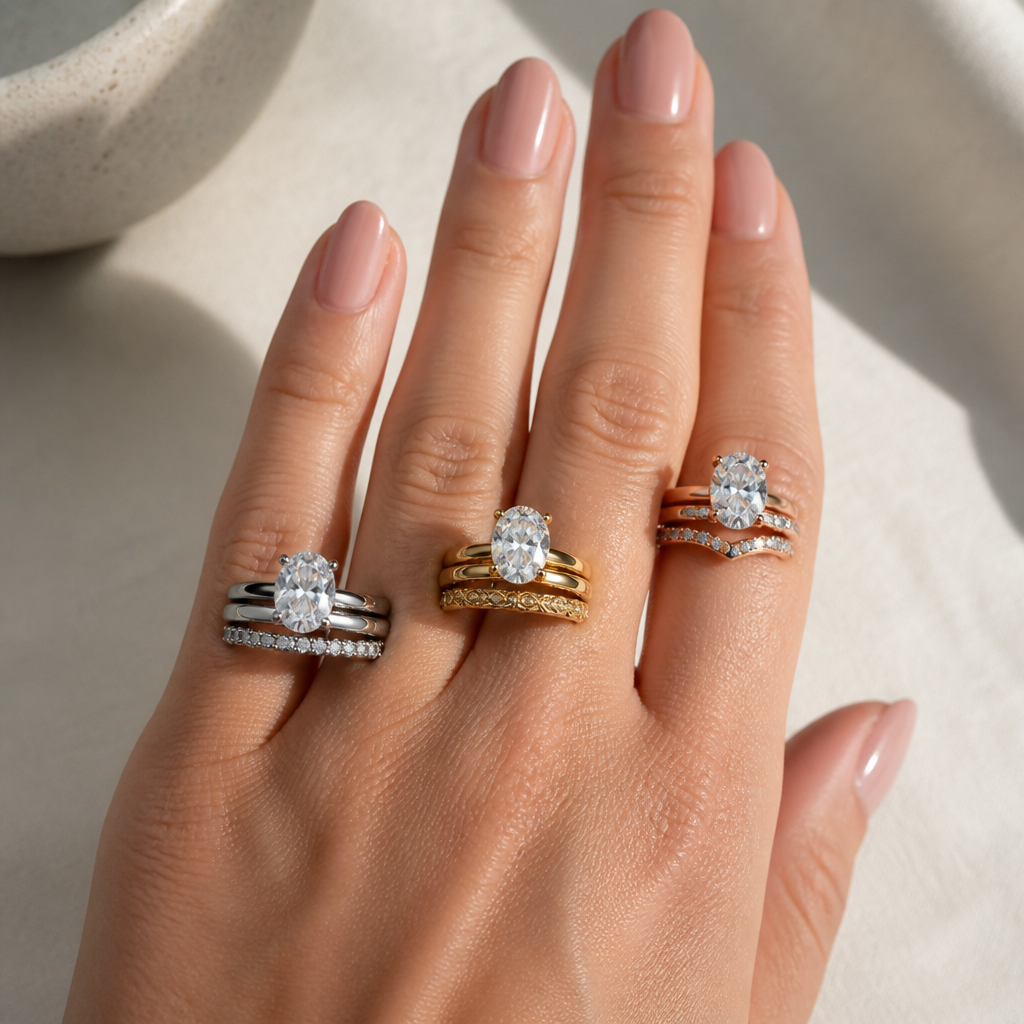
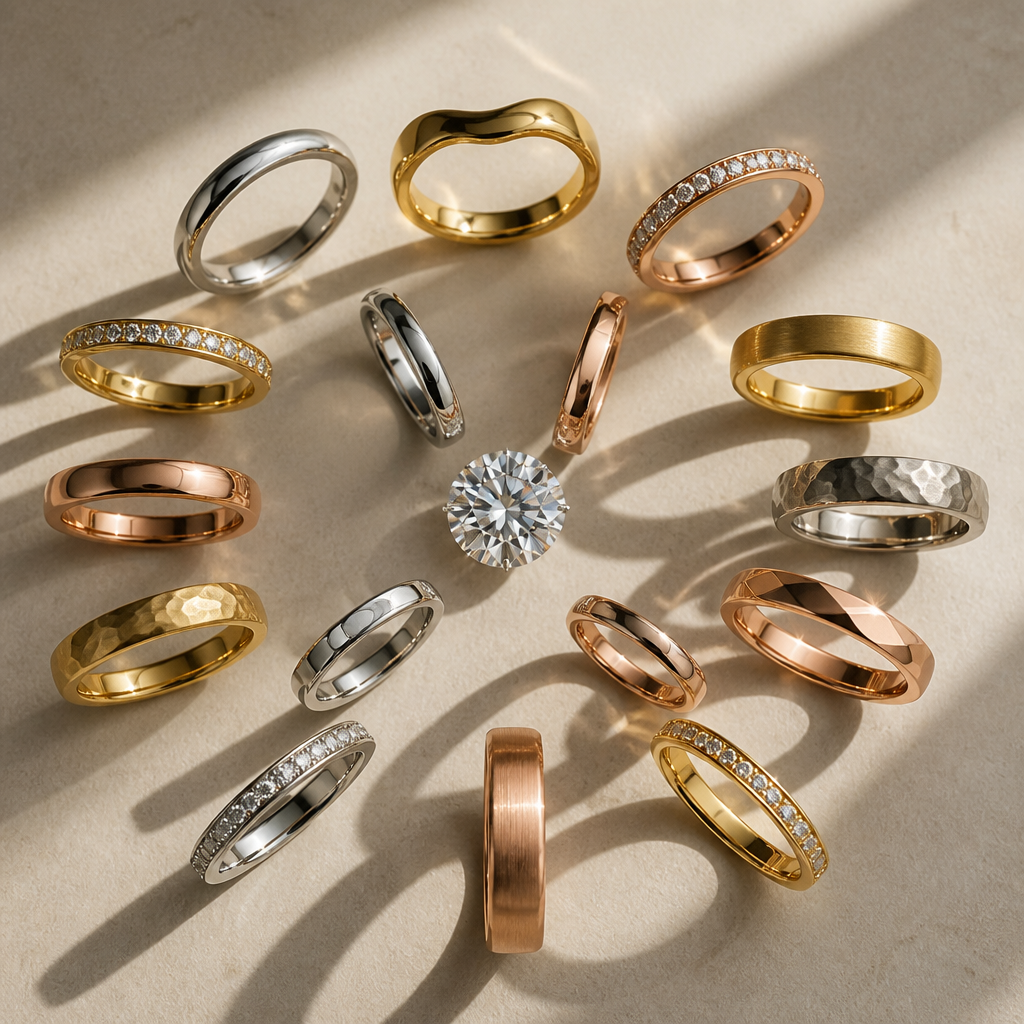
Before you consider any band profile or stone setting, you need to lock in the metal. Getting this wrong is the most common and most visible mistake couples make. A mismatched metal combination does not look intentional or modern. It just looks like you bought the rings separately without coordinating.
White Gold and Platinum
White gold is the most popular choice for moissanite engagement rings in Canada because it maximizes the stone's colourless appearance. If your engagement ring is 14k or 18k white gold, match the wedding band to the same karat. Platinum is whiter and harder, and while it looks almost identical to white gold initially, the two metals age differently. Platinum develops a patina over time while white gold maintains its bright finish through rhodium plating. If you mix them, the colour difference becomes obvious within a few years.
Yellow Gold and Rose Gold
Yellow gold moissanite rings are having a genuine resurgence among Canadian couples. A yellow gold wedding band against a yellow gold moissanite setting looks rich and intentional. Rose gold follows the same logic: match the tone, match the karat where possible. The warmth of rose gold actually flatters moissanite's near-colourless body by creating contrast that makes the stone appear brighter by comparison.
Intentional Mixed Metal Stacks
Mixing metals intentionally is a legitimate design choice, but it requires commitment. If you plan to mix, for example a rose gold engagement ring with a white gold band, buy both pieces from the same jeweller at the same time so the combination looks deliberate. Livia Diamonds offers virtual and in-person consultations in Toronto specifically to help couples test these combinations before committing.
Pro tip: If you are unsure about mixing metals, photograph your engagement ring under natural light and bring that photo to your band consultation. Metal tones shift dramatically under jewellery store lighting, and a photo taken outdoors gives you a more accurate reference.
Band Profile Styles That Work Best with Moissanite Settings
The profile of a wedding band is the shape you see when you look at the ring from the side. This affects how the band sits against your engagement ring and how comfortable it feels during daily wear. There are four main profiles worth knowing about.
Flat Bands
Flat bands have a squared-off profile with no curvature on the inner or outer surface. They sit flush against most engagement ring shanks and work particularly well with solitaire moissanite rings that have a simple, clean base. The limitation is that flat bands can look blocky when stacked next to settings with decorative shoulders.
Comfort Fit Bands
Comfort fit bands have a slightly domed inner surface that reduces contact with the finger. They feel noticeably different from standard bands after a full day of wear. For anyone who has never worn rings before getting engaged, a comfort fit band is worth the marginal price difference. The outer profile can still be flat, domed, or knife-edge depending on your preference.
Knife Edge Bands
Knife edge bands taper to a narrow ridge along the top. They read as delicate and modern and pair well with halo and three-stone moissanite settings where the engagement ring itself already has significant width. The narrower visual profile of a knife edge band keeps the overall stack from looking too heavy.
Low Dome Bands
Low dome bands are the traditional choice and the most forgiving in terms of fit. The gentle curve on the outside surface means minor gaps between the engagement ring and band are less obvious. For rings with elevated settings or pronounced side stones, a low dome band is often the safest pairing from a visual standpoint.
Curved vs. Straight Bands: Which Actually Fits Better
The gap problem is real. Many couples buy a straight wedding band and only discover after the wedding that it sits away from their engagement ring with a visible space between the two pieces. This happens because moissanite engagement rings often have wider bases, detailed side settings, or prong work that prevents a straight band from sitting flush.
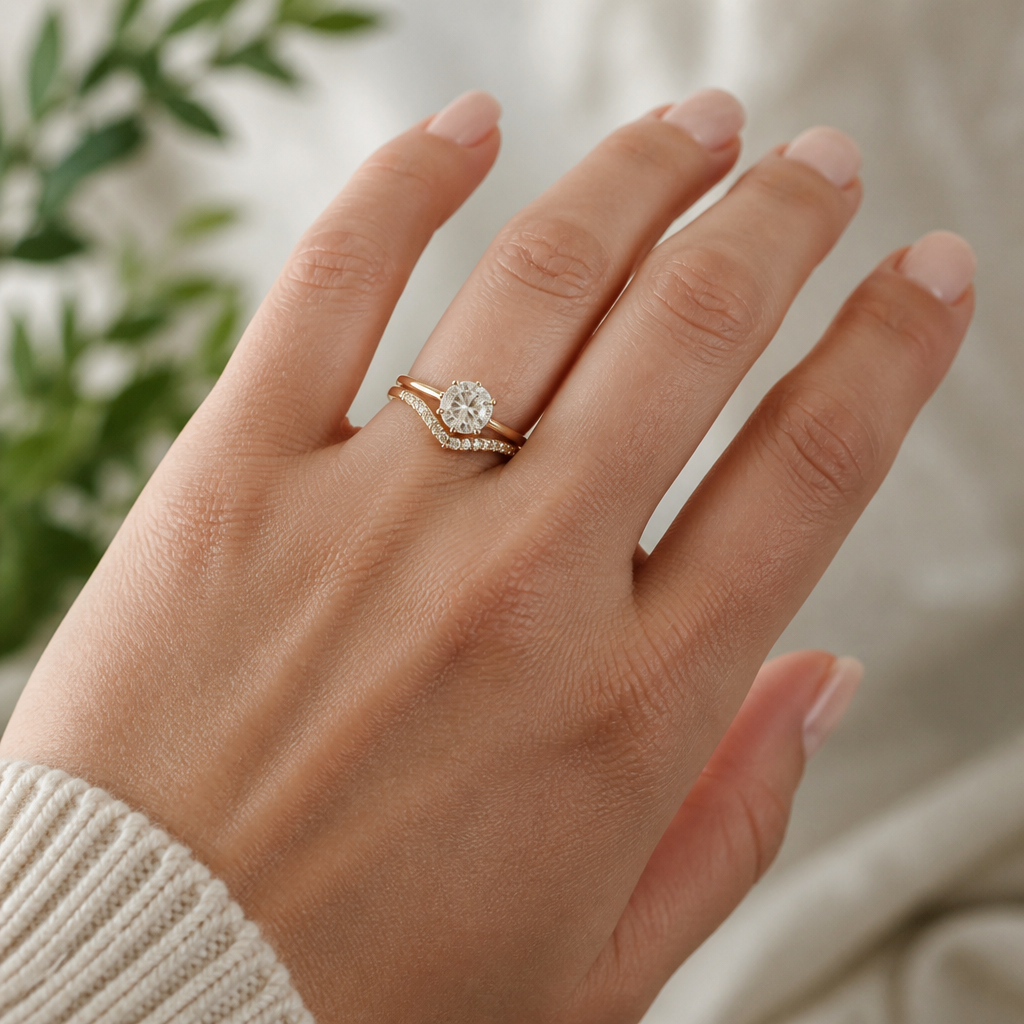
A curved or contour wedding band is specifically shaped to nestle against the engagement ring's profile. The curve corresponds to the base of the engagement ring shank, eliminating the gap entirely. The result is a seamless stack that looks like the rings were designed together, which at Livia Diamonds they often are.
"A wedding band that does not sit flush with the engagement ring is one of the most common complaints we hear from couples who bought their rings from different retailers without coordinating the fit. The fix is a contour band, and it is almost always available as a custom option." - Livia Diamonds design team, Toronto
Straight bands are not the wrong choice universally. They work well with solitaire settings on thin, unadorned shanks, and with east-west stone settings where the elongated centre stone leaves room on either side. The rule is simple: look at the base of your engagement ring shank before choosing band shape, not the top of the stone.
Pro tip: When ordering a contour band, bring your actual engagement ring to the jeweller or ship it to them temporarily. A contour band made without the engagement ring present is fitted to a standard template, not your specific ring, and the gap problem may persist.
Stone-Set Wedding Bands Next to Moissanite
Stone-set wedding bands are the most popular category for moissanite pairings, and for good reason. When the band shares the same stone type as the engagement ring, the whole stack reads as a unified set rather than two separate pieces of jewellery.
Pavé Bands
Pavé bands feature small stones set close together along the band surface with minimal metal visible between them. They add sparkle without height, which makes them an excellent choice for moissanite engagement rings with lower profiles. The key decision is stone size. Micro-pavé with very small stones reads as delicate. Standard pavé with slightly larger stones reads as bolder and more substantial.
Channel-Set Bands
Channel-set bands hold stones in a groove between two metal walls. The stones are protected on the sides, making this the most practical option for people with active lifestyles or jobs where rings take physical wear. Channel-set moissanite wedding bands are also easier to clean than pavé because there are no prongs for dirt to accumulate around.
Bezel-Set Bands
Bezel settings encircle each stone in a metal rim. This setting style gives a modern, minimalist look and provides excellent stone security. Next to a moissanite solitaire, a bezel-set band creates a clean contrast between the contemporary setting and the brilliant centre stone. This combination works particularly well in yellow and rose gold.
Matching Stone Size to Your Engagement Ring
A common mistake is choosing a band with stones that are visually larger than the side stones or pave on the engagement ring. This creates an inverted hierarchy where the eye is drawn to the band first and the centre stone second. Match the stone scale of the band to the secondary stone scale of the engagement ring, not to the centre stone.
Side-by-Side: Three Pairing Approaches Compared
Pairing Approach |
Best For |
Limitations |
|---|---|---|
Plain metal band (flat or comfort fit) |
Solitaire moissanite settings, people who prefer minimal jewellery, partners who work with their hands frequently |
Can look understated if the engagement ring is highly detailed. Offers no sparkle from the band itself. |
Half-eternity pavé moissanite band |
Halo, three-stone, and cathedral settings. Couples who want the wedding band to have visual presence without overwhelming the centre stone. |
Requires careful alignment so pavé section sits on top of the finger. Can shift if not properly fitted to the engagement ring shank. |
Custom curved contour band with channel-set moissanite |
Any engagement ring with a shaped or detailed base. Couples buying both rings from the same jeweller and wanting a guaranteed flush fit. |
Higher upfront design time. Must be made with the engagement ring present for accurate contouring. Not available as a quick off-the-shelf option. |
Common Pairing Mistakes and How to Avoid Them
Most pairing mistakes are not about taste. They are about information gaps that could have been avoided with fifteen minutes of expert guidance. Here are the ones that come up most often when couples arrive at Livia Diamonds having already purchased a band that does not work.
The first mistake is buying the wedding band online without seeing it next to the engagement ring in person. Product photography is shot to make each ring look its best in isolation. That same band may look too wide, too yellow, or too sparkly when placed beside your specific engagement ring. Order samples or arrange a consultation before committing.
The second mistake is matching metal type rather than metal colour. As noted earlier, 14k white gold and platinum are both described as white metals but they are not the same colour in natural light. Verify colour tone from a jeweller who stocks both, not from a website comparison.
The third mistake is choosing a full eternity band without considering future resizing. Fingers change. Pregnancy, temperature fluctuations, and age all affect ring size. A full eternity band cannot be resized because cutting into it removes or damages the continuous stone setting. The half-eternity band solves this problem by keeping the bottom third of the band stone-free.
The fourth mistake is ignoring band width relative to engagement ring width. A 3mm band next to an engagement ring with a 6mm head makes the band look like an afterthought. A 6mm band next to a delicate solitaire overwhelms it. The wedding band width should be within 1mm to 2mm of the engagement ring shank width for visual coherence.
Shopping for Wedding Bands in Canada: What to Expect
The Canadian fine jewellery market is smaller and more service-oriented than the American market, which works in the buyer's favour. Unlike large online-only retailers such as Blue Nile or VRAI, Canadian independents like Livia Diamonds offer the combination of online shopping with the option to book a consultation in Toronto before purchasing. This hybrid model matters specifically for wedding band pairings because the consultation is where the gap and metal-matching issues get caught before they become expensive problems.
Pricing for wedding bands in Canada varies significantly based on metal, stone setting, and whether the band is custom-made or from an existing collection. A plain 14k white gold comfort fit band from a Canadian independent typically starts around $400 to $700 CAD. A half-eternity moissanite band in the same metal starts around $900 to $1,500 CAD depending on total stone weight and carat equivalent. Custom contour bands add design time but are often within the same price range as a comparable pre-made band from a larger retailer.
Livia Diamonds offers free shipping and returns across Canada, which removes the risk from ordering a band to see how it looks at home with your engagement ring. This is worth using. The return window gives you real-world conditions, natural light, and your actual finger to evaluate the pairing rather than a showroom environment.
Flexible payment plans are also available, which is relevant for couples who have already allocated most of their budget to the engagement ring and are now financing the wedding band separately. Confirming the payment terms before you shop prevents the decision from being driven purely by what is available in the cheapest range.
Frequently Asked Questions
Can I wear my moissanite wedding band and engagement ring on the same finger?
Yes, and that is the most common way to wear them. The standard practice is to wear the engagement ring closest to the heart, meaning below the wedding band. Some people reverse this order for comfort or because their wedding band is the piece they want more visible. There is no single correct way, but wearing both on the left ring finger is the tradition followed by most Canadian couples.
Does the wedding band have to be moissanite if the engagement ring is moissanite?
No, but it should be visually compatible. A plain metal band pairs perfectly well with a moissanite engagement ring. The practical advantage of choosing a moissanite wedding band is that the stones will age and maintain their brilliance at a similar rate, keeping the stack looking cohesive over decades of wear. If you mix stone types, choose stones with similar hardness and refractive properties to avoid one piece looking dulled next to the other.
How much should a wedding band cost compared to an engagement ring?
There is no set ratio that applies to every couple, but in practice most people spend between 15% and 30% of what they spent on the engagement ring when buying a wedding band. For a moissanite engagement ring priced at $2,000 CAD, that suggests a wedding band budget of $300 to $600 CAD at the lower end, or up to $1,000 CAD for a stone-set band. At Livia Diamonds, the band and ring can be priced together as a set, which sometimes reduces the combined cost.
What is the difference between a contour band and a curved band?
The terms are often used interchangeably, but there is a technical difference. A curved band has a gentle arc that curves upward to allow the engagement ring to sit beside it without a gap. A contour band is custom-shaped to match the exact profile of a specific engagement ring setting. A contour band is a more precise version of a curved band and requires the engagement ring to be present or measured during production.
Can I buy a wedding band now and add an engagement ring later?
This is more common than most people expect, particularly for couples who get engaged quickly or on a limited budget and plan to upgrade the engagement ring later. If you buy the wedding band first, choose a style that is versatile enough to pair with a range of engagement ring profiles. A simple comfort fit or low dome plain band in your preferred metal is the safest choice in this scenario. Avoid custom contour bands at this stage since a contour band is shaped to a specific ring and will not adapt easily to a different engagement ring later.
Is it normal for my wedding band and engagement ring to fit differently?
Yes, and this is a practical issue that many buyers do not anticipate. Your ring finger is rarely perfectly cylindrical, so two rings worn together may feel tighter or looser than either ring worn alone. Order your wedding band in the same size as your engagement ring and then assess the combined fit. If the stack feels tight, sizing up by half a size on the wedding band is usually sufficient. Livia Diamonds' free return policy makes this adjustment risk-free.
What has your experience been finding a wedding band that genuinely fits your engagement ring? Share what worked for you or what you wish you had known before purchasing.
References
Statista: Consumer spending data on jewellery and wedding purchases in North America
Forbes: Coverage of lab-grown diamond and moissanite jewellery market trends
The Knot: Wedding jewellery planning data and engagement ring and wedding band pairing guidance
WeddingWire Canada: Canadian wedding planning data and jewellery budgeting benchmarks