
Lab-Created Diamonds vs Mined Diamonds: Quality & Value
Most people still assume a mined diamond is automatically the superior choice. That assumption is costing Canadian couples thousands of dollars for no measurable gain in quality. The debate around lab-created diamonds vs mined diamonds is no longer a fringe conversation among budget shoppers. It is a mainstream question being asked by informed buyers who want the best possible stone for their money. At Livia Diamonds, we have spent over 20 years handling both stone types, and the truth is far more nuanced, and far more favorable to lab-grown, than the traditional jewelry industry wants you to believe.
Table of Contents
- Quick Takeaways
- What Actually Makes a Diamond Real
- Lab Grown Diamond Quality: The Hard Facts
- How Mined Diamonds Are Actually Graded
- Price and Value Comparison
- Ethical Diamond Alternatives Canada: Why Origin Matters
- Resale Value: The Honest Picture
- Who Should Choose Which
- Frequently Asked Questions
- References
Quick Takeaways
Key Insight |
Explanation |
|---|---|
Lab diamonds are chemically identical to mined diamonds |
Both score 10 on the Mohs hardness scale and share the same crystal structure, refractive index, and carbon composition. |
Lab-grown diamonds cost 50 to 80 percent less |
A 1-carat lab diamond that would retail for $800 to $1,200 CAD could cost $4,000 to $7,000 CAD as a mined stone of equivalent grade. |
GIA and IGI both certify lab-grown diamonds |
Reputable grading labs apply the same 4C standards to lab stones, so you get a verified quality report either way. |
Mined diamond resale value is also poor |
The resale myth favoring mined stones is largely false. Most mined diamonds resell at 20 to 40 cents on the dollar at retail. |
Ethical sourcing is simpler with lab-grown |
Lab diamonds have a fully traceable supply chain with no conflict-region exposure, making them a clear choice for ethically minded buyers in Canada. |
Moissanite is a third option worth knowing |
Moissanite is not a diamond but offers exceptional brilliance at even lower price points, making it a strong alternative for budget-conscious buyers. |
Custom ring design works well with lab stones |
Because lab diamonds are available in a wider range of cuts and sizes at accessible prices, custom design becomes affordable rather than a luxury. |
What Actually Makes a Diamond Real
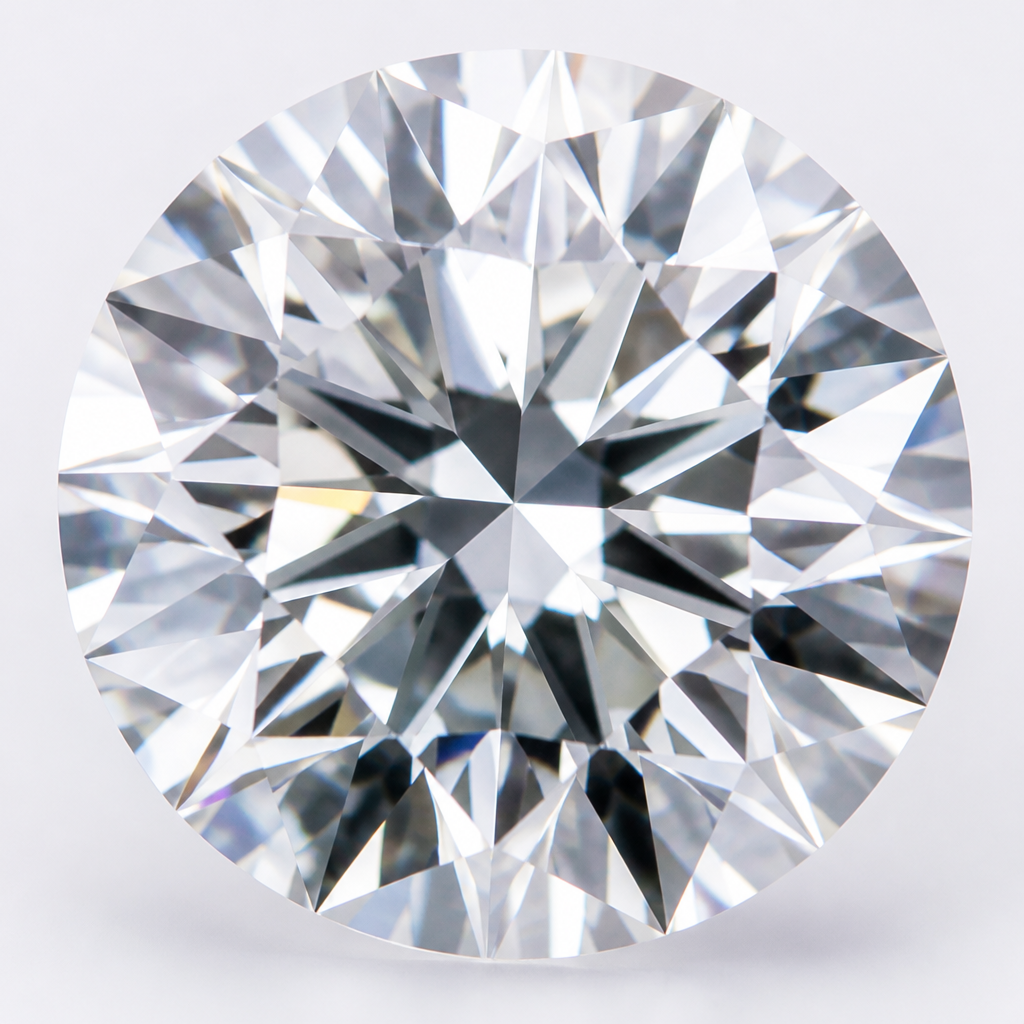
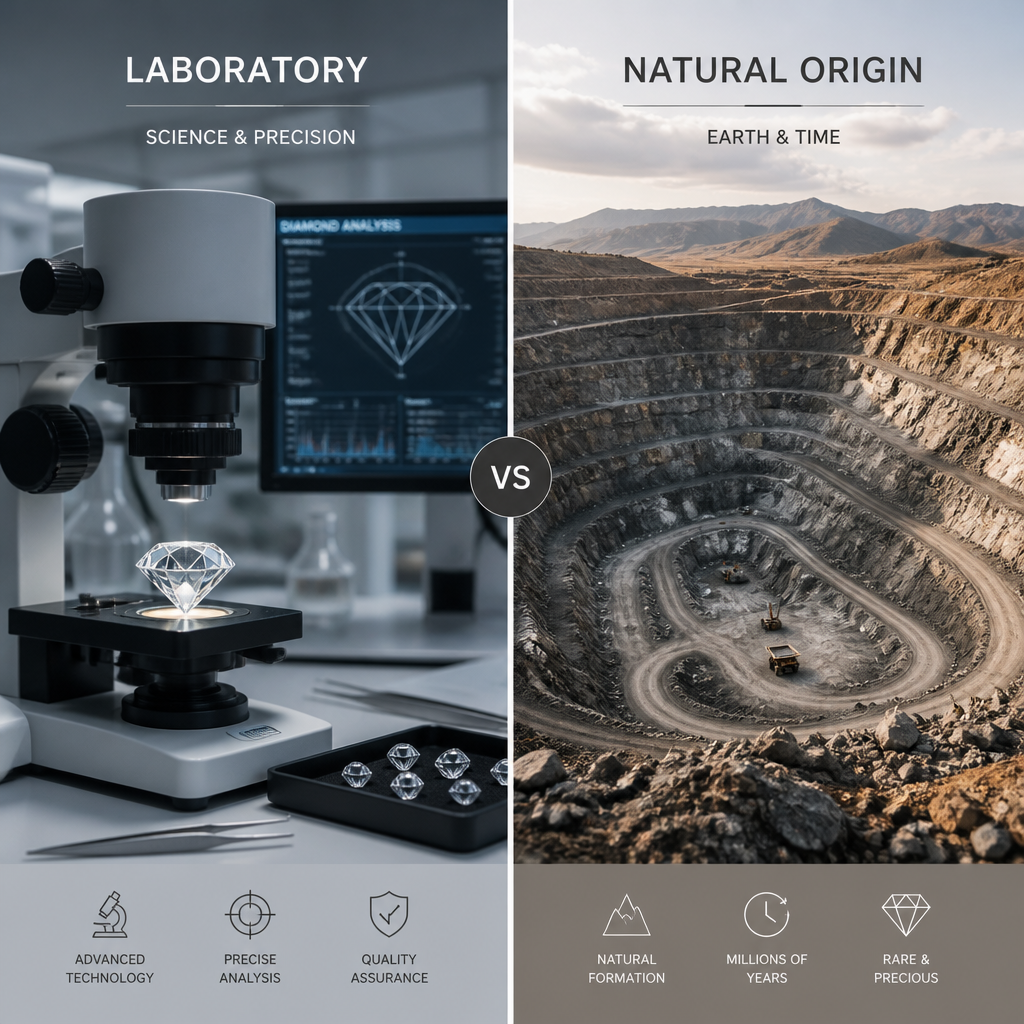
A diamond is defined by its physical and chemical composition, not by where it formed. Both mined and lab-created diamonds are made of pure carbon atoms arranged in a cubic crystal structure. That structure is what gives diamonds their hardness, brilliance, and fire. A gemologist using standard equipment cannot distinguish a lab diamond from a mined diamond without specialized spectroscopy tools.
The Gemological Institute of America confirmed this in its grading reports. When GIA began grading lab-grown stones in 2020, it applied the same 4C methodology used for mined diamonds. There is no asterisk on a lab diamond grading report that says "lesser quality." The stone either meets the grade or it does not, using the same standards across both categories.
The word "synthetic" is often used to imply inferiority, but in gemological terms it simply means human-made origin. By that logic, cultured pearls are synthetic, yet no one questions their value or legitimacy. The same principle applies here.
Lab Grown Diamond Quality: The Hard Facts
Lab grown diamond quality is graded using the exact same 4Cs: cut, color, clarity, and carat weight. The production process, whether HPHT (High Pressure High Temperature) or CVD (Chemical Vapor Deposition), allows manufacturers to control growth conditions more precisely than geological processes allow. In practice, this often results in fewer inclusions in comparable price brackets.
HPHT vs CVD: Which Process Produces Better Stones
HPHT replicates the natural pressure and heat conditions deep in the earth. CVD grows diamonds layer by layer from a carbon-rich gas. Both produce genuine diamonds. The quality difference comes down to the specific producer and their quality control processes, not the method itself.
CVD stones sometimes show graining or strain patterns that can affect color grades, while HPHT stones can occasionally carry metallic inclusions from the catalyst used. Neither issue is universal or a reason to reject either method outright. A certified stone with a verified grade tells you everything you need to know.
How Lab Diamond Clarity Compares in Practice
In practice, lab-grown diamonds at the VS1 and VS2 clarity grades are more consistently clean to the naked eye than mined stones at the same price point. Because the price premium is removed, buyers can allocate their budget toward higher clarity and cut grades rather than settling for lower grades to stay within budget.
At Livia Diamonds, we regularly help couples in Toronto find VS1 lab stones in ideal cut grades for budgets where the mined equivalent would only reach SI1 clarity in a good cut. That is a tangible quality difference that matters when the ring is on someone's finger.
"Lab-grown diamonds are diamonds. They have the same chemical, physical, and optical properties as mined diamonds." - Gemological Institute of America (GIA)
How Mined Diamonds Are Actually Graded
Mined diamonds go through the same 4C grading process, but the natural formation process is uncontrolled. This means that within any given price range, quality variation is higher. A mined diamond graded SI1 from one mine may look noticeably different from another SI1 from a different geological deposit.
A common mistake buyers make is assuming that a mined diamond with a higher price automatically has superior visual quality. Price in the mined diamond market reflects rarity and origin premiums as much as it reflects optical performance. You can pay significantly more for a mined stone and still get a stone that performs worse visually than a lower-priced lab alternative.
Mined diamond pricing also factors in the long supply chain from mine to cutter to wholesaler to retailer. Each step adds a markup. By the time a mined diamond reaches a consumer, the retail price can be three to five times the mine value. Lab diamonds, with a shorter and more direct supply chain, carry fewer of those embedded markups.
Pro tip: Always request a GIA or IGI grading certificate when purchasing any diamond, mined or lab-grown. If a retailer cannot provide one, walk away. At Livia Diamonds, every diamond engagement ring comes with full certification documentation so you know exactly what you are buying.
Price and Value Comparison
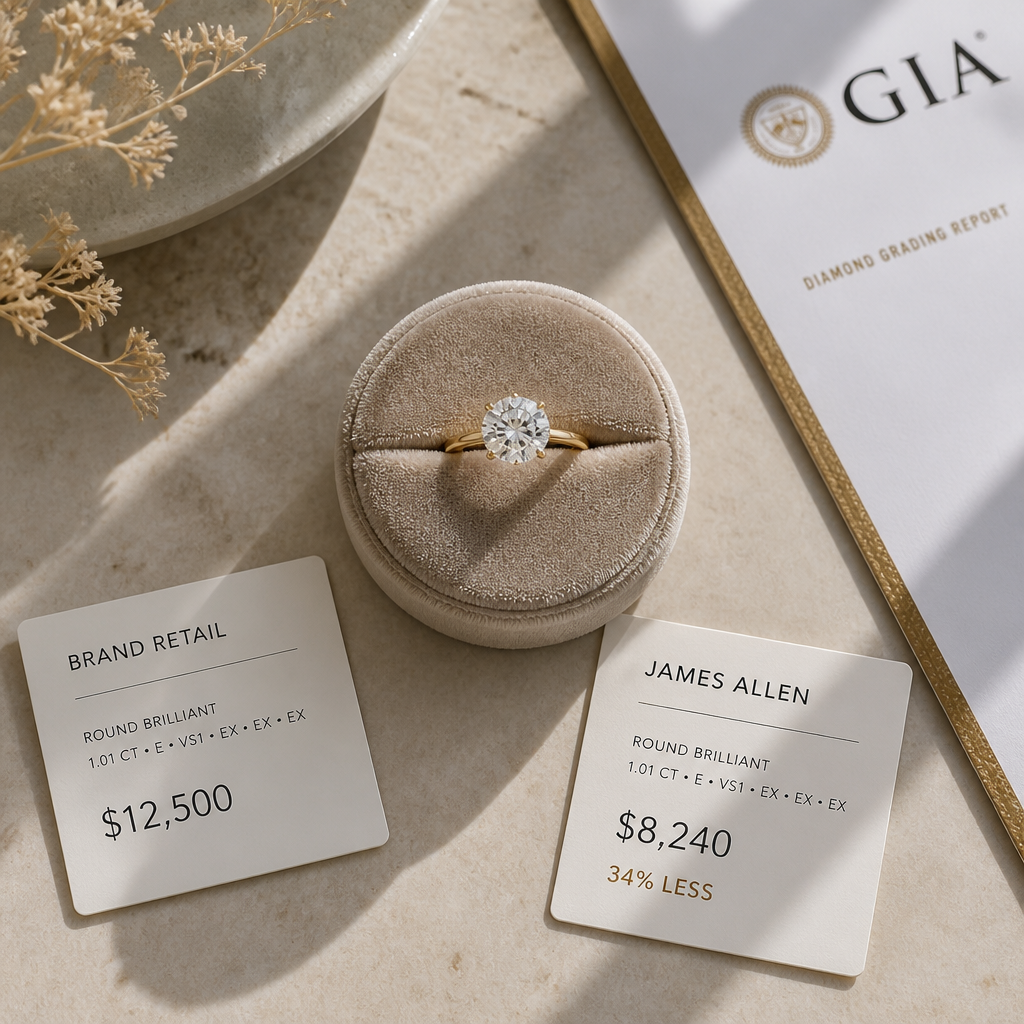
The price gap between lab-created and mined diamonds has widened significantly since 2020. According to data tracked by industry analysts at Edahn Golan Diamond Research, lab-grown diamond prices have dropped approximately 50 to 80 percent below mined equivalents in comparable grades. This is not a temporary trend. Increased production capacity and growing consumer acceptance have permanently shifted the pricing dynamic.
Category |
Lab-Created Diamond |
Mined Diamond |
|---|---|---|
Price (1-carat, G color, VS1, excellent cut) |
$800 to $1,500 CAD |
$5,000 to $9,000 CAD |
Chemical composition |
100% carbon, identical structure |
100% carbon, identical structure |
Hardness (Mohs scale) |
10 |
10 |
Grading certification |
GIA, IGI, GCAL available |
GIA, AGS, HRD available |
Resale value |
20 to 30 cents on the dollar |
20 to 40 cents on the dollar |
Ethical sourcing confidence |
High, traceable origin |
Variable, depends on supply chain |
Custom design accessibility |
High, lower cost allows more flexibility |
Low, large stones significantly increase budget |
The value proposition for lab-created stones is straightforward. You get a physically identical stone, certified by the same grading institutions, for a fraction of the price. The budget you save can go toward a better setting, a wedding band, honeymoon costs, or simply staying out of debt.
Pro tip: If you are comparing a mined diamond and a lab diamond of the same stated grade, insist on viewing both side by side under natural light and magnification before purchasing. The certified grade is a starting point, not the final answer. Our team at Livia Diamonds offers in-person and virtual consultations where you can do exactly this comparison with real stones.
Ethical Diamond Alternatives Canada: Why Origin Matters
Canadian buyers are increasingly asking where their diamonds come from. The Kimberley Process, which was designed to prevent conflict diamonds from entering the market, has significant gaps that the diamond industry itself has acknowledged. Diamonds can be certified conflict-free under the Kimberley Process while still being sourced from regions with documented human rights violations or environmental destruction.
For couples seeking ethical diamond alternatives Canada, lab-grown diamonds offer a clear and simple answer. The entire growth process takes place in a controlled facility. There is no ambiguity about mining conditions, worker safety, or community impact. The carbon footprint is also lower per carat when renewable energy is used in the growth process, which is increasingly common among reputable producers.
Why Moissanite Is Also Worth Considering
Moissanite deserves an honest mention here. It is not a diamond, and no reputable retailer should present it as one. But moissanite is a naturally occurring mineral, silicon carbide, that was first discovered in a meteor crater. Lab-grown moissanite offers a refractive index of 2.65 compared to diamond's 2.42, meaning it actually produces more fire and sparkle than a diamond of equivalent size.
For buyers whose primary concern is budget and visual impact, moissanite is the strongest option available. Livia Diamonds carries a full range of moissanite engagement rings precisely because we believe in giving customers accurate information and real choices, not just steering them toward the highest margin product.
Resale Value: The Honest Picture
The most persistent argument for mined diamonds is that they hold their value better. The data consistently shows this is mostly myth. A mined diamond purchased at retail will typically resell for 20 to 40 percent of its retail price, according to multiple industry analyses. Pre-owned jewelry platforms like Worthy and I Do Now I Don't consistently confirm this range.
Lab-grown diamonds currently resell at 20 to 30 percent of retail, which is slightly lower but not dramatically different. The meaningful difference is the entry price. If you paid $1,200 CAD for a lab diamond that resells at 25 percent, you recover $300. If you paid $7,000 CAD for a mined equivalent and recover 35 percent, you get $2,450 back but you spent $5,800 more to start. The math does not favor mined stones as an investment by any reasonable calculation.
Neither diamonds nor moissanite are financial investments in the way that stocks or real estate are. They are personal purchases tied to an emotional milestone. Framing the mined diamond premium as "better value" because of resale misrepresents how jewelry actually behaves as an asset. Buy the diamond that fits your life, your values, and your budget. Not the one that sounds like a smarter purchase according to an industry that profits from the premium.
Who Should Choose Which
Lab-created diamonds are the right choice for the majority of buyers who want a certified, visually excellent diamond without the arbitrary premium attached to geological origin. If you want a 1.5-carat stone in an ideal cut with VS clarity and the budget conversation is real, lab-grown is not a compromise. It is the optimal decision.
Mined diamonds still make sense for a small subset of buyers who place intrinsic value on geological origin as part of the stone's meaning to them personally. That is a legitimate preference. But it should be a fully informed choice, not a default because the industry presented mined as "real" and lab-grown as lesser.
Moissanite is the right choice when maximum visual impact per dollar is the goal, or when the buyer genuinely does not want to purchase any diamond. With Livia Diamonds' range of custom ring designs and stone options, couples can explore all three categories and make a decision based on actual comparisons rather than marketing assumptions.
Frequently Asked Questions
Can a jeweler tell the difference between a lab diamond and a mined diamond just by looking at it?
No. A trained gemologist cannot distinguish a lab diamond from a mined diamond using standard visual inspection or even a loupe. Specialized spectroscopy equipment is required to detect the minor growth pattern differences. In everyday wear, the stones are indistinguishable.
Do lab-created diamonds come with grading certificates?
Yes. Reputable retailers including Livia Diamonds provide lab-grown diamonds certified by GIA, IGI, or GCAL. These certificates grade the stone on the same 4C scale used for mined diamonds and are the standard you should insist on for any diamond purchase.
Are lab-grown diamonds a good option for engagement rings specifically?
Lab-grown diamonds are an excellent choice for engagement rings. They offer the same visual and physical properties as mined diamonds, come in every popular cut including round brilliant, oval, and cushion, and allow couples to get a significantly larger or higher-clarity stone within the same budget. This is why they now account for a growing share of engagement ring sales in Canada and globally.
Is moissanite the same thing as a lab-created diamond?
No, moissanite and lab-created diamonds are different materials. A lab diamond is carbon-based and chemically identical to a mined diamond. Moissanite is silicon carbide. Moissanite has different optical properties, including higher fire and brilliance, and is priced lower than lab diamonds. Both are legitimate choices depending on the buyer's priorities.
How do ethical diamond alternatives in Canada compare to traditional Canadian mined diamonds?
Canadian mined diamonds from provinces like Northwest Territories do have stronger ethical documentation than many internationally mined stones, and they carry a price premium for that origin story. Lab-grown diamonds offer equivalent or better ethical assurance without that premium, since their origin is fully controlled and documented from creation. For most buyers, lab-grown is a more affordable way to achieve the same ethical outcome.
Will a lab-created diamond scratch or chip more easily than a mined diamond?
No. Both score 10 on the Mohs hardness scale, which is the maximum. Durability is identical. Neither is scratch-proof against another diamond or certain industrial materials, but in practical daily wear both lab-grown and mined diamonds perform the same way.
If you are working through this decision right now, we would genuinely like to hear what is driving your thinking. Drop your questions or experience in the comments and our team will respond directly.
References
GIA official website covering diamond grading standards and lab-grown diamond research
Statista data and statistics on the global diamond industry and lab-grown market growth
Forbes coverage of lab-grown diamond market trends, pricing, and consumer adoption
Natural Resources Canada information on Canadian diamond mining and ethical sourcing standards