
Stackable Wedding Bands: Build a Ring Stack You'll Love
Most couples spend weeks choosing an engagement ring and then treat the wedding band as an afterthought. That approach leaves a significant opportunity on the table. Stackable wedding bands have become one of the most personalized expressions of commitment in modern jewelry, and building a stack you will genuinely love for decades requires more than just picking pretty rings. This guide walks through metal matching, stone selection, proportions, and the specific stacking principles that separate a cohesive set from a cluttered collection. Whether you are shopping in Toronto or browsing from across Canada, these principles apply.
Table of Contents
- Quick Takeaways
- Why Ring Stacking Works as a Long-Term Investment
- The Foundations of a Great Stack
- Metal and Stone Matching for Stacked Rings in Canada
- Moissanite vs. Lab-Created Diamond Stacks
- How to Build Your Wedding Band Stack Step by Step
- Stack Style Comparison: Three Popular Approaches
- Common Stacking Mistakes and How to Avoid Them
- How Livia Diamonds Supports Your Stacking Journey
- Frequently Asked Questions
- References
Quick Takeaways
Key Insight |
Explanation |
|---|---|
Odd numbers stack better visually |
A three-band or five-band stack creates natural visual symmetry. Two bands of equal width can look like a mistake rather than a choice. |
Metal consistency matters most |
Mixing 14k white gold with platinum looks good in theory but causes wear because platinum is harder and will scratch the gold over time. |
Profile height determines wearability |
High-profile bands with tall settings sit awkwardly in a stack. Low-profile or flush-set bands stack flat and comfortably. |
Moissanite is ideal for accent stack bands |
The brilliance of moissanite in a thin eternity band elevates the entire stack without the cost of mined diamond accent bands. |
Width ratios prevent visual imbalance |
Your center engagement ring should generally be the widest piece. Stack bands work best at 1.5mm to 2.5mm each flanking a 4mm to 6mm center band. |
Custom sizing is non-negotiable in a stack |
Adding two bands to one finger changes the effective fit. Size up by a quarter size for every additional band you plan to wear simultaneously. |
Ethical sourcing adds meaning to the stack |
Lab-created diamonds and moissanite carry a documented origin story. For Canadian buyers increasingly focused on ethics, this matters in a tangible way. |
Why Ring Stacking Works as a Long-Term Investment
Ring stacking is not a trend that appeared on social media and will disappear next season. Jewelry historians trace layered finger adornment back to ancient Egypt, where stacked gold bands signified social status and marital commitments simultaneously. What has changed is accessibility and intent.
The modern ring stacking guide philosophy is built on the idea that a jewelry collection should evolve with your life. You start with an engagement ring, add a wedding band at the ceremony, and potentially add an anniversary band at the five or ten-year mark. Each piece carries meaning, and together they create a wearable timeline of your relationship.
For Canadian shoppers specifically, the economics of stacking have improved dramatically with the rise of lab-created diamonds and moissanite. A three-band stack featuring a moissanite center stone and two lab-diamond accent bands now costs a fraction of what an equivalent mined-diamond stack would have cost a decade ago. That affordability opens stacking to a much wider audience than the traditional bridal market.
The Foundations of a Great Stack
Before you purchase a single additional band, you need to assess your engagement ring as the anchor piece. Every decision about the rest of your stack flows from the existing ring's profile, metal, stone shape, and width.
Profile and Setting Height
A high-cathedral solitaire setting sits 6mm or more above the finger surface. Stacking flat bands next to it creates a visual cliff. The solution is either to choose a low-dome curved band that follows the engagement ring's silhouette, or to restyle into a lower-profile setting if you are customizing from scratch. Livia Diamonds' custom design service is particularly useful here because you can specify a coordinating profile from the start.
Flush-set or bezel-set stack bands have no prongs or raised elements, which means they lie completely flat against adjacent rings. This creates a cleaner, more modern look and reduces the snagging that high-prong eternity bands are known for. In practice, flush-set moissanite eternity bands represent the most wearable everyday stack option available at any price point.
Finger Size and Band Fit Across the Stack
A common mistake is ordering all rings in the same size and then discovering the stack is too tight by midday. Fingers fluctuate in size by up to a half size throughout the day due to temperature and activity. When wearing three bands simultaneously, the compression effect is noticeable.
The practical rule is to size your engagement ring for a comfortable single-band fit, then order your stack bands a quarter size larger. Livia Diamonds offers a wide range of ring sizes and, critically, their team can advise on fit during both in-person and virtual consultations in Toronto. That guidance is worth more than any online size chart.
Metal and Stone Matching for Stacked Rings in Canada
Metal choice is where many stacks go wrong within the first two years of wear. The issue is not just aesthetics. It is chemistry and physics.
Why Matching Metal Type Matters More Than Matching Metal Color
White gold and platinum look nearly identical in a jewelry display case. On a finger, wearing them together every day for five years tells a different story. Platinum is a denser, harder metal. When it rubs against 14k or 18k white gold in a stack, the platinum wins. The gold will show surface wear patterns the platinum does not.
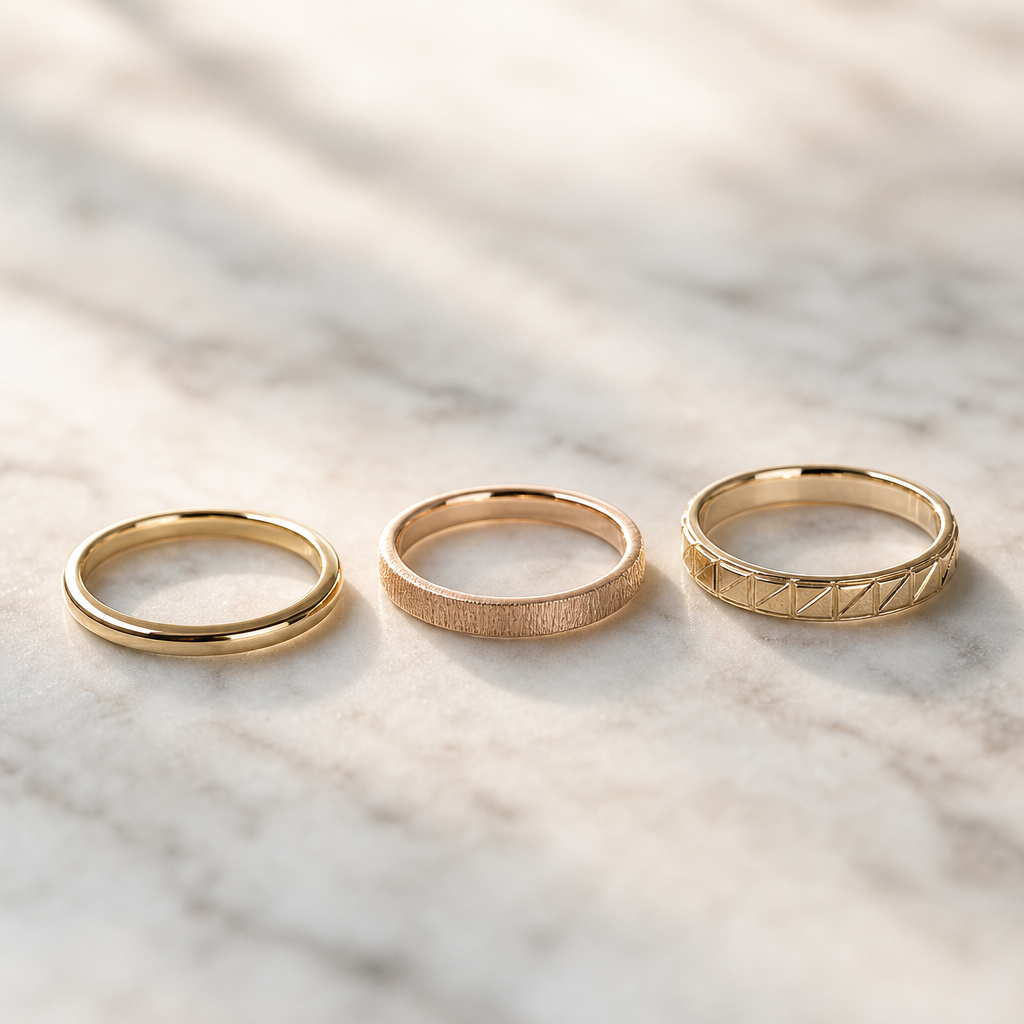
If your engagement ring is white gold, your stack bands should also be white gold at the same karat. If you want to mix metals intentionally for a two-tone or tri-tone aesthetic look, the visual contrast needs to be deliberate enough that it reads as a design choice. A 14k rose gold band flanked by two 14k white gold bands is intentional. White gold next to platinum is just a maintenance problem waiting to happen.
Stone Cuts That Stack Well Together
Round brilliant stones are the most forgiving in a stack because their symmetry reads cleanly from any angle. Oval and elongated cuts look stunning as a center stone but can appear to float awkwardly if surrounded by round-accent-stone bands that do not mirror their orientation.
For stacked rings Canada shoppers, the most popular combination at Livia Diamonds has consistently been a round or oval moissanite solitaire flanked by two thin pavé bands featuring lab-created diamond accents. This combination photographs well, wears comfortably, and scales in value as you add pieces over time.
Pro tip: If you love the look of marquise or pear shapes, choose a curved or contoured stack band specifically shaped to nestle beside that cut. A straight band next to a marquise center stone will always show a gap, which collects dirt and dulls the overall look within weeks.
Moissanite vs. Lab-Created Diamond Stacks
This is one of the most common questions at Livia Diamonds, and the honest answer is that the right choice depends on where each stone sits in your stack, not on a blanket preference.
"Moissanite has a refractive index of 2.65, compared to diamond's 2.42. That means moissanite throws more rainbow fire and colored light dispersion than diamond. In a thin eternity band, that fire is a feature. In a large center stone next to diamond accent bands, it can create a visible color mismatch." - Gemological Institute of America gemstone resource literature
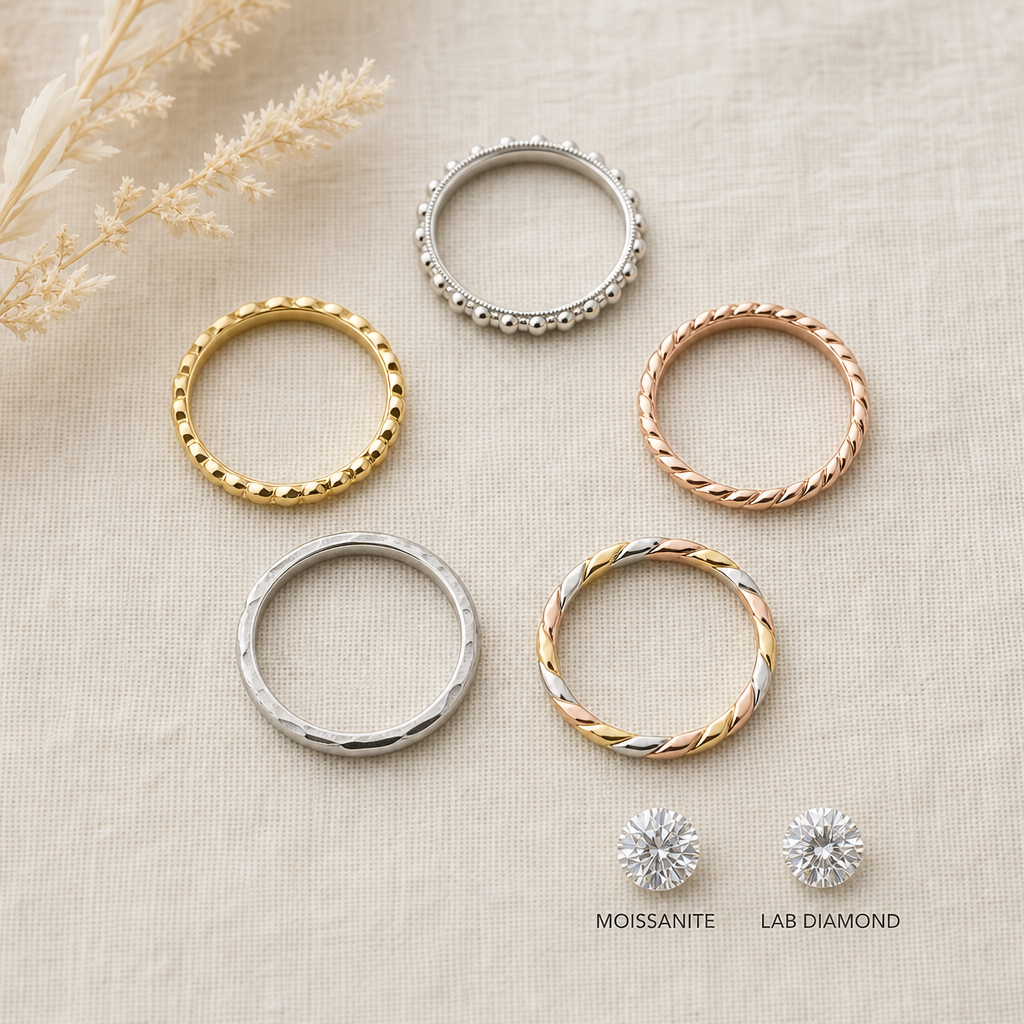
In practice, moissanite works brilliantly as an accent stone in stack bands because the small stone sizes reduce the visible fire difference. When stones are under 3mm in diameter, the human eye cannot easily distinguish moissanite fire from diamond fire in everyday lighting. This makes moissanite eternity stack bands a genuinely excellent value choice alongside a lab-created diamond center stone.
Cost Difference Across a Full Stack
A three-band wedding band stack using all lab-created diamonds at Livia Diamonds will cost significantly less than an equivalent mined-diamond stack from traditional retailers. A comparable three-band stack using lab-created diamond accent bands through a competitor like Blue Nile or Vrai will often cost more simply due to brand markup, with no difference in stone origin or quality. Livia Diamonds' family-run model and over 20 years of direct sourcing experience remove several layers of cost from that equation.
How to Build Your Wedding Band Stack Step by Step
Building a stack is most satisfying when approached as a multi-year project rather than a single purchase. Here is the sequence that produces the most cohesive results.
Step One: Anchor Your Stack with the Engagement Ring
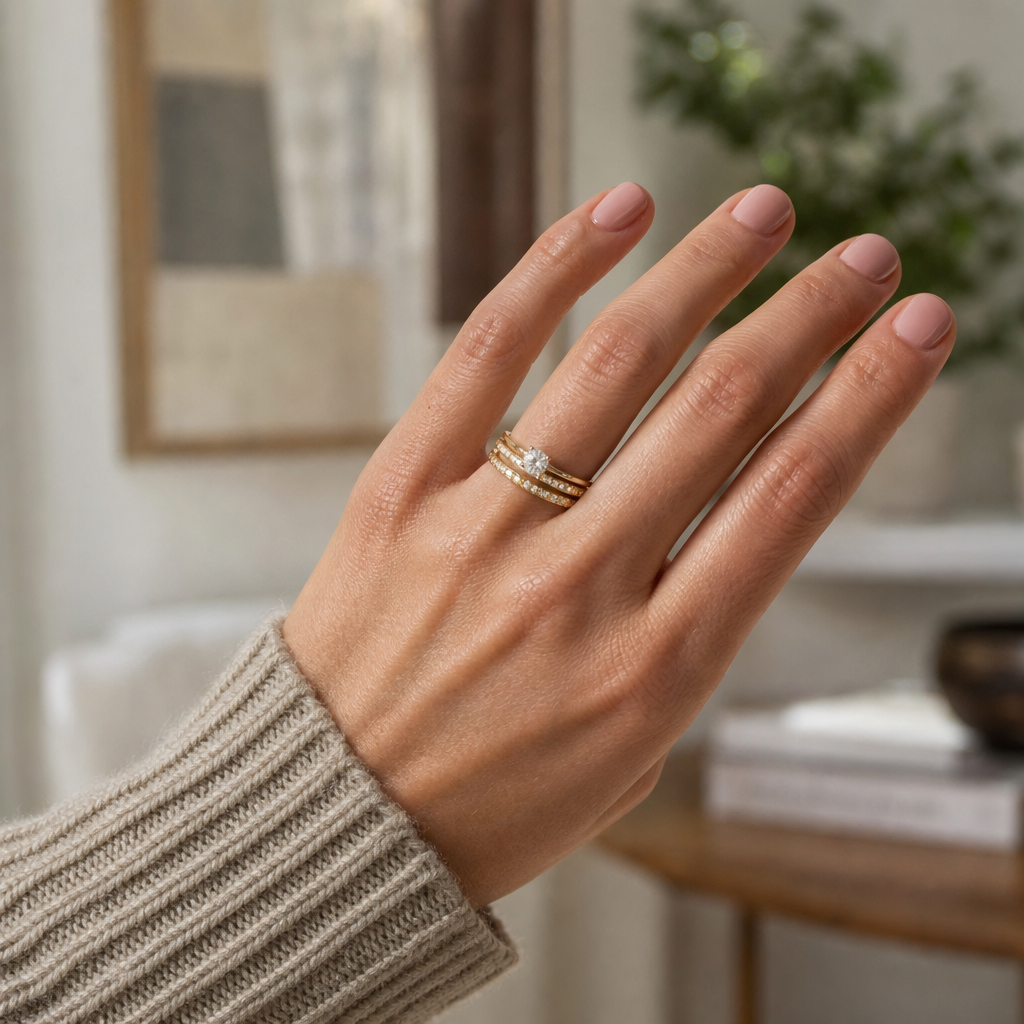
Your engagement ring is not just a ring. It is the visual center of gravity for everything else you add. Before buying any stack bands, photograph your engagement ring from above, from the side, and on your hand. Use those photos when consulting with Livia Diamonds' team to identify which band profiles will complement it versus compete with it.
Step Two: Choose Your Wedding Band to Contour or Contrast
Your wedding band, worn directly alongside the engagement ring, should either contour to match its shape or create a clean deliberate gap. Contoured bands are curved to nestle against the specific shape of your center stone setting. They eliminate the gap and make the pairing look like a set even if the two rings were purchased separately.
Straight bands work next to round solitaires because a round stone has no angles to create an uneven gap. Next to princess cut, cushion cut, or emerald cut stones, a straight band will show an uneven space on at least one side. Contoured bands solve this and are available as a custom option at Livia Diamonds.
Step Three: Add Anniversary or Milestone Bands Over Time
The outer bands in your stack carry the most design flexibility because they are not constrained by the need to nestle against the center stone. This is where you can introduce a different texture, a different stone size, or even a slightly different metal tone if you want a mixed-metal look. A thin hammered yellow gold band on the outer edge of a white gold stack is a current favorite in the stacked rings Canada market and looks particularly striking on medium to deeper skin tones.
Pro tip: Order your first anniversary band at the same time as your wedding band, even if you do not plan to wear it immediately. Ring styles and specific stone cuts get discontinued. Having the band sourced early from Livia Diamonds means it will match your set perfectly when the time comes.
Stack Style Comparison: Three Popular Approaches
Stack Style |
Best For |
Key Considerations |
|---|---|---|
Matching Set Stack (engagement ring + coordinating band from same collection) |
Buyers who want a cohesive, designed-as-one look without visual complexity |
Easiest to execute. Less flexible for future additions. Works best when ordered together from Livia Diamonds' existing collections. |
Mixed Metal Stack (white gold center, rose gold or yellow gold accent bands) |
Buyers who want a fashion-forward, editorial look and change their style frequently |
Requires deliberate contrast to read as intentional. Use same karat across all metals. Rose gold and white gold is a more flattering combination than yellow and white gold for most skin tones. |
Milestone Stack (bands added at engagement, wedding, 5-year, 10-year marks) |
Buyers who want their jewelry to tell a chronological story of their relationship |
Requires planning for consistent metal and profile across purchases made years apart. Custom design service at Livia Diamonds is the safest way to ensure future bands match past ones. |
Common Stacking Mistakes and How to Avoid Them
The mistakes that ruin a ring stack are almost always invisible at the point of purchase and only become obvious after months of wear. Here are the most frequent ones and how to prevent them.
Buying Bands from Different Retailers Without Metal Testing
White gold from one jeweler and white gold from another will look identical in a store. The difference emerges over time. White gold alloys vary in their composition. Some contain more nickel, some more palladium, and some more silver. These variations affect how the metal ages, how the rhodium plating wears off, and whether the rings develop different patinas that make the stack look mismatched after a year.
The solution is to source your entire stack from one retailer who can confirm matching alloy compositions. Livia Diamonds' 20-plus years of sourcing experience means their metal standards are consistent across their entire collection, which eliminates this problem entirely.
Ignoring the Weight Distribution of the Stack
Three rings on one finger add meaningful weight. Thin 1.5mm bands weigh approximately 1.5 to 2 grams each in 14k gold. A three-band stack can add 5 to 6 grams of metal to a single finger. For most people this is comfortable. For people with arthritis, joint sensitivity, or active manual jobs, it is worth discussing with the Livia Diamonds team before committing to a full stack approach.
Choosing a Stack That Does Not Work With Your Lifestyle
A stack with high-prong settings and raised pavé diamonds looks magnificent for formal occasions and causes genuine practical problems for people who work with their hands, type for long hours, or exercise frequently. The data consistently shows that jewelry return rates spike when buyers prioritize aesthetics over lifestyle compatibility during the purchase decision. Pavé eternity bands with prong-set stones catch on fabric, scratch adjacent rings, and can lose stones faster than bezel or flush-set alternatives.
How Livia Diamonds Supports Your Stacking Journey
Livia Diamonds occupies a specific position in the Canadian bridal jewelry market that makes it particularly well suited to ring stacking customers. The combination of custom design capability, in-person and virtual consultations, and an e-commerce store with free shipping and returns means you can plan and build a stack incrementally without the pressure of a single high-stakes showroom visit.
Competitors like Blue Nile and Vrai offer large online inventories but limited custom design flexibility and no local Canadian consultation option. Kimberfire provides Toronto-based service but focuses primarily on custom engagement rings rather than a full bridal stack experience. Livia Diamonds bridges that gap by offering both the in-stock selection and the custom capability within a family-run business that has two decades of direct customer relationships in the Toronto market.
Their flexible payment plans are also directly relevant to the milestone stacking model. Rather than purchasing a full three-band stack at once, you can finance the engagement ring, then the wedding band, then add an anniversary band as a future planned purchase. That approach spreads the investment in a way that aligns with how most couples actually build their jewelry collection over time.
If you are based outside Toronto, the virtual consultation service replicates the in-person experience closely enough that stacked rings Canada customers across British Columbia, Alberta, and Ontario have reported receiving the same quality of guidance remotely as they would in person. Bring your engagement ring photos and your lifestyle context to that conversation. The team's recommendations will be more specific and more useful as a result.
Frequently Asked Questions
How many bands should a ring stack include?
Three is the most functional and visually balanced number for everyday wear. Two bands can look intentional or unfinished depending on the width relationship between them. Five bands is the maximum most jewelers recommend before the stack becomes uncomfortable for daily wear on a standard finger. Start with three, and add a fourth or fifth only when you have worn the initial stack for at least a year and confirmed the fit is right for your lifestyle.
Can I stack rings on the same finger as my engagement ring?
Yes, and this is the most common approach. The engagement ring typically sits closest to the palm, the wedding band sits directly above it, and additional stack bands sit above the wedding band toward the fingertip. Some people prefer to place the wedding band on the palm side of the engagement ring for symbolic reasons. Either arrangement works visually as long as the band profiles are compatible.
Do stackable wedding bands need to match in metal color?
They do not need to match, but the mix needs to be intentional. A stack with one rose gold, one white gold, and one yellow gold band reads as a deliberate mixed-metal choice if the bands are distinct enough in tone. If two of the three are nearly the same tone, the slight difference looks like a mismatch rather than a design decision. When in doubt, stay within one metal family for your first stack and introduce mixed metals as a later addition.
Is moissanite durable enough for a stack band worn every day?
Moissanite scores 9.25 on the Mohs hardness scale, compared to diamond's 10. For a stack band worn alongside other rings, this means moissanite will not scratch from contact with metal, but it can scratch if it rubs against another diamond. In a practical everyday stack, moissanite and lab-created diamond bands worn together will show no meaningful difference in surface durability over a five to ten year period. The setting style, specifically whether stones are bezel-set versus prong-set, matters more for durability than the stone type itself.
How do I clean a ring stack without removing all the bands?
Warm water with a small amount of dish soap and a soft baby toothbrush is the most effective method. The toothbrush reaches the crevices between bands where soap and skin oil accumulate. Soak the stack for five minutes, then gently brush each band individually. Rinse thoroughly with clean water and dry with a lint-free cloth. Do this once every two weeks for a stack worn daily. Ultrasonic cleaners are safe for moissanite and lab-created diamonds but should be avoided if any band contains fracture-filled stones or organic materials like pearls or opals.
What is the best way to plan a ring stack before purchasing?
The most reliable method is to book a virtual or in-person consultation with a jeweler who offers custom design services, like Livia Diamonds in Toronto. Bring your engagement ring or clear photographs of it from multiple angles. Describe your lifestyle, your dominant hand, and how many bands you eventually want in the stack. A qualified jeweler can assess profile compatibility, recommend band widths, and flag any sizing adjustments needed before you spend anything. Trying to plan a stack entirely from online photos without that expert input leads to most of the costly mistakes described in this guide.
What does your current ring stack look like, and what is the one addition you are considering next? Share your setup in the comments and our team will offer specific suggestions.
References
GIA gemological research and stone grading standards for diamonds and moissanite
Statista jewelry market statistics and consumer spending data for bridal categories
Forbes coverage of sustainable jewelry trends and lab-grown diamond market growth
The Knot wedding jewelry planning resources and engagement ring trend reports
Brides magazine editorial guidance on ring stacking, band selection, and bridal jewelry styling