
Lab-Grown Diamond Engagement Rings Canada: Full Guide
Canadian couples shopping for engagement rings are facing a choice that simply did not exist a generation ago: pay full price for a mined diamond, or get the same hardness, brilliance, and certified quality in a lab-grown diamond engagement ring in Canada for a fraction of the cost. That price difference is not marginal. A 1.50ct G/VS1 round in 14k white gold runs roughly $2,000-$3,500 lab-grown versus $9,000 or more for a mined equivalent. For couples who want a stunning ring without draining a down-payment fund, the math is hard to argue with. This guide covers everything Canadian shoppers need to know before buying.
Table of Contents
- Quick Takeaways
- What Are Lab-Grown Diamonds, Really?
- Lab-Grown vs. Mined vs. Moissanite: Choosing the Right Stone
- Understanding the 4Cs for Lab Diamonds
- Buying Lab-Grown Diamond Rings in Canada
- Custom Design and Band Options
- Resale Value and Long-Term Ownership
- How Lab-Grown Diamonds Compare: A Side-by-Side Breakdown
- Frequently Asked Questions
- References
Quick Takeaways
Key Insight |
Explanation |
|---|---|
Lab diamonds are chemically identical to mined diamonds |
Both share the same carbon crystal structure, Mohs 10 hardness, and optical properties. No gemologist can tell them apart with the naked eye. |
Price savings of 60-80% are realistic |
A comparable lab-grown stone costs a fraction of its mined counterpart, giving Canadian buyers significantly more stone for the same budget. |
IGI and GIA grading applies to lab diamonds |
Reputable labs grade lab-grown stones using the same 4Cs criteria. Always ask for a grading certificate before purchasing. |
Two main production methods exist: HPHT and CVD |
High-Pressure High-Temperature (HPHT) and Chemical Vapor Deposition (CVD) both produce genuine diamonds. CVD is more common in jewelry-grade stones today. |
Moissanite is a separate stone, not a lab diamond |
Moissanite is silicon carbide, not carbon. It has different refractive properties and a lower price point. Both are legitimate alternatives to mined diamonds, but they are not the same product. |
Custom design is practical with lab stones |
Because lab diamonds cost less per carat, more of the total budget can go toward custom band work, unique cuts, or side stones, which is harder to do with mined diamonds at the same price. |
Virtual and in-person consultations are available from Toronto-based retailers |
Buyers do not need to commit to a ring without expert guidance. Retailers like Livia Diamonds offer both consultation formats, which matters for Canadians outside major cities. |
What Are Lab-Grown Diamonds, Really?
The term "lab-grown" creates confusion for many shoppers who assume it means synthetic or fake. It does not. Lab-grown diamonds are real diamonds, composed entirely of carbon arranged in the same crystal structure as stones pulled from the earth. The physical and chemical properties are identical: same hardness (Mohs 10), same refractive index, same thermal conductivity, same everything that makes a diamond a diamond.
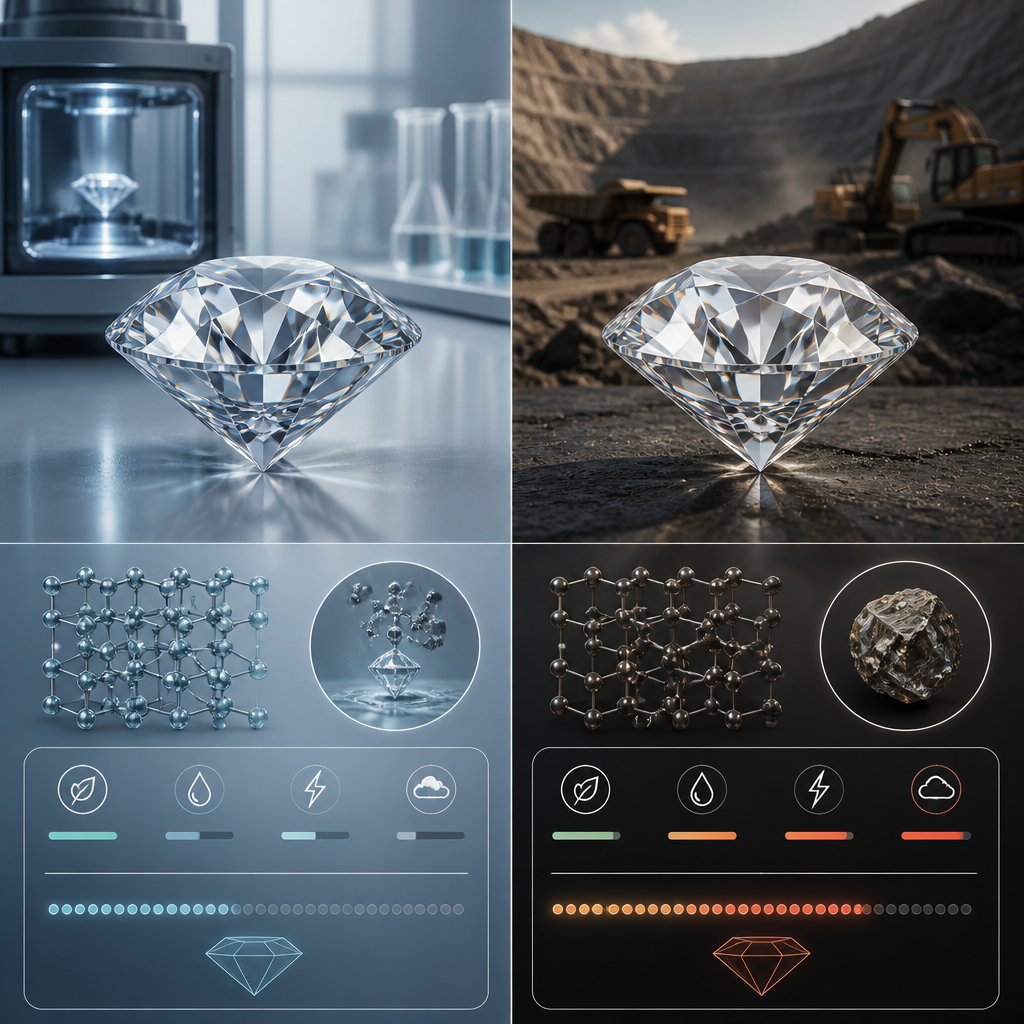
The only meaningful difference is origin. Natural diamonds form deep within the earth's mantle over billions of years under extreme heat and pressure. Lab-grown diamonds replicate those conditions inside a controlled environment, producing the same end result in weeks rather than geological ages.
HPHT vs. CVD: Two Paths to the Same Stone
High-Pressure High-Temperature (HPHT) mimics the underground conditions that create natural diamonds, using intense mechanical pressure and heat to crystallize carbon. Chemical Vapor Deposition (CVD) grows diamonds layer by layer from a carbon-rich gas in a chamber. Both methods produce genuine diamonds that meet grading standards. In practice, CVD has become the dominant method for gem-quality stones because it allows for more precise control over the growing environment, which translates to better consistency in clarity and color.
Neither method is inherently superior for the buyer. What matters is the finished stone's grade, not the process that produced it. When shopping, focus on the grading certificate rather than asking which method was used.
Lab-grown diamonds deliver the same Mohs 10 hardness and IGI/GIA grading as mined stones, with a significantly smaller environmental footprint and a price point that opens up options most couples assume are out of reach.
For Canadian shoppers comparing options, it helps to know that modern grading standards from institutions like the International Gemological Institute (IGI) and the Gemological Institute of America (GIA) now evaluate lab-grown diamonds using the exact same 4Cs criteria applied to natural stones. A certified lab diamond is not graded on a softer scale. It earns its grade the same way.
Lab-Grown vs. Mined vs. Moissanite: Choosing the Right Stone
Canadian shoppers increasingly walk into consultations asking about three options: mined diamonds, lab-grown diamonds, and moissanite. Understanding where each sits helps buyers make a decision they will not second-guess in five years.
Lab-Grown Diamonds
The case for lab-grown diamonds is straightforward. You get a certified diamond, the same durability, the same sparkle, and you keep 60-80% more of your budget. For couples who want a diamond but not the diamond industry markup, this is the practical choice. Retailers like Livia Diamonds' lab-created diamond rings offer a wide range of cuts and settings, making it easy to find something that feels personal rather than off-the-shelf.
Mined Diamonds
The argument for mined diamonds rests primarily on tradition and resale. Natural diamonds carry a cultural weight that some buyers genuinely value. Their resale market is also more established, though resale on any diamond is rarely a strong financial proposition. If rarity and provenance matter deeply to the buyer, a mined stone with a documented origin makes sense. If those factors are secondary, paying the premium is hard to justify on purely practical grounds.
Moissanite
Moissanite is not a diamond. It is silicon carbide, a different mineral entirely. Moissanite has a higher refractive index than diamond, which produces a "rainbow" fire effect that some buyers love and others find too flashy. It is also harder than most gemstones (Mohs 9.25), making it durable for daily wear. The price point is lower than even lab-grown diamonds. Livia Diamonds' moissanite ring collection gives buyers the option to compare moissanite and lab diamond side by side before committing, which is the right way to make that decision.
Pro tip: If you are torn between moissanite and a lab diamond, book a virtual or in-person consultation and ask to see both under the same lighting conditions. The visual difference is subtle in some cuts and obvious in others. Seeing them together eliminates guesswork.
Understanding the 4Cs for Lab Diamonds
The 4Cs, cut, color, clarity, and carat weight, apply to lab-grown diamonds exactly as they do to mined stones. A common mistake buyers make is over-prioritizing carat weight and under-investing in cut quality. Cut is the only factor that is entirely human-controlled, and it is the one that determines how much light a diamond returns to the eye. A well-cut 1.0ct lab diamond will outshine a poorly cut 1.3ct stone every single time.
Cut
Prioritize Excellent or Ideal cut grades. In round brilliants, an Excellent cut grade from IGI or GIA is not an upsell. It is the baseline for a ring that looks as good in natural light as it does in a jewelry store.
Color and Clarity
For lab diamonds, the sweet spot for color is typically G to I, which is near-colorless to the naked eye but meaningfully cheaper than D-F (colorless). For clarity, VS1 to SI1 is the practical range for most buyers. Inclusions in SI1 stones are visible under magnification but not to the unaided eye in most cuts. Going below SI1 risks inclusions you can actually see, which matters for daily wear.
Carat Weight
Because lab diamonds cost significantly less per carat than mined stones, Canadian buyers can often size up without stretching the budget. A couple who planned on a 0.75ct mined diamond may be able to afford a 1.25ct or 1.50ct lab diamond for a similar total spend. That shift in carat size is visually significant.
Pro tip: Avoid "magic weights" like exactly 1.00ct or 2.00ct. A stone graded at 0.97ct or 1.48ct will look identical to its round-number neighbor but often carries a noticeably lower price because fewer buyers search for it specifically.
Buying Lab-Grown Diamond Rings in Canada
The Canadian market for lab-grown diamond engagement rings has grown considerably, but the shopping experience still varies widely depending on who you buy from. Buyers in Toronto and surrounding areas have the advantage of being able to access both in-person consultations and a strong e-commerce selection. Buyers in smaller cities or rural areas need a retailer with a robust virtual consultation process and a fair returns policy.
What to Look for in a Canadian Lab Diamond Retailer
Any retailer worth buying from should offer certified stones (IGI or GIA certificates), transparent pricing, and a clear returns process. Free shipping and returns are particularly important for online purchases of high-value jewelry. Livia Diamonds offers free shipping and returns across Canada, which removes a real barrier for buyers who cannot visit in person.
Payment plans matter too. Engagement rings are a significant purchase, and flexible payment options make it possible to get the right ring rather than the affordable-this-month ring. Livia Diamonds provides flexible payment plans, which is a practical advantage over competitors that require full payment upfront.
Comparing Canadian Retailers
Blue Nile and Vrai are frequently cited by Canadian shoppers comparing options. Blue Nile offers a wide selection but ships from the United States, which introduces import considerations and longer shipping timelines. Vrai focuses on lab-grown diamonds and has strong sustainability messaging, but their customization options and in-person consultation access are more limited for Canadian buyers. KimberFire operates in Canada but has a narrower selection of lab-grown options compared to dedicated lab diamond retailers.
Livia Diamonds differentiates through over 20 years of family-run expertise, the ability to handle custom ring design, and a Toronto office that serves both walk-in and virtual clients. For Canadian shoppers who want both e-commerce convenience and the option to speak with a real expert, that combination is genuinely useful.
Custom Design and Band Options
One of the underappreciated advantages of buying a lab-grown diamond is what it does to your overall budget. When the stone costs significantly less, more budget is available for the setting, band metal, side stones, and custom design work. A couple spending $4,000 total can get a better custom ring with a lab diamond than they could with a mined stone at the same price point.
Band Metal Choices for Canadian Buyers
The most common choices are 14k white gold, 14k yellow gold, 14k rose gold, and platinum. Platinum is more durable and naturally white, but it comes at a higher price and is denser, making rings heavier. For most buyers, 14k white gold is the practical choice: it is durable, has a similar appearance to platinum, and costs less. Rose gold has seen strong popularity in recent years and pairs well with warmer-toned diamonds in the G-I color range. Yellow gold is a strong choice for buyers going with lower color grades, as the metal's warmth masks any slight yellowness in the stone.
Stone Cuts Worth Considering Beyond Round Brilliant
Round brilliant remains the most popular cut because it maximizes light return. But oval, cushion, and elongated radiant cuts offer visual advantages of their own. Oval cuts in particular create an illusion of greater size relative to carat weight, which means a 1.0ct oval often looks larger than a 1.0ct round. Livia Diamonds' engagement ring collection includes a range of cuts and settings, making it practical to explore alternatives before deciding.
Resale Value and Long-Term Ownership
The resale value question comes up in almost every consultation, and the honest answer is that it should not drive the purchase decision for most buyers. Diamonds, whether mined or lab-grown, are not liquid investments. A mined diamond purchased at retail will sell for a fraction of its purchase price on the secondary market. Lab-grown diamonds face steeper depreciation as production costs have continued to fall and supply has increased.
The meaningful question is not "which diamond holds value better?" but rather "which diamond gives me the most stone, the best quality, and the most flexibility for my budget?" Framed that way, lab-grown diamonds win the comparison for the vast majority of Canadian buyers who are purchasing a ring to wear and enjoy, not to liquidate.
For durability, there is no concern. Lab-grown diamonds share the same Mohs 10 hardness as mined stones, making them equally resistant to scratching from daily wear. They do not degrade, cloud, or change appearance over time. An engagement ring with a lab-grown diamond that is properly set and cared for will look identical in twenty years to how it looks on day one.
How Lab-Grown Diamonds Compare: A Side-by-Side Breakdown
The table below compares the three main stone options Canadian shoppers encounter when shopping for engagement rings. These comparisons reflect general market characteristics rather than specific current pricing from any single retailer.
Feature |
Lab-Grown Diamond |
Mined Diamond |
Moissanite |
|---|---|---|---|
Composition |
100% carbon |
100% carbon |
Silicon carbide |
Hardness (Mohs) |
10 |
10 |
9.25 |
Grading Certification |
IGI, GIA (same 4Cs) |
IGI, GIA (same 4Cs) |
Not graded by same 4Cs standards |
Price vs. Mined Diamond |
60-80% less |
Baseline (full price) |
Lower than lab-grown diamond |
Environmental Footprint |
Smaller than mined; varies by energy source |
Larger; significant land use per carat |
Minimal; produced in a lab |
Visual Appearance |
Identical to mined diamond |
Baseline reference |
Higher fire/rainbow effect; visually distinct |
Resale Market |
Limited; depreciating |
Established; still depreciates from retail |
Very limited secondary market |
Custom Design Flexibility |
High - more budget available for setting |
Lower - more budget goes to the stone |
High - lowest stone cost frees the most budget |
Available at Livia Diamonds |
Yes |
No |
Yes |
Frequently Asked Questions
Are lab-grown diamonds real diamonds?
Yes. Lab-grown diamonds are composed of the same carbon crystal structure as mined diamonds. They have the same hardness, brilliance, and thermal conductivity. Modern grading institutions including IGI and GIA certify them using the same 4Cs criteria applied to natural stones. No gemologist can distinguish a lab-grown diamond from a mined one without specialized equipment.
How much can I save by choosing a lab-grown diamond engagement ring in Canada?
Savings typically range from 60 to 80 percent compared to a mined diamond of equivalent grade. In practical terms, a 1.50ct G/VS1 round that might cost $9,000 or more in a mined stone can run roughly $2,000-$3,500 as a lab-grown stone. The exact figure depends on cut, color, clarity, and the retailer. These are general market estimates; always get a specific quote from the retailer you are considering.
What is the difference between lab-grown diamonds and moissanite?
Lab-grown diamonds are carbon, chemically and physically identical to mined diamonds. Moissanite is silicon carbide, a different mineral. Moissanite has a higher refractive index than diamond, which produces a more pronounced fire (rainbow sparkle) effect. Both are durable and ethical alternatives to mined diamonds, but they are distinct products with different visual characteristics. Seeing both in person or via a virtual consultation is the best way to decide which appearance you prefer.
Do lab-grown diamonds hold their value?
Lab-grown diamonds do not hold their retail value well on the resale market. As production technology has improved, the cost to produce lab diamonds has decreased, and this is reflected in secondary market prices. Mined diamonds also depreciate significantly from retail, but have a more established resale infrastructure. For most buyers purchasing a ring to wear for a lifetime, resale value should not be the primary factor. The better question is what delivers the most quality and size for your budget, which lab-grown diamonds consistently do.
Can I get a custom lab-grown diamond engagement ring in Canada?
Yes. Retailers like Livia Diamonds offer full custom design services for lab-grown diamond rings, including choice of stone cut, band metal, setting style, and ring size. Because lab diamonds cost significantly less per carat than mined stones, custom design becomes more accessible: more of the total budget can go toward craftsmanship and band work rather than the stone alone. Custom orders can be discussed through in-person consultations at Livia Diamonds' Toronto office or via virtual appointment.
Is it safe to buy a lab-grown diamond engagement ring online in Canada?
Yes, provided you buy from a retailer that offers grading certificates (IGI or GIA), transparent return policies, and Canadian shipping. A certificate protects you because it documents exactly what you purchased. Free returns remove the risk of receiving something that does not match the description. Livia Diamonds offers free shipping and returns across Canada, which is a meaningful protection for online buyers. For additional confidence, book a virtual consultation before purchasing to ask specific questions about the stone and setting you are considering.
What stone cuts are available for lab-grown diamond engagement rings?
All major cuts are available in lab-grown diamonds: round brilliant, oval, cushion, princess, emerald, pear, marquise, radiant, and others. Round brilliant remains the most popular because it maximizes brilliance. Oval cuts offer the illusion of greater size relative to carat weight. Cushion and emerald cuts suit buyers who prefer a vintage or architectural aesthetic. Livia Diamonds carries a diverse range of cuts in both lab-grown diamond and moissanite options, making it practical to compare styles before deciding.
Have you recently purchased or considered a lab-grown diamond engagement ring in Canada? Share your experience or questions in the comments below - your insight helps other couples making the same decision.