
Emerald Cut Engagement Ring: Why It's Back in Style
Search interest in the emerald cut engagement ring has climbed steadily over the past three years, and it is not a coincidence. Celebrities, influencers, and everyday couples are choosing this elongated, step-cut stone over flashier brilliant-cut alternatives at a rate that surprises even seasoned jewelers. But the shape comes with real trade-offs most buyers do not fully understand before purchasing. This article breaks down exactly why the emerald cut is resonating right now, what makes it different from every other cut, and how to choose one that will look stunning for decades, whether you are shopping for a moissanite, a lab-created diamond, or a natural stone.
Table of Contents
- Quick Takeaways
- What Is an Emerald Cut and How Is It Different
- Why the Emerald Cut Is Trending Right Now
- Emerald Cut Moissanite: The Practical Choice
- Emerald Cut Lab Diamond: Premium Look, Ethical Price
- Step Cut Ring Comparison: Emerald vs. Asscher vs. Baguette
- How to Choose the Right Emerald Cut Ring
- What to Avoid When Buying an Emerald Cut
- Frequently Asked Questions
- References
Quick Takeaways
Key Insight |
Explanation |
|---|---|
Emerald cuts show clarity flaws more easily |
The open table facet acts like a window. Prioritize VS2 clarity or higher for a clean appearance. |
Step-cut faceting creates a mirror effect, not sparkle |
Instead of the scintillation of a round brilliant, emerald cuts produce long flashes of light called the "hall of mirrors" effect. |
Moissanite performs exceptionally well in this shape |
Moissanite's fire and brilliance index is higher than diamond, and the emerald shape channels that beautifully without looking gaudy. |
Lab-created diamonds in emerald cuts offer serious savings |
A 2-carat lab-grown emerald cut can cost 60 to 80 percent less than a mined equivalent of the same grade. |
Length-to-width ratio matters enormously |
A ratio between 1.40 and 1.50 is the most flattering for most finger sizes. Outside this range, the stone can look stubby or too narrow. |
Emerald cuts look larger per carat than rounds |
The shallow depth and wide table make a 1.5-carat emerald cut appear visually close to a 2-carat round brilliant. |
Thin fingers are flattered by this shape specifically |
The elongated silhouette creates a slimming effect on the finger, which is one reason it is gaining popularity with a wide age range. |
What Is an Emerald Cut and How Is It Different
The emerald cut originated as a shape designed for actual emerald gemstones. Cutters realized that the elongated rectangular form with cropped corners reduced the pressure on a fragile stone during setting. When the shape migrated to diamonds in the early 20th century, jewelers discovered it produced an entirely different visual effect than the brilliant-cut styles becoming popular at the same time.
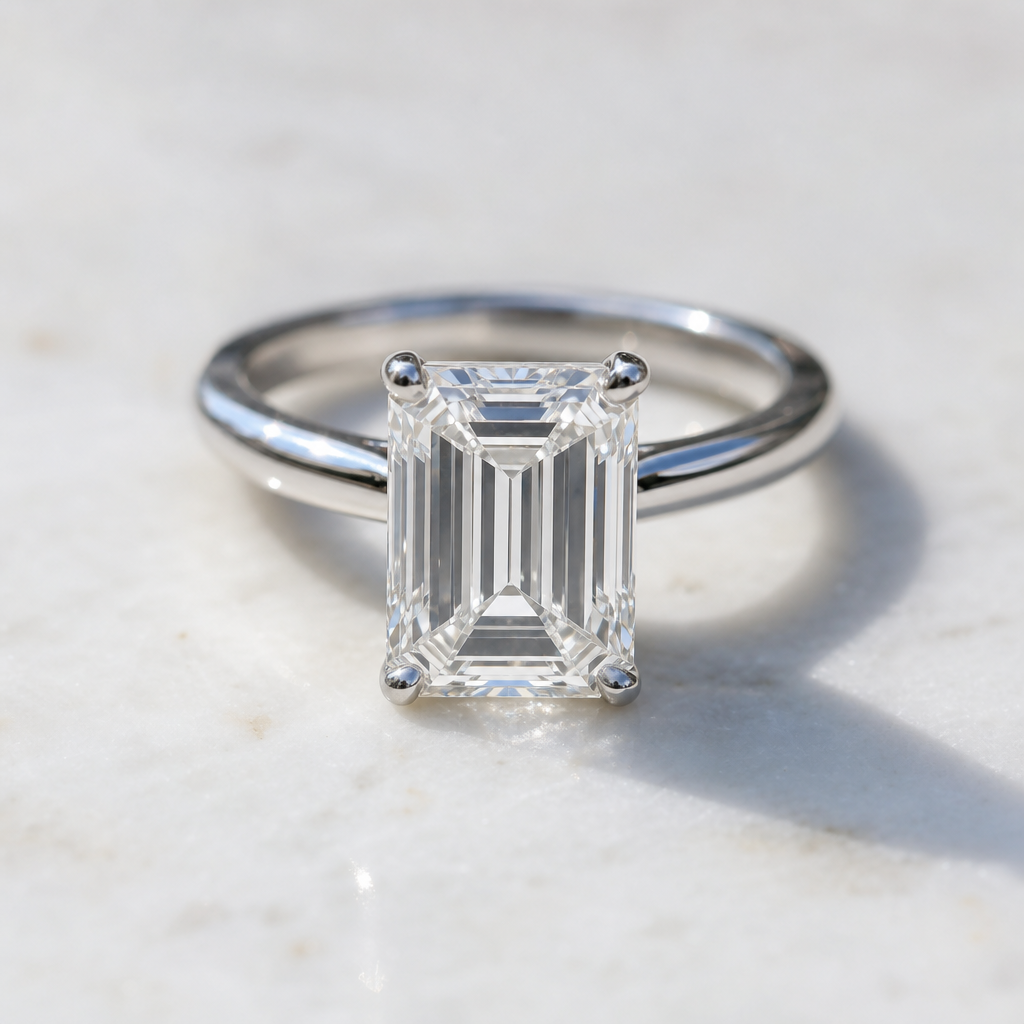
A step cut ring like the emerald cut uses parallel, recessed facets arranged in steps rather than the triangular and kite-shaped facets of a brilliant cut. This produces long, linear flashes of light instead of the scattered sparkle most buyers associate with engagement rings. The result looks elegant and architectural rather than flashy.
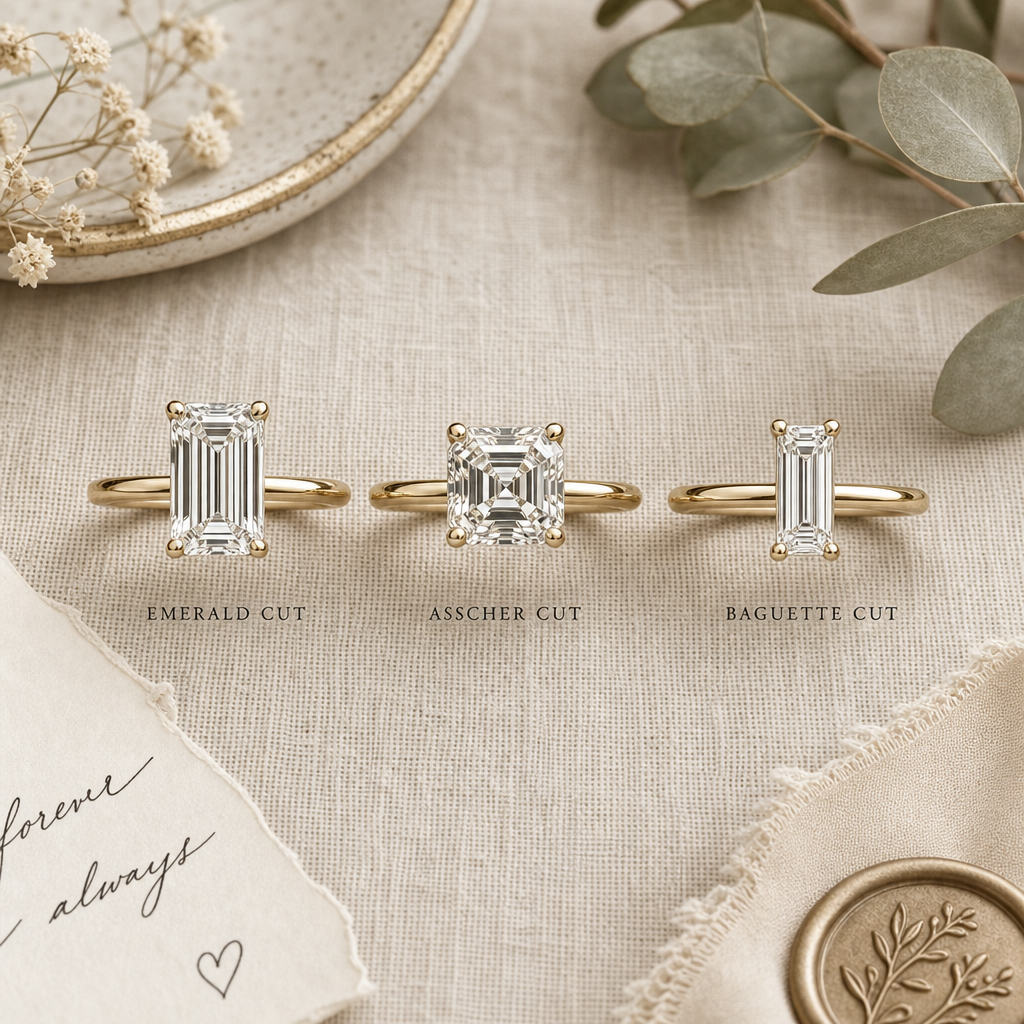
The emerald cut has a rectangular table, stepped pavilion facets, and characteristic cropped corners that distinguish it from every other rectangular cut. The Asscher cut is also a step cut but is square and has a higher crown. The radiant cut has similar proportions but adds brilliant-style faceting for more sparkle. Understanding these distinctions matters because the visual outcome is dramatically different, and it affects which stone material performs best in each shape.
Why the Emerald Cut Is Trending Right Now
The resurgence of the emerald cut is connected to a broader cultural shift toward understated luxury. Couples shopping in 2024 and 2025 are rejecting the idea that a ring must be maximally sparkly to signal value. The emerald cut communicates sophistication, restraint, and a specific kind of taste that resonates with design-conscious buyers.
High-profile engagements featuring emerald cuts have kept the shape in the public eye. Beyonce, Amal Clooney, and Jennifer Lopez have all worn emerald cut stones at various points, and celebrity influence on ring shopping is measurable. According to data tracked on Google Trends, searches for emerald cut rings spiked sharply in Q1 2023 and have remained elevated.
"The emerald cut has an intellectual appeal. It does not try to impress you. It invites you closer." Aja Raden, jewelry historian and author of "Stoned: Jewelry, Obsession, and How Desire Shapes the World"
There is also a practical financial driver. Because the emerald cut retains more of the rough stone during cutting compared to a round brilliant (which loses up to 60 percent of rough weight), it can be priced more accessibly per carat. At Livia Diamonds, this means couples stretching a budget can often size up in carats without exceeding their ceiling. That is a meaningful advantage that brilliant-cut shapes cannot offer equally.
Pro tip: If you are shopping an emerald cut lab diamond or moissanite on a budget, go slightly larger in carat weight rather than spending extra on cut quality. The emerald shape is less sensitive to minor cut variations than a round brilliant, and you will notice the size difference immediately.
Emerald Cut Moissanite: The Practical Choice
Emerald cut moissanite is arguably the most underrated configuration in engagement ring shopping right now. Moissanite has a refractive index of 2.65 compared to diamond's 2.42, which means it bends light more aggressively. In a brilliant cut, this can occasionally produce a rainbow fire effect that some buyers find too intense. The step-cut faceting of an emerald shape moderates that effect and channels it into the long mirror-like flashes the shape is known for.
In practice, an emerald cut moissanite looks strikingly close to a high-quality diamond to the naked eye, especially once it is set in a metal band. The differences require magnification and experience to identify. For couples who prioritize the visual experience over certification paperwork, this is an honest and rational choice.
Pricing Reality for Emerald Cut Moissanite
A 2-carat emerald cut moissanite from Livia Diamonds retails at a fraction of what a comparable diamond would cost. The savings are not marginal. We are talking about a difference that could fund a honeymoon, a down payment contribution, or a custom setting that would otherwise be out of reach. The flexible payment plans available through Livia Diamonds make even larger stones accessible to couples who would otherwise feel priced out.
Moissanite also scores 9.25 on the Mohs hardness scale compared to diamond's 10, making it excellent for everyday wear. Over the course of a lifetime of wearing an engagement ring, that durability difference is negligible for most people.
Setting Styles That Complement Moissanite
A solitaire setting with a thin platinum or white gold band is the most common pairing for an emerald cut moissanite because it lets the stone dominate without visual competition. A channel-set band or a pavé band can add brilliance around the center stone, which some buyers prefer. East-west settings, which rotate the stone 90 degrees, are gaining traction as a modern alternative to the traditional orientation.
Emerald Cut Lab Diamond: Premium Look, Ethical Price
The emerald cut lab diamond occupies a specific position in the market. It offers chemical, physical, and optical properties identical to a mined diamond, certified by the same grading laboratories (IGI and GIA both certify lab-grown stones), but at 60 to 80 percent lower cost per carat depending on the stone's specifications and market timing.
For buyers who want the specific experience of owning a diamond, including the way it interacts with light and the certification that confirms its grade, a lab-grown emerald cut is the most financially intelligent path. The ethical dimension also matters to a growing segment of the market. A 2023 survey by the Natural Diamond Council found that 70 percent of millennials consider sustainability a significant factor in jewelry purchasing decisions.
Clarity Grades That Matter in a Lab Diamond Emerald Cut
Because the emerald cut's open table exposes inclusions more readily than any brilliant cut, clarity grade selection is critical. In practice, VS1 or VS2 is the sweet spot for lab-grown emerald cuts. SI1 clarity can work if the inclusions are located toward the edges rather than the center table, but this requires examining the actual stone or its high-resolution images, not relying on the grade alone.
Livia Diamonds offers virtual consultations specifically to walk buyers through this kind of stone evaluation. This is where working with a specialist matters. A generic e-commerce platform with no consultation layer cannot guide you through the real trade-offs in an emerald cut selection the way a dedicated advisor can.
Pro tip: When comparing an emerald cut lab diamond against a round brilliant lab diamond at the same carat weight, the emerald cut will appear larger because its shallow depth means more of the carat weight spreads across the visible face of the stone. Use this to your advantage when setting a budget.
Step Cut Ring Comparison: Emerald vs. Asscher vs. Baguette
All three of these shapes fall under the step-cut family, but they are not interchangeable. Understanding their differences helps buyers make a confident choice rather than defaulting to the most familiar option.
Feature |
Emerald Cut |
Asscher Cut |
Baguette Cut |
|---|---|---|---|
Shape |
Rectangular with cropped corners |
Square with cropped corners |
Narrow rectangle, sharp corners |
Facet Style |
Step-cut, parallel facets |
Step-cut with higher crown |
Minimal step facets, very simple |
Light Effect |
Hall of mirrors, long flashes |
Concentric square reflections |
Subtle, geometric gleam |
Clarity Demand |
High (VS2 minimum recommended) |
Very high (VS1 minimum) |
Very high (used mainly as accent) |
Finger Effect |
Elongating |
Widening |
Elongating (primarily accent stone) |
Best For |
Center stones, solitaires, halo settings |
Art Deco aesthetic, vintage lovers |
Side stones, eternity bands |
Availability at Livia Diamonds |
Wide selection in moissanite and lab diamond |
Available in select styles |
Featured in wedding band designs |
The emerald cut wins the comparison for center stone versatility. It works across setting styles, metal colors, and finger shapes in a way that neither the Asscher nor the baguette can match. The Asscher is a committed choice for a specific aesthetic. The baguette is almost exclusively an accent stone. The emerald cut is the workhorse of the step-cut family.
How to Choose the Right Emerald Cut Ring
Selecting an emerald cut engagement ring requires attention to four variables: length-to-width ratio, clarity grade, depth percentage, and setting style. Each one has a measurable impact on how the finished ring looks.
Length-to-Width Ratio
The ideal ratio for an emerald cut is between 1.40 and 1.50. A ratio below 1.35 makes the stone look nearly square, which defeats the purpose of choosing the elongated shape. A ratio above 1.55 creates a narrow, almost bar-like appearance that can feel too angular. For reference, a 1.45 ratio on a 2-carat stone gives you the classic emerald cut silhouette that most buyers have in mind when they picture the shape.
Depth Percentage and Brilliance
Depth percentage for an emerald cut should sit between 60 and 67 percent. Stones cut shallower than 60 percent sacrifice structural integrity and appear glassy. Stones cut deeper than 67 percent lose face-up size, which negates one of the key advantages of choosing this shape. A depth percentage around 63 to 65 is the practical sweet spot for balancing visual size with light performance.
Metal and Setting Pairing
White gold and platinum are the most popular metal choices for emerald cut rings because they do not compete visually with the stone's clean geometry. Yellow gold has seen a significant revival and pairs particularly well with warmer-toned moissanite or near-colorless lab diamonds. Rose gold is a softer option that works well for buyers drawn to a romantic, vintage-adjacent aesthetic. Livia Diamonds offers custom design consultations both in person and virtually, which makes exploring these combinations with actual stone samples practical rather than theoretical.
What to Avoid When Buying an Emerald Cut
A common mistake is prioritizing carat weight over clarity in an emerald cut. Because the faceting is open and the table is wide, a SI2 or I1 clarity stone in this shape will show inclusions visibly to the naked eye in ways that the same clarity grade in a round brilliant would not. This is not a minor quibble. It is the single most consequential decision after choosing the stone type itself.
Another mistake is ignoring the bow-tie effect. While the bow-tie is primarily associated with oval and pear cuts, poorly proportioned emerald cuts can develop dark zones across the center that reduce the hall-of-mirrors effect. Always review high-resolution images or request a video of the stone in natural light before purchasing, especially when buying online.
Comparing an emerald cut from Livia Diamonds to what Blue Nile or Vrai offers on a spec sheet alone also misses the point. Livia Diamonds operates with over 20 years of family expertise and offers direct consultation support, which means you are evaluating stones with knowledgeable guidance rather than interpreting numbers on a screen alone. That difference shows up in buyer satisfaction, not in a product listing.
Frequently Asked Questions
Is an emerald cut engagement ring more affordable than a round brilliant?
Yes, typically. Because the emerald cut retains more rough material during cutting, it is priced lower per carat than a round brilliant of equivalent quality. In lab-grown diamonds and moissanite, this advantage is compounded by the already-lower base cost of these materials. You can often get a larger emerald cut stone for the same budget as a smaller round brilliant.
Does an emerald cut look good on all finger types?
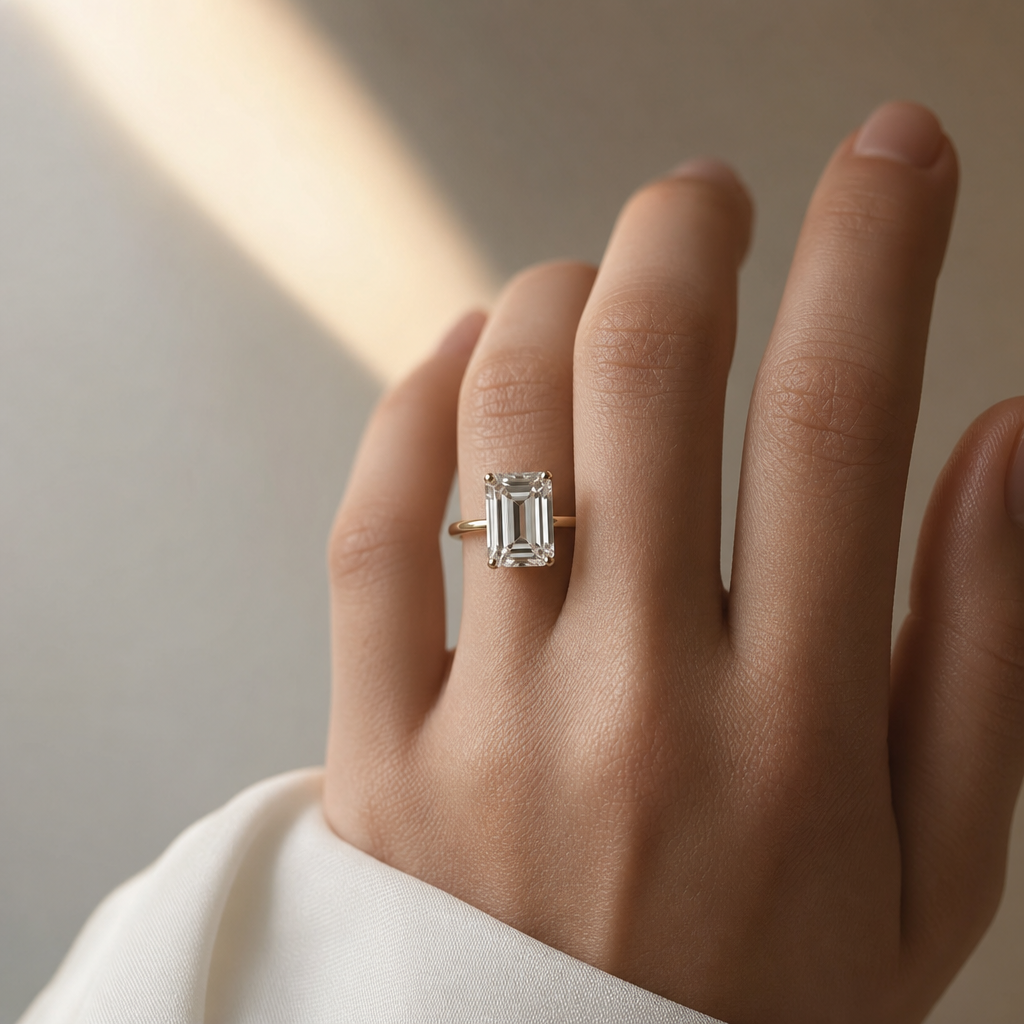
The elongated shape of an emerald cut is particularly flattering on shorter or wider fingers because the length creates a visual slimming effect. For very long, narrow fingers, it can also work beautifully but may appear understated. In practice, this shape is one of the most universally flattering cuts available, which is part of why it is gaining broad appeal across different buyers.
What is the difference between an emerald cut and a radiant cut?
Both shapes are rectangular with cropped corners, but the internal faceting is completely different. An emerald cut uses step-cut faceting that produces long, parallel flashes of light. A radiant cut uses brilliant-style faceting that produces scattered sparkle similar to a round brilliant. If you want drama and scintillation, choose a radiant. If you want sophistication and a mirror-like quality, choose the emerald cut.
How does emerald cut moissanite compare to emerald cut diamond visually?
Side by side and in person, the differences are subtle enough that most people cannot identify which is which without specialized equipment. Moissanite has slightly higher fire (colored light dispersion), which some buyers find more beautiful and others find less traditional. In the step-cut faceting of an emerald, the fire is channeled into the characteristic flashes of the shape rather than radiating outward, making moissanite a particularly strong performer in this cut.
What clarity grade should I choose for an emerald cut lab diamond?
VS2 is the minimum recommended clarity grade for an emerald cut lab diamond intended for a center stone. VS1 gives you more margin. SI1 can work if the inclusions are near the girdle edge and not under the table, but this requires inspecting the actual stone rather than relying on the grade alone. Livia Diamonds' consultation service is specifically useful for this kind of evaluation because advisors can walk you through the stone's inclusion map directly.
Can I customize an emerald cut engagement ring at Livia Diamonds?
Yes. Livia Diamonds offers full custom design services for engagement rings, including emerald cut center stones in moissanite and lab-created diamonds. Customers can select their preferred metal, setting style, band design, and stone specifications. Both in-person and virtual consultations are available to guide the process. Custom pieces are handcrafted, which means you are not choosing from a generic catalog but building something specific to your preferences.
Have you tried on an emerald cut ring in person or explored this shape for your engagement? Share what surprised you most about how it looks compared to your expectations.