
4 Cs Moissanite & Lab Diamond Grading Guide
Most people shopping for an engagement ring spend hours comparing prices but only minutes thinking about the four factors that actually determine what they're buying. If you've been browsing moissanite and lab-created diamond rings and found yourself confused by grading certificates, color ranges, or why two stones that look similar cost completely different amounts, you're not alone. Understanding the 4 Cs for moissanite and lab diamonds is the single most practical skill you can develop before making a purchase. This guide breaks down each factor the way a jeweler actually uses it, so you can evaluate any stone with confidence, whether you're shopping online or sitting down for a consultation.
Table of Contents
- Quick Takeaways
- Why the 4 Cs Work Differently for Moissanite and Lab Diamonds
- Cut: The One C That Overrules Everything Else
- Color: How to Read the Scale Without Overpaying
- Clarity: What Inclusions Actually Look Like in Practice
- Carat Weight vs. Size: The Distinction That Matters Most
- Comparing Grading Standards: GIA, IGI, and GRA
- Frequently Asked Questions
- References
Quick Takeaways
Key Insight |
Explanation |
|---|---|
Cut matters more than any other C |
A poorly cut stone will look dull regardless of its color or clarity grade. Always prioritize Excellent or Ideal cut grades. |
Moissanite color grading is not identical to diamond color grading |
Moissanite uses a simplified range: colorless (D-F equivalent), near-colorless (G-I equivalent), and faint color (J-K equivalent). The grading language differs from GIA diamond standards. |
Eye-clean clarity is the real target, not flawless |
For both moissanite and lab diamonds, VS2 or SI1 clarity is almost always eye-clean, meaning no visible inclusions to the naked eye. Paying for FL or IF grades rarely changes how a stone looks in real life. |
Moissanite carat weight is listed as equivalent carat weight, not actual weight |
Moissanite is less dense than diamond, so a stone listed as 1 carat is sized to match a 1-carat diamond visually, but it weighs less. This matters when comparing prices across stone types. |
Lab diamond grading certificates are standardized and reliable |
Lab-created diamonds are graded by the same labs using the same criteria as mined diamonds. IGI certification is widely accepted and trusted for lab diamond purchases. |
Not all moissanite is graded equally |
Premium moissanite from established producers offers consistent color and cut quality. Budget stones sold without credible grading can vary significantly in how they look and perform. |
Fire and brilliance behave differently in moissanite vs. lab diamonds |
Moissanite has a higher refractive index than diamond, producing more intense rainbow flashes (fire). Whether you prefer that or the more subdued sparkle of a diamond is a personal preference worth testing in person. |
Why the 4 Cs Work Differently for Moissanite and Lab Diamonds
The 4 Cs framework, cut, color, clarity, and carat, was developed specifically for diamond grading. When applied to moissanite, some of the terminology carries over but the underlying standards shift. Lab-created diamonds, on the other hand, follow exactly the same grading system as mined diamonds because they are chemically and physically identical to them. Knowing this distinction upfront prevents a lot of confusion when reading product listings or certification documents.
For lab-created diamonds, every major grading lab applies the same criteria it uses for mined stones. A G-color, VS1-clarity, Excellent-cut lab diamond is graded exactly the same way a mined stone with those specifications would be graded. This is one of the underappreciated advantages of choosing a lab diamond: the grading language is universal and the certificate gives you reliable, standardized information.
For moissanite, the 4 Cs still apply conceptually, but the grading is done by the manufacturer or a moissanite-specific grading entity rather than GIA or IGI. Moissanite grading uses color categories (colorless, near-colorless, faint color) rather than letter grades, though most retailers map these to the GIA diamond color scale for comparison purposes. Understanding where those comparisons are accurate and where they are approximate is important before you buy.
The most common mistake buyers make is treating all 4 Cs as equally important. Cut is the engine of a stone's beauty. The other three Cs determine what kind of fuel you're working with.
At Livia Diamonds, customers shopping for moissanite and lab-created diamond engagement rings benefit from in-person and virtual consultations specifically because these distinctions are easier to understand when you can see two stones side by side. Reading a grading report is one skill; seeing what the numbers actually look like on a ring is another.
Cut: The One C That Overrules Everything Else
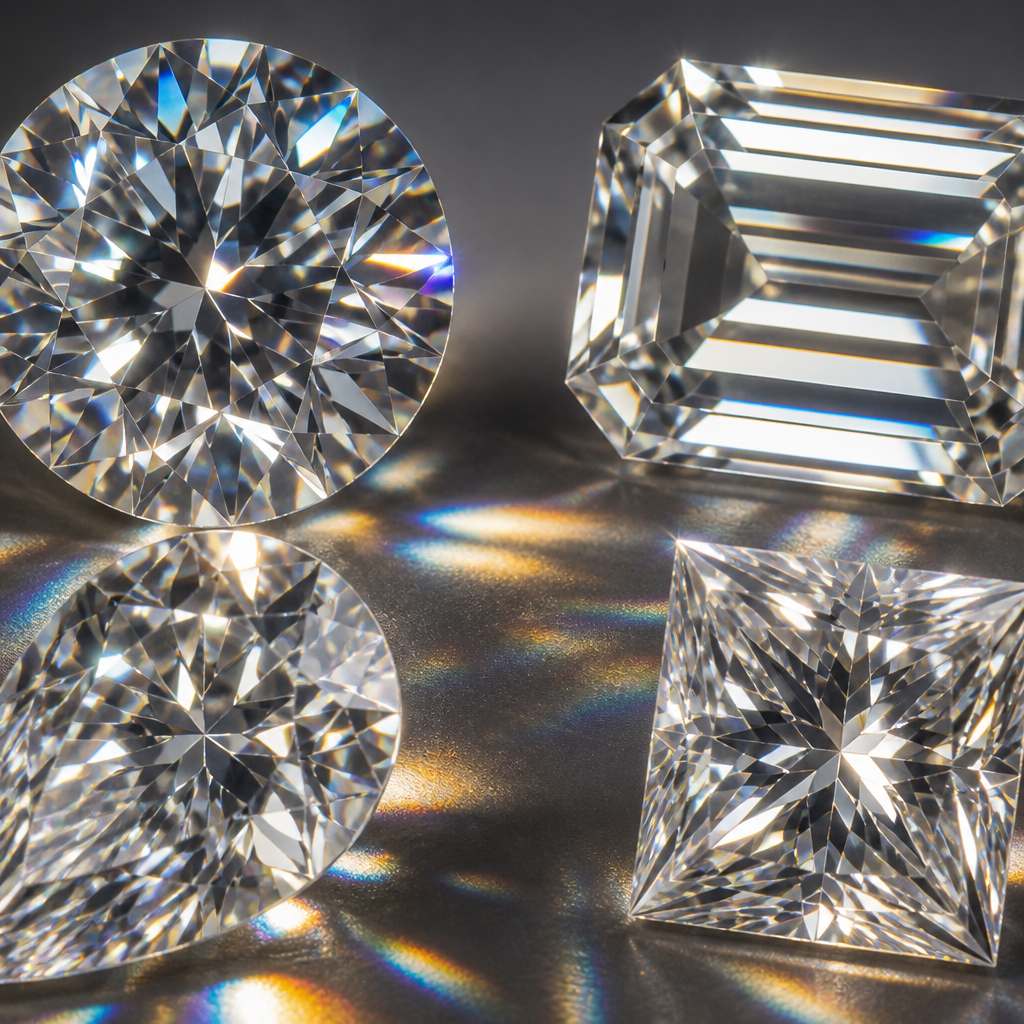
Cut is not about the shape of a stone. Shape is what most people think of first: round, oval, cushion, emerald, pear. Cut refers to the proportions, symmetry, and polish of the facets, and it is the single biggest driver of how much a stone sparkles. A round brilliant moissanite with an Excellent cut grade will outperform a poorly cut stone in the same shape at a higher clarity and color grade, every time.
What Cut Grades Actually Mean
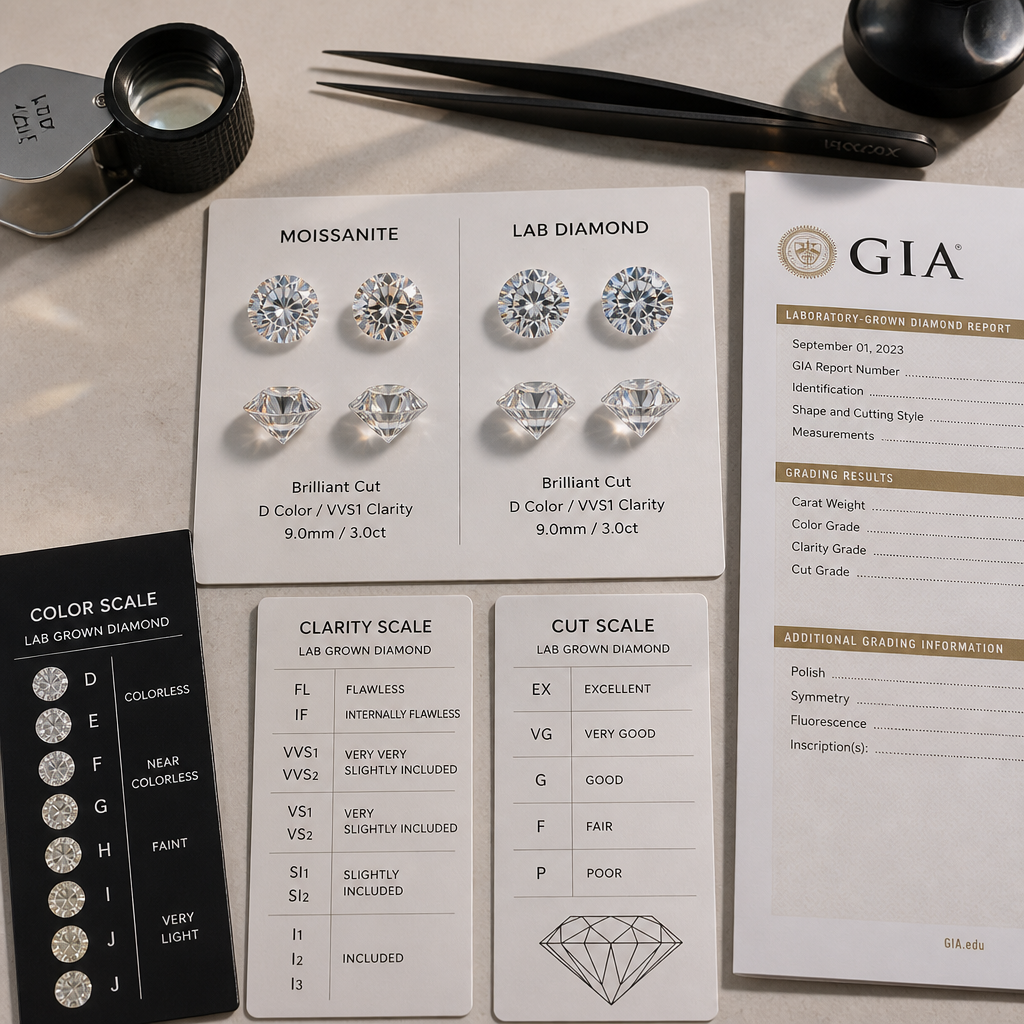
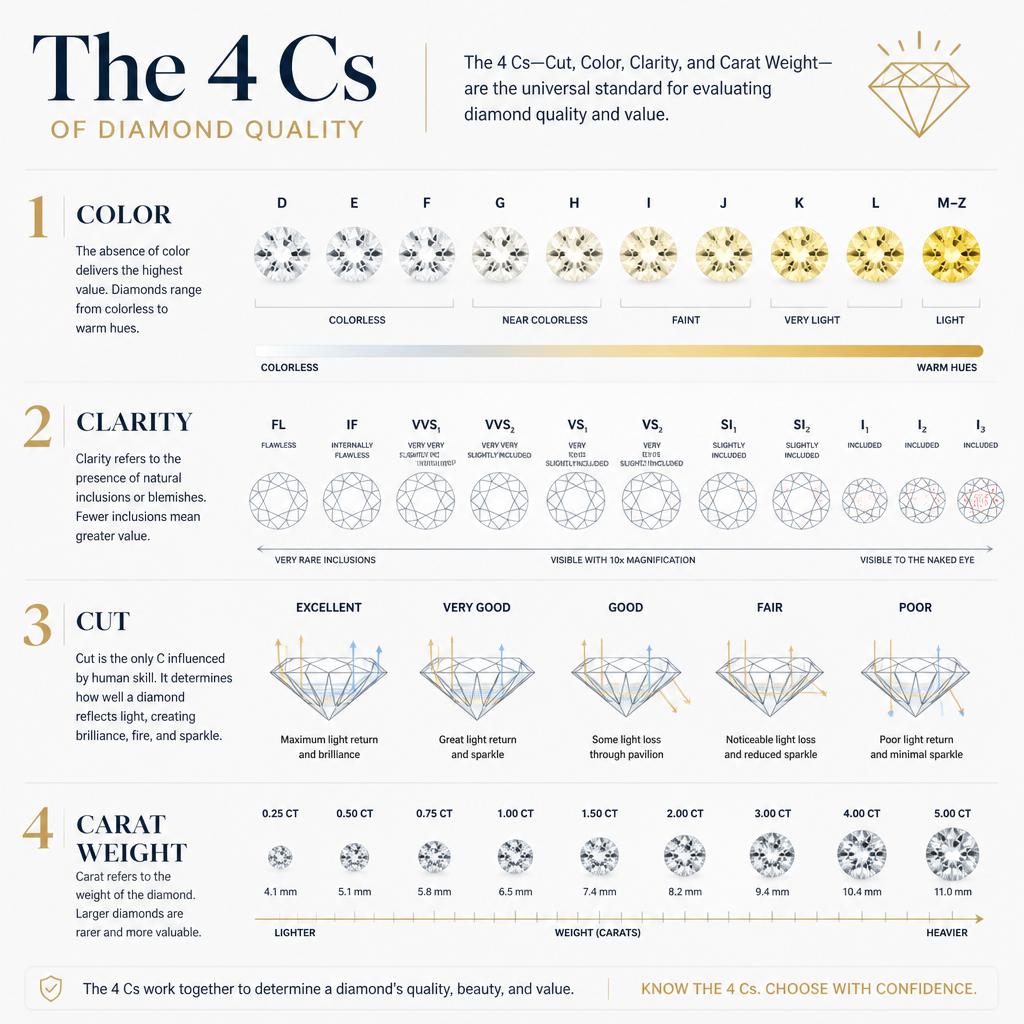
For lab diamonds graded by IGI or GIA, cut is scored on a five-point scale: Excellent, Very Good, Good, Fair, and Poor. In practice, you should be looking at Excellent or Very Good cut grades only. Good and below will show visible light leakage through the bottom of the stone, meaning light exits out the sides instead of bouncing back to your eye as sparkle.
Moissanite cut quality is controlled primarily at the manufacturing stage. Premium moissanite producers calibrate their facet angles specifically to account for moissanite's higher refractive index (2.65 compared to diamond's 2.42), which means that facet angles that produce optimal light return in a diamond will produce different results in moissanite. Well-cut moissanite is engineered to perform brilliantly, but the cut grade on a moissanite certificate is not directly comparable to an IGI or GIA cut grade on a lab diamond.
How Shape Affects Perceived Sparkle
Certain shapes show moissanite's fire (the rainbow flashes produced by its high dispersion rate of 0.104) more intensely than others. Round brilliant cuts maximize fire and brilliance simultaneously. Elongated shapes like oval, pear, and marquise can appear larger face-up for the same carat weight, which is worth considering if size-to-budget ratio matters to you. Step cuts like emerald and Asscher prioritize clarity and elegance over fire, so they're a better choice if you prefer a more understated look.
Pro tip: If you are comparing a moissanite and a lab diamond side by side in a round brilliant shape, look at how each stone performs under a single overhead light source (like a ceiling light, not direct sunlight). Moissanite will produce noticeably more colorful fire. Some people love this; others prefer the more neutral white sparkle of a lab diamond. There is no wrong answer, but you should decide which you prefer before committing to a stone.
Color: How to Read the Scale Without Overpaying
The GIA color scale for diamonds runs from D (completely colorless) to Z (visibly yellow). Lab diamonds are graded on this same scale. Moissanite is typically categorized into three broad ranges: colorless (equivalent to D-F), near-colorless (equivalent to G-I), and faint color (equivalent to J-K and below). These ranges are approximate comparisons, not direct equivalents, but they are the most useful reference point most buyers have.
Where Color Actually Becomes Visible
In practice, the difference between a D-color and a G-color lab diamond is nearly impossible to detect when a stone is set in a ring and worn on a hand. The color difference only becomes visible when stones are placed face-down on a white background and compared side by side under controlled lighting. For most engagement ring buyers, selecting a G or H color lab diamond represents the best balance between appearance and price.
For moissanite, the near-colorless (G-I equivalent) range performs beautifully in most settings. The one exception worth knowing: if you set a near-colorless moissanite in a platinum or white gold setting, the cool metal can emphasize any slight warmth in the stone. In that scenario, stepping up to a colorless-grade moissanite is worth considering. In yellow gold or rose gold settings, near-colorless performs just as well as colorless because the warm metal tone masks any faint warmth in the stone.
The Green Tint Question in Moissanite
A common concern among moissanite buyers is whether the stone will appear green or grey in certain lighting. This was a more notable issue with earlier generations of moissanite. Modern premium moissanite has largely eliminated this in colorless and near-colorless grades. If you are shopping on a tight budget and considering budget-tier moissanite from unknown manufacturers, this is a real risk worth investigating before purchasing. Asking to see the stone under multiple light sources before committing is the most reliable check.
Pro tip: When reading a lab diamond grading report, look at the color grade and the fluorescence grade together. A lab diamond graded H-color with strong blue fluorescence can actually appear whiter in sunlight than a D-color stone with no fluorescence. Fluorescence is not a defect. Whether it works for or against a stone depends on its color grade.
Clarity: What Inclusions Actually Look Like in Practice
Clarity measures the presence of internal characteristics (inclusions) and surface characteristics (blemishes) in a stone. The GIA clarity scale for diamonds runs from Flawless (FL) to Included (I1, I2, I3), with several grades in between. Lab diamonds are graded on this same scale. Moissanite clarity is evaluated similarly, though the grading is done by the manufacturer rather than an independent lab in most cases.
What Eye-Clean Actually Means
The phrase "eye-clean" means that no inclusions are visible to the naked eye when looking at the stone face-up at a normal viewing distance of about 15 centimeters. This is the practical clarity standard that matters for jewelry. A stone graded FL by GIA and a stone graded VS2 by GIA will look identical to anyone wearing or admiring the ring. The FL grade only matters under 10x magnification.
For lab diamonds, VS2 and SI1 are typically the sweet spots: eye-clean in the vast majority of cases, and significantly less expensive than VVS or FL grades. For SI2, you need to review the actual stone or its grading report carefully, because some SI2 stones are eye-clean and some are not, depending on the type and location of the inclusion.
Clarity in Moissanite: A Different Starting Point
Moissanite is produced in a controlled laboratory environment, which means it starts with fewer inclusions than mined diamonds and often fewer than many lab diamonds as well. Most premium moissanite falls in the VS or better clarity range. This is one area where moissanite has a practical advantage: you are very unlikely to receive a moissanite with visible inclusions when buying from a reputable retailer. The clarity concern that occupies significant mental space for diamond buyers is largely a non-issue for moissanite shoppers.
A common mistake is spending a premium on an FL or IF clarity moissanite when VS1 or VS2 clarity moissanite is visually indistinguishable in a finished piece of jewelry. That money is better directed toward cut quality or a more interesting setting design.
Carat Weight vs. Size: The Distinction That Matters Most
Carat is a unit of weight, not size. One carat equals 0.2 grams. Two stones can weigh exactly one carat and look noticeably different in size if they have different depths or shapes. This distinction matters a great deal when comparing moissanite to lab diamonds, and it affects how listings across different retailers should be read.
Why Moissanite Uses Equivalent Carat Weight
Moissanite is less dense than diamond, with a specific gravity of approximately 3.21 compared to diamond's 3.52. A moissanite stone sized to match a 1.00-carat diamond (6.5mm round brilliant) will actually weigh approximately 0.88 carats on a scale. To avoid confusion, moissanite retailers list stones by their equivalent carat weight (often abbreviated as ct. tw. or DEW, diamond equivalent weight), meaning the weight a diamond of the same size would have. When you see a moissanite listed as "1 carat," you are being told it is sized like a 1-carat diamond, not that it weighs 1 carat.
This matters for cross-shopping. If you are comparing a 1-carat lab diamond to a 1-carat moissanite (listed by DEW), you are comparing stones that will look roughly the same size face-up on a ring. The weight comparison is meaningless for practical purposes; what you care about is face-up size, which the equivalent carat weight system communicates accurately.
The Size-to-Price Advantage of Moissanite
Because moissanite is significantly less expensive per equivalent carat weight than lab diamonds, buyers can access larger stone sizes for the same budget. A 2-carat equivalent moissanite and a 2-carat lab diamond will look similar in size face-up, but the price difference between them is substantial. For buyers who prioritize size and visual impact over the specific material, this is a meaningful factor in the decision.
At Livia Diamonds, the range of moissanite and lab-created diamond options across different carat weights lets couples make that comparison directly, with access to custom design services so the setting can be scaled appropriately for the stone size chosen.
Comparing Grading Standards: GIA, IGI, and GRA
Not all grading certificates carry the same weight, and understanding which labs are credible will save you from making a purchase based on an inflated grade. Here is a practical comparison of the three grading systems you will encounter most often when shopping for moissanite and lab diamonds.
Grading Body |
What It Grades |
What You Need to Know |
|---|---|---|
GIA (Gemological Institute of America) |
Mined diamonds primarily; also grades lab diamonds but with a separate report format |
The most recognized and consistent grading standard globally. If you see a GIA certificate for a lab diamond, it is reliable. GIA does not grade moissanite. |
IGI (International Gemological Institute) |
Lab-created diamonds, mined diamonds, and some colored stones |
The most widely used grading lab for lab diamond purchases. IGI lab diamond reports are accepted and trusted by reputable retailers worldwide. Livia Diamonds offers IGI certification on lab diamond pieces. |
GRA (Gemological Research Association) |
Moissanite primarily |
GRA is not a globally recognized independent grading institution in the same category as GIA or IGI. A GRA certificate confirms that a stone is moissanite but does not carry the same quality assurance as an IGI or GIA report. When buying moissanite, the cut, color, and clarity grade matter more than the GRA certificate itself. |
The practical takeaway: for lab diamonds, insist on an IGI or GIA certificate. For moissanite, use the grading certificate as a reference point, but prioritize buying from a retailer with a transparent return policy and the ability to inspect stones, since the certificate alone does not guarantee quality consistency across all moissanite manufacturers.
Livia Diamonds provides IGI certification options for lab diamond purchases, which means you are getting a standardized, independent assessment of the stone you are buying, not just a manufacturer's self-reported grade. That matters when you are making a purchase of this size.
Frequently Asked Questions
Is the 4 Cs grading system the same for moissanite and lab diamonds?
Not exactly. Lab-created diamonds use the same 4 Cs grading system and the same grading scales as mined diamonds, because they are chemically identical to mined diamonds. Moissanite also uses cut, color, clarity, and carat as evaluation criteria, but the grading is done by manufacturers or moissanite-specific entities rather than by GIA or IGI, and the color scale uses broad categories (colorless, near-colorless, faint) rather than individual letter grades. The concepts are the same; the grading infrastructure differs.
Which of the 4 Cs should I prioritize when buying a moissanite ring?
Cut, without question. A well-cut moissanite will outperform a higher-clarity or higher-color stone that is poorly cut. After cut, color matters most if you are setting the stone in platinum or white gold. Clarity is rarely a concern with reputable moissanite, since most premium stones are produced with very few inclusions. Carat weight should be chosen based on your preferred face-up size, not the number itself.
What color grade of moissanite looks best in a white gold or platinum setting?
Colorless-grade moissanite (D-F equivalent) performs best in white metal settings. Near-colorless (G-I equivalent) is also an excellent choice and will appear virtually identical to colorless in most lighting conditions. The contrast between a cool white metal and any slight warmth in a faint-color moissanite is more noticeable than the same warmth set in yellow or rose gold, so stepping up one tier in color is worth it specifically for white metal settings.
Can I tell the difference between a lab diamond and a moissanite just by looking?
In most practical settings, no. Both stones are visually similar to untrained eyes. The most consistent visual difference is that moissanite produces more colorful fire (rainbow flashes) than a lab diamond of comparable size under the same lighting. Under a direct spotlight, moissanite's fire is noticeably more intense. Under diffused indoor lighting, the difference is less obvious. A trained jeweler using a specialized tester can distinguish them reliably, but casual observation rarely reveals which is which.
What does "eye-clean" mean and why does it matter more than the clarity grade?
Eye-clean means no inclusions are visible to the naked eye at normal viewing distance. This is the relevant standard for jewelry because no one inspects a ring under a loupe in everyday wear. A VS2 lab diamond and a Flawless lab diamond look identical on a finger. The clarity grade on a certificate tells you what is there under magnification; eye-clean tells you what is there in real life. For most buyers, VS2 or SI1 in lab diamonds, and VS or better in moissanite, is the practical target.
Does carat weight affect how a moissanite and lab diamond look the same size?
Yes, when the carat weight is listed as equivalent carat weight (DEW) for moissanite. A 1-carat moissanite (DEW) and a 1-carat lab diamond will appear roughly the same size face-up because the DEW system sizes moissanite to match diamond dimensions. However, moissanite actually weighs slightly less than diamond at the same size due to its lower density. The face-up appearance is what matters for ring-wearing purposes, and DEW comparisons are accurate for that purpose.
Is it worth paying for a higher clarity grade than VS2 in a lab diamond?
For most buyers, no. VVS1, VVS2, and FL clarity grades in lab diamonds are visually indistinguishable from VS2 in a finished ring setting. The premium paid for those grades is real, but the visible benefit in everyday wear is not. There are specific situations where a higher clarity grade matters, such as step cuts like emerald and Asscher that act like mirrors and show inclusions more readily than brilliant cuts, where VS1 or VVS2 is a safer target than SI1.
Have you compared moissanite and lab diamond quality grades in person, or are you working through these decisions online? Share what's been most confusing in your shopping process and we'll help clarify it.